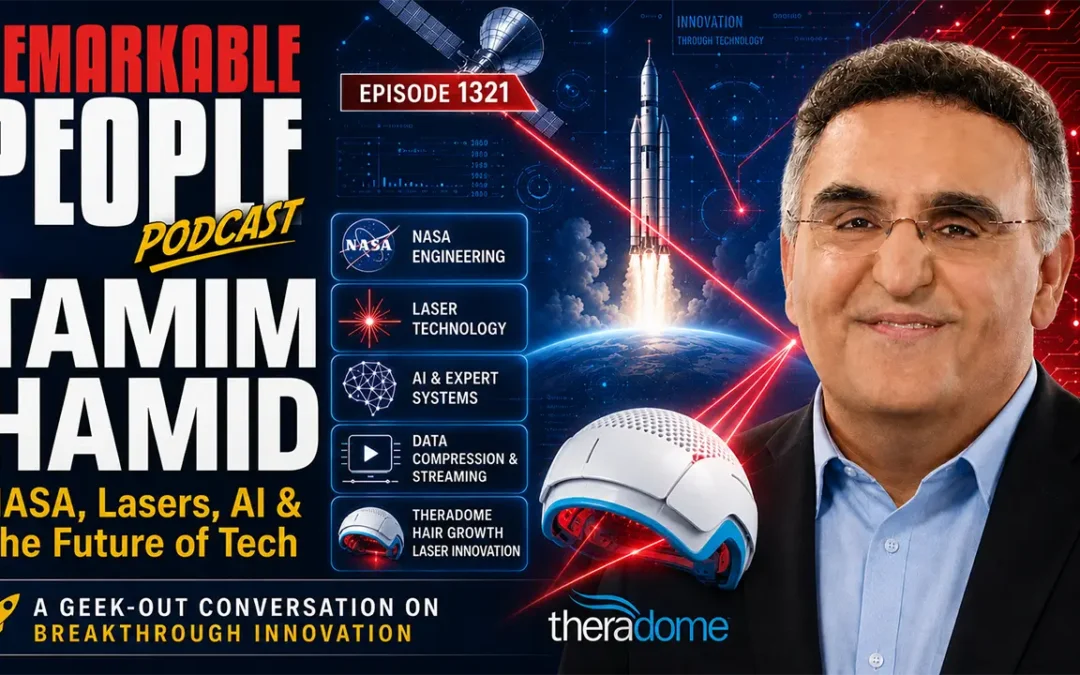
"Do you want to go back in time, or do you want to go forward in time? I don't care about the past. I want to go forward, and I can't wait to see what's out there. In all our short years, we've literally transformed this earth into something that's amazing."
~ Tamim Hamid
WATCH THE PODCAST
Click the play button ▶️ above 👆 to watch now!
Please Note: You may need to click twice depending on your browser. 😉
LISTEN TO THE PODCAST
Episode / Guest Frequently Asked Questions... and Answers!
Q: What wavelength does the Theradome laser use to grow hair?
A: Theradome operates at a highly precise 680-nanometer wavelength within the completely safe, visible red light spectrum, which penetrates deep into the scalp to directly stimulate the mitochondria of the hair follicles without producing heat.
Q: How long does it take for Theradome to stop active hair loss?
A: Clinical data demonstrates that the Theradome device successfully halts active hair loss within two to three weeks of consistent usage, with new hair growth patterns visibly manifesting between four to six months.
Q: Did a NASA engineer help invent the swallowable camera pill?
A: Yes, biomedical engineer Dr. Tamim Hamid, who previously designed automated laser systems for NASA space shuttles, served as Head of R&D to help miniaturize camera technology and develop the first wireless swallowable camera pill.
Q: What is the difference between expert systems and modern AI?
A: Expert systems, popularized in the late 1980s, rely on rule-based algorithmic structures, object-oriented programming, and specific heuristic modeling for clear-cut tasks, whereas true artificial intelligence requires a level of consciousness that modern data-regurgitating large language models have not yet attained.
Key Discussion Highlights & Takeaways
-
The Post-Challenger NASA Optimization: Following the 1986 disaster, Tamim engineered an automated laser measurement system that replaced slow manual shims on 25,000 silica tiles—slashing inspection processing time from 30 days down to just three days.
-
The Authentic Stanford AI Era: Studying at Stanford's AI Institute in 1989, Tamim developed "Expert Systems" utilizing object-oriented programming, algorithmic edge detection, and heuristic modeling decades before today's modern large language models hit the mainstream.
-
Biomedical Disruption & The Camera Pill: As Head of R&D for a prominent endoscopy firm, Tamim shrank camera tech to help engineer the world's first swallowable camera pill—transmitting 24 frames per second wirelessly to a belt pack receiver.
-
The Architecture of Cardiac Output: Transitioning to cardiac care, Tamim engineered a novel diagnostic application utilizing industrial accelerometers placed on the trachea to directly track the mechanical pumping power of the heart's left ventricle.
-
The Science of Theradome: Replicating a forgotten 1965 cold laser study on rats, Tamim custom-grew a specialized 680-nanometer cold laser chip in Silicon Valley. This safe, visible light spectrum device specifically targets and stimulates the mitochondria inside individual hair follicles to halt hair loss in two to three weeks.
Key Timestamps & Moments of Gold
- 00:00:00 - Episode Intro: A Legendary Geek-Out Session
- 00:01:15 - A Lifetime on the Cutting Edge of Global Tech
- 00:03:36 - The Core Power of Cold Lasers vs. Burning Lights
- 00:04:50 - Affiliate Sponsor Intermission: MyPillow Special Offers
- 00:05:52 - Origin Story: From Afghanistan to Electrical Engineering
- 00:07:45 - Re-Engineering NASA Space Shuttle Inspections Post-Challenger
- 00:13:58 - Top-Secret Clearances & The Reality of Atlantic Ocean Recovery Wreckage
- 00:16:40 - The Stanford AI Era: Architectural Roots of Expert Systems
- 00:18:40 - Miniaturizing Medicine: Inventing the Swallowable Camera Pill
- 00:22:50 - Edge Detection, Image Processing, and Human Cognition
- 00:26:55 - Why Large Language Models Don't Possess Consciousness Yet
- 00:28:50 - The True Future of Automation and Robotic Assistance
- 00:32:20 - MIPS Power: Microprocessing Demands of the AI Grid
- 00:34:40 - Global Data Centers, Environmental Needs, & Nuclear Energy
- 00:37:30 - The Silicon Valley Startup Shift: Wavelet Compression Realities
- 00:41:50 - The Technological Vanguard: Turning Down the Adult Entertainment Industry
- 00:45:00 - Tracking the Heart Mechanically: The Trachea-Accelerometer Connection
- 00:51:30 - Re-Discovering the 1965 Cold Laser Rat Research Paper
- 00:54:20 - Etching Semiconductor Chips: Creating the Theradome Laser Wavelength
- 00:56:45 - The Indiegogo Launch: Disrupting Global Hair Loss Treatment
- 00:58:20 - "Grow It Back": Reversing Cellular Aging via Mitochondrial Stimulation
- 01:03:40 - Demystifying Laser Dangers: Safety in the Visible Light Spectrum
- 01:06:50 - The Timeline of Hair Restoration: From Shampoos to Full Recovery
- 01:12:20 - From Oncology to Inventions: Honoring a Father's Medical Legacy
- 01:17:35 - Why Doctors Don't Learn Laser Physics in Medical School
- 01:21:50 - Microelectronic Manufacturing Systems (MEMS) and Semiconductor Cityscapes
- 01:27:00 - Moving Forward in Time: The Ultimate Technological Shift
- 01:32:50 - The Automated AI Quiz and a Bulletproof One-Year Guarantee
- 01:35:10 - Combating Morality: Faith, Integrity, and the Pinata Theory
- 01:38:00 - Wrap-Up: Applying Intentional Action For Life
REMARKABLE SPECIAL OFFER(S):

MyPillow
Save 30% to 80% on EVERYTHING you order at MyPillow.com with Free Promo Code, “REMARKABLE“. Yes, that’s right! Use the best My Pillow promo code out there to save a TON of money on all 200+ quality, comfortable, cozy home goods at MyPillow.com/Remarkable, or by calling 1-800-644-6612. From sheets, to blankets, to pillows, to mattress toppers, be ready to sleep better and live more comfortably than you ever have before!

Console Vault
Your Exclusive Offer: Save Big on Your Console Vault In-Vehicle Safe. With our exclusive promo code, "REMARKABLE", you will Save 10% or more on all Console Vault anti-theft vehicle safes you order. And sometimes, you'll receive Free Shipping too! Just make sure to use the free Console Vault discount code, “REMARKABLE” at checkout.

Omaha Protein Popcorn
Taste the most delicious, nutritious, and highest quality protein popcorn on the planet at https://www.omahaproteinpopcorn.com! Not only will you, your children, friends, and loved ones enjoy this healthy snack immensely, but you'll all benefit from the 32-40g of the highest quality protein in the world PER SERVING. Use the Omaha Protein Popcorn promo code, "REMARKABLE" at checkout to save 10-20% off of your entire order, and Free Shipping too! 💪

Hunter's Blend Coffee
Stop wasting your hard-earned money on overpriced, corporate coffee that funds liberal agendas. It’s time to upgrade your morning routine with Hunter’s Blend Coffee! Hunter's Blend sources only the top 6% of specialty beans on the planet, precision-roasts them in micro-batches, and ships them fresh right to your door. This is quite possibly the smoothest, best coffee David has ever tasted—and it directly supports the values you live by, including pro-life organizations, veterans, youth shooting sports, wildlife conservation, and anti-human trafficking causes. Don't settle for mediocre, politically correct brew. Click here to order your fresh batch now and use promo code Remarkable at checkout to instantly save 10% and lock in Free Shipping! You will not be disappointed. ☕
Full Episode Transcript
NASA Lasers, Biotech, & Theradome: How Tamim Hamid Changed the World and is Still Growing
Thanks for watching the Remarkable People Podcast!: [00:00:00] The Remarkable People Podcast. Check it out.
Remarkable People Podcast. Listen. Do. Repeat. For Life!
The Remarkable People Podcast
David Pasqualone: Hello, friend. Welcome to this episode of the Remarkable People Podcast. After nine years and hundreds of episodes, this is one of my favorite geek-out episodes of all time. So today's episode is a little bit different than usual, where we normally have a guest share their life story, and they reverse engineer and break down the steps of what they achieved and how they did it so we can, too.
This guest has just [00:01:00] achieved so much in so many areas of life in high-tech roles that it really is mind-blowing to me that one person can be involved in so much in one lifetime, and he's still going. So in this episode, you're going to see how our guest today worked with NASA after the Challenger exploded, and then he designed a laser system that took a 30-day review process of the tiles down to just a couple days.
And then we talk about how he's involved in what he called "expert systems", which we refer to as AI today, and he talks about how it's not really AI yet. He also talks, the same man was involved in developing the gastrointestinal cameras that, you know, go both ends of a human to see what's going on inside.
He also, if you like to stream, if you're watching this now, he was part of the [00:02:00] team that condensed data in a way that you can go to a movie theater, you can watch a streaming service. This man was part of it, and then recently he invented Theradome. He took the same laser technology from NASA and studies done in the '60s when lasers were first brought out and utilized, and he used them in 2008 to create this company and a product that you and I can buy to regrow hair, to stimulate hair growth, and he talks about that.
And then at the end of the episode, we talk about how even though he's been part of all these things and more, I forgot things, he has something coming out next year that's bigger than this all. So completely geek-out, mind-blowing episode, something that's really interesting to me, and I hope it is to you, too.
So grab your favorite beverage, get in a quiet place, and [00:03:00] enjoy this episode of the Remarkable People Podcast now.
David Pasqualone: Hello, friends. Welcome to this week's episode of the Remarkable People Podcast with our remarkable friend, Tamim Hamid. Tamim, thanks for being here today. How are you?
Tamim Hamid: Thank you, David, for having me. I appreciate the invite. Looking forward to talking to you.
David Pasqualone: Absolutely. I'm looking forward to the show. And for our listeners around the world who've maybe heard of you or never heard of you, what is the core of this episode about and how is it going to benefit their lives?
Tamim Hamid: Great. Appreciate it. . So my claim to fame are lasers, and what I've been able to show over one million people around the world, that lasers can stop hair loss and regrow hair. I will explain how this works in a very simple way, because people do not understand [00:04:00] why lasers can grow things instead of burn things.
And people associate lasers with burning than growing. And I'm going to explain to you in a very easy way how I discovered and patented this idea and made it into a product.
David Pasqualone: Awesome. So yeah, I think many of us have watched Star Trek way too much and, the old Buck Rogers is, that's our generation, and today they watch Marvel movies, and lasers destroy.
So ladies and gentlemen, we're going to talk to Tamim and we're going to hear his story. We're going to hear about the lasers and how this technology can benefit you and those you love. So we're going to take a quick break and we'll be right back.
Speaker 2: Eight years ago, we developed and launched the best bed sheets ever. Since then, you've all enjoyed the best sleep of your life. And to thank [00:05:00] you all for your support, we're bringing you our bed sheets for the lowest price in MyPillow history. Get our seasonal flannel sheets for 50% off. They're nearly sold out, so get yours today before they're gone.
Check out our new percale line. Queen size only $39.98, king size only $49.98. And our famous Kesa Dream bed sheets, queen size originally $139.96, wait on it, now only $59.98. King's just $10 more. So go to MyPillow.com or call the number on your screen. Use your promo code to get huge discounts on all MyPillow bed sheets.
And for a limited time, when you order $75 or more, your entire order ships absolutely free. We have very low quantities at these prices, so order now
David Pasqualone: All right, Tamim, let's do this.
Before we get to you working for NASA and you discovering this innovative [00:06:00] technology and how to apply it better to mankind, let's start off. Where did your story begin, your life journey? Everything that happens to us makes us the men we are, so good, bad, ugly pretty ugly. What's your origin story, brother?
Tamim Hamid: I have a, quite a beginning. I started in Afghanistan, and a few years ago, Afghanistan was regarded as a cool country to be in and all this. But now with all the chaos and all this it's not such a good country the, to be in these days. But I was born there. My, my father's a physician.
My mom was a school teacher. And we, As soon as we- he got out of medical school, we went to France. I became a French citizen. He became a ENT. My dad was from a general practitioner and then specialized in ENT surgery, specifically in oncology. And after a few years, and when I was 17, I moved to Kansas City, Missouri, good old, in the heart of [00:07:00] the United States, and that's where I was I went through the last year or so of high school, and then I graduated from Rolla University of Missouri Rolla in engineering, electrical engineering.
And after that it was so ironic. I hate to say this but the Challenger the space shuttle Challenger blew up and right the semester I was finishing up my electrical engineering degree. And what happened was it was actually a very good thing for me because they were looking for new engineers, new blood to automate the system.
So I got into engineering program at NASA and specialized in lasers, and goes on from there
David Pasqualone: Yeah, no, continue your story. Bring us-
Tamim Hamid: Okay, great. It
David Pasqualone: was very interesting ... bring us through, brother. 'Cause there's not many people that work for NASA, let alone get to play with lasers for a living.
Tamim Hamid: Right.
It was very interesting because the Rogers Commission which is a [00:08:00] study done by Congress, they were trying to figure out why the Challenger blew up. And so they found out that there was not enough technology in the space shuttle, because the space shuttle was actually invented in 1961, and it didn't get built till, it took a few years to build it. It took all the way till in the '70s to finally build the space shuttle. So i- when you look at drawings within the space shuttle, you see all these antiquated vacuum tubes and voltage dividers and, there is no chips in there, right? Intel chips like we have in our...
even our watch has more technology than the space shuttle. So So they asked young engineers like myself to come in and automate a lot of the space shuttle operations and also as well as the processing and launch systems because that's what Kennedy Space Center does.
Kennedy Space Center is responsible for [00:09:00] launching the space shuttle and recovery. After it lifts, as soon as it lifts off the ground, Johnson Space Center takes over and does all the space operations for NASA space shuttle missions. So that's what I was specializing doing automation and one of the things that that was assigned to me was the space shuttle tiles.
There was about 25,000 space shuttle tiles around the space shuttle because what happens is that during reentry the space shuttle can get up to about 2,000 to 3,000 degrees Celsius during reentry. That's why you see shooting stars, right? When you see shooting stars, that's usually a big rock or asteroid or a meter, a meteor going through the atmos- Earth atmosphere and it heats up pretty badly.
So the only thing that was there was these tiles which are made of silica, basically sand, but coated in a very [00:10:00] special vulcanized paint. And the problem was, is that these sha- shuttle tiles would fluctuate as they came in from space down to the Earth's atmosphere. And if there was any gap or any kind of type of step on the tile, just like your tile on your on your floor of your bathroom, right?
If there's a little step, you're going to catch that step and stub your toe, right? Same thing with air. Air has what's called laminar flow, which you want it to be smooth, just like you want your bathroom tile or there's turbulent flow. That means as soon as you hit the hit a step on the tile, it'll actually stub your toe and you can hurt yourself.
We don't want any steps on the 25,000 tiles that are covering the whole space shuttle. So what they asked me to do, it was like if there's a better way to do this. So because the way they were doing it was they were taking literally shims, which are like credit card [00:11:00] size plastic, and measuring how many shims, just like you do your if you're familiar with doing your spark plugs.
You use shims until the gap on the spark plug is perfect. They were using shims on twenty-five thousand tiles times four, because there's four sides to a tile, right? It's a square tile. You have to do this side. It would take them a month, and that month was spent mostly on space shuttle tiles.
So they couldn't do space shuttle missions back to back because of this thermal protection system. It was so important, but yet so backwards in time. So what-- one of my ideas which I got Engineer of the Year for, was that why don't we use a laser to measure the step the height of the tiles and the gap between the tiles to measure this?
So I created a laser which measured within few seconds [00:12:00] a, the step and the gap, and it would tell you what's acceptable, what's not acceptable, and then it would send that down to and get a, like for example a, a ticket to fix that tile or accept it through quality control and so on.
So what what we, what we did is we implemented that in, and the processing went from about thirty days down to three days processing. So we cut down processing of the thermal protection system on the sh- space shuttle from about th- about four weeks, thirty days, down to a few days, and that's what makes it able to launch shuttle after shuttle.
Because before it would take at least thirty days to get another shuttle up. So if somebody was stranded, it would take you another thirty days to get a spa- space shuttle up there, depending on the inventory of space shuttles that are available for launches. So we processed that very fast. [00:13:00]
David Pasqualone: So now let's actually...
You know what's funny is I was a ch- I was in grade school when the Challenger exploded.
Tamim Hamid: Yeah.
David Pasqualone: And I remember Kristen McAuliffe was the teacher, and she was a couple towns over from me. So I remember watching on TV and seeing it, and I just heard something this week. I- coincidences, there's no coincidences.
There isn't. But someone actually said that there's a conspiracy theory out there that the Challenger never really blew up. Oh. That all the people are still alive, and it was all a big conspiracy. I've never heard that before, nor do I believe it, but you being part of it, can you confirm or deny if the Challenger blew up?
Tamim Hamid: I do have a top sequence, a top secret clearance from the DOD, Department of Defense while working there. But I can tell you this for sure, for a fact, that w- I was Let me see. It was right after the Challenger accident I think it was about [00:14:00] nine months after the Space Shuttle a- accident.
It was January and I got to be in the fall at Kennedy, and they took me to a big warehouse, and they had every part that they were able to recover from the Atlantic Ocean laid out in pieces. And I was shocked to see how small of a pieces they were able to get. So whoever did this w- was able to get to the bottom of the ocean.
I don't know how they got there. I don't know the depth of what they went through because it was it was probably like 100 miles out don't quote me on the number, but it was pretty far out there. It wasn't li- it wasn't like right off, It was beyond the continental shelf of the Florida coast.
So it, it's about 100 miles out, and I can s- tell you that it was probably, if I think about it, I never really thought about it until you just asked me, but I could [00:15:00] have swore it over 1,000 parts varying in size. Some big sizes, m- medium and small sizes, and very minute si- I think the smallest size about probably probably two or three inches- Wow
all over the place. So I don't know what that was. I think it was the Challenger because it looked like the Challenger. I wasn't I wasn't around when the Challenger was around. I was only around after it blew up. So I did see the recovery warehouse where they had all the parts, and they were keeping that for analysis.
So I can confirm that I saw a blew up, blown up space shuttle, and I can almost confirm that it was the Challenger. I didn't see any emblems or anything like that, but to me it seemed like it was the Challenger.
David Pasqualone: Yeah, I'm not saying there's any validity to that or not. Yeah. I'm just saying I never heard that and it caught me off guard, and I'm like, what are the odds that we have
Tamim Hamid: you as a contributor?
Yeah. No I saw it. Like I said I did see the [00:16:00] wreckage. I saw all the parts that they could recover. It was sad to see but it was one of the things I was lucky enough to be able to to observe.
David Pasqualone: Improve. Yeah, so after that tragedy happened, you were able to improve on the design, and you did it through laser.
So-
Tamim Hamid: Yeah ...
David Pasqualone: and take us from there. So now your career's growing. You're- Yeah ... using technology in a way that even NASA wasn't. You're... got Engineer of the Year. Yeah ... Tamim, where does your life go from there?
Tamim Hamid: Yeah I was there for about 10 years, and I did other technologies for the space shuttle, for...
I imple- my... I did my master's at that time, and one of the things that was great is that my master's was paid by NASA. I did it in computer engineering. And at the time there was this new thing which it was called expert systems We call it today AI, but my specialty was in expert systems, which is, we didn't dare [00:17:00] call it AI back in eight- in 1989, '90. We called it expert systems. So as a computer engineering, I was fascinated by AI, and they sent me to the AI Institute in San Francisco at Stanford to study AI, basically, expert systems. And now we have a lot of, quote-unquote, AI.
I don't call it AI yet. I call it a large language model, which is well connected to many resources and a, and very specific programs that are application programs that are very specific to a task, like ChatGPT or Gemini or whatever. They've done a really good job of connecting everything.
My specialty was in that, so I was able to improve the space shuttle operations by combining black boxes together to be able to do very innovative things using hur- heuristic modeling and scheduling and all these things that are AI-based. What you would call [00:18:00] AI today, but we didn't call them AI.
We would just have really smart applications to schedule the space shuttle much better and things like that. So I was really fascinated with AI, but at the time I... There was not enough jobs and other opportunities to go further in AI, so I gave that up after NASA and I went... my first job out of NASA was and some people called it as going from the moon to the other side of the world, which is I went from g- going up in space to inventing gastrointestinal endo- endoscopy systems.
I went from the rectum or from the mouth with a camera and I in- I invented there. I was head of R&D for a large endoscopy company, Japanese endoscopy company, and we invented endoscopy systems that that were clever enough to be flexible. So that means you can go all the way to [00:19:00] about 180 centimeters up the up the colon, the large intestine, and then from the mouth, we're able to go all the way to the small intestine and even go into the liver and be able to see what's in the, in the bile duct, like the gallbladder and things like that.
So we were able to get really small cameras to be able to do Very cool things. And I really loved that job because The ability to see what's in your stomach was fascinating to me, because the majority of diseases start from the stomach, right? Everything starts from the stomach. And w- your diet gives you cardiovascular disease or diabetes or cancers.
It starts mainly in the stomach and propagates on out. So it was fascinating to me for, to finally see the the stomach and the small intestine and the large intestine. Those are things [00:20:00] that I was fascinated by. We developed the swallowable pill, for example, and it had a camera on it.
It was able to see the whole journey down your esophagus and your stomach and everything like that. And it was probably very cool to watch, but unfortunately, that didn't work w- so well because at the time, the cameras were so big, right? Camera technology, the CMOS technology was big.
And so we had to wait until technology came down, until the camera's tiny. Now you have, camera camera lenses that is as big as the end of a pinhead of a of a... What do you call it? Of a needle. And so it's gotten much, much better since I've been working at that time, because the cameras that we had to be able to invent that was swallowable was very difficult to swallow.
You had to have some lubrication to [00:21:00] swallow these pills. But the other thing that was wrong with it that I was shocked by is that as soon as it, it went into the large intestine, the pill would just tumble, right? And tumble because the esoph- if you look at the the large intestine, it's about two or three inches wide, and so it wouldn't give you a good picture.
So there was a lot of thinking about how do we do a swallowable pill that can, you can just see everything, and it's, of course, d- disposable because at the end you get... you have to get it flushed down the toilet. So it was a cost versus benefit. Very fascinating technologies that I worked on there.
David Pasqualone: Yeah, and how many frames per second do those cameras take, or do they just record live video and you
Tamim Hamid: frame it? 24 frames per second.
David Pasqualone: Okay, so like an old-
Tamim Hamid: Yeah ...
David Pasqualone: cartoon reel, 24 frames
Tamim Hamid: per second. Yeah, 24 frames per second is what we had it, because that was at 480 by yeah, 480 by 280 back then. That was the resolution [00:22:00] that, that was- Yeah
available to us back then. But of course, these days, it's all, 2K by 2K.
David Pasqualone: And back then, was there like a mini memory card on it, or did it actually- Oh,
Tamim Hamid: No ...
David Pasqualone: wirelessly send signals?
Tamim Hamid: Yeah, it was done through a, You had a back that, like a little pack outside your belt, and it would send information to that pack because we try to keep the electronics as small as possible.
It was just a wireless, At the time we used a wireless connecti- connection to the box on your belt.
David Pasqualone: Yeah. And see, that always in- intrigued me. There's so much technology that's being used actively, and then the mainstream doesn't get it for 10, 20 years.
Tamim Hamid: Oh, yeah.
David Pasqualone: Yeah. And like you're talking about AI back in 1989.
What was your AI like back then?
Tamim Hamid: Back then AI, That's why we didn't call it AI, right? We called it,
David Pasqualone: Expert systems ...
Tamim Hamid: expert systems. So back then, we really focused on, on one specific thing. For example- [00:23:00] My thesis for my master's was ability to look at video. You- have you ever seen a video and you want a know, let's say, what's in the video?
Instead of going through the whole video, watching a video, and fast-forwarding and playing it on five speed my my thesis back then was like, okay, let's take a video reel and apply a expert system that looks like... Let's say we want a look at bottle a, the standard bottle, and I want a know how many bottles, plastic bottles, for example, are in a video reel.
Let's say in a two-hour re- video reel, three hours. You're not going to go through all these videos just looking for an object. So to do that, we had to create an expert system that looked at object-oriented programming. That means that I want a see the bottle in every type of configuration, right? In this particular horizontal, vertical, Z axis, and then look at every frame [00:24:00] by frame if there's a bottle in that frame.
So that expert system was able to look frame by frame. And so in order to do that, we had to do what's called image processing. So the image processing, this is kinda like Photoshop or whatever, and then you had to do what's called a fast Fourier transform, edge detection, and everything. Because if you realize, the reason our human visual system is so fascinating is because we have amazing edge detection ability.
We can actually do, in light, we can see what an edge is of an outline of a chair, an outline, let's say, of your telescope behind you or your light. We have edge detection in our brain that can match that shape to an object, and that object gives you enough to recall that's a lamp, for example, or a telescope.
And we have to do the same programming for an expert system. Okay, that's a telescope. This [00:25:00] is a lamp. Learn all these models. And what today's expert systems or l- large language models, that they were able to enter every book, every resource, every material to train their models to know what lamps look like, what telescope looks like, and teach those models millions and millions of books.
They're running out of books, actually. That's the problem, is that you can only enter so many books because of, copyright and all these other things they're going through. But back then, when we were working with it, we only had programmatic books. We weren't connected to the internet. We weren't connected to a large database model.
To be able to look at, like for example, my little bottle. I only had probably f- 30 or 40 instances of this bottle that I can put into this expert systems. So the difference between what a model [00:26:00] looked like before, which was very limited, so it was only standalone and it wasn't literally connected to a internet system.
Back then we had dial-up modems and T1 lines and very limited access to the internet. There wa- it was just starting to begin, but it wasn't populated Does that answer you?
David Pasqualone: Yeah, no, absolutely. Because anything with technology, anything to do with government, weapons, medical devices, again, it's... We're behind by, as the public, by the time we hear about it.
It's already been developed for years. So with the expert systems, what we call commonly AI, it is connected globally. It's, for a human, it's almost instantaneous. Still not as fast as the human brain that God gave us, but it's fast, and it's pulling data from all sources in microseconds. Do you have any concerns with the growth and the rate it's just taking [00:27:00] over?
Tamim Hamid: No, because that was my master's degree is in ex- this system. And do you know the difference between, I'm asking you, is that do you understand why it isn't AI yet? That when I say it's not AI yet, even though it- it's pretty fascinating what it could do today.
David Pasqualone: Yeah, my understanding is artificial intelligence in its rawest form can almost think on its feet and come up with its own thought, where the models we have now is just regurgitating data.
That- is that a good explanation- Yeah ... or am I way off base?
Tamim Hamid: Yeah, no you're pretty spot on. It's only one word, the difference. It's a consciousness, right? Consciousness, yep. Yeah, c- AI has consciousness. It can look at right and wrong. It has all the metrics that can almost stimulate, as- assimilate what a human could think because it can do things.
And there's a test on that. It's called a Turing engine, and the Turing [00:28:00] model is a good test to see if it's an AI response or if it's a human response. And they- they've been doing the Turing test for a very long time and it's been getting better and better, right? It started out like it's it's got the consciousness of a two-year-old, four-year-old, eight-year-old.
It's getting better and better, but to test consciousness is becoming more and more difficult to achieve these days. But today, we need these tools because these tools today, it's not AI. It's not going to take over the world yet. I don't think we should be scared of that. But having assistance, mundane work, put in robots to do certain things, I think this is very exciting.
I think this is going to- do amazing things for humanity. Look at this. These people that are elderly s- I'm 65, and I could tell you this, that I'm thinking about, God, I gotta get a robot in 10 [00:29:00] years to take care of me because my kids will be very busy doing all this stuff. I need somebody to do some tasks for me and or help me walk or help me do something.
And I think robots with ar- artificial in- artificial intelligence, true artificial intelligence, will be to help humanity in a lot of ways, and it's going to come in waves like that, things that are like, oh, yeah, I can use this tool, I can use that tool, I can use ChatGPT to do this and Gemini to do this and Claude to do this.
But in about five years from now, it's going to be transformational that AI is all we're going to be working with. And A- if you have a toaster, why doesn't it have AI? If you have a oven, where's the AI on this thing? Because it's, it- all these things will help out.
David Pasqualone: Yeah, no I don't disagree at all.
I do, I have some concerns just at the rate of growth, and there's a scene. Did you ever see the movie WALL-E? [00:30:00] It's a cartoon. Yeah. Remember the scene- I
Tamim Hamid: love that m- I lo- it's, I think it's one of the best movies I've ever seen.
David Pasqualone: Yeah. It's really, people don't understand the art and the beauty in it and just the social and political messages.
Tamim Hamid: Oh, it's a beautiful movie.
David Pasqualone: Yeah.
Tamim Hamid: Beautiful.
David Pasqualone: Remember the sc- Beautiful message. Yeah. Yeah. Remember the scene, though, when the people are just fat and they're sitting in their chairs consumed by media, sucking their protein shake down? Su- sucking
Tamim Hamid: their drink. Yeah.
David Pasqualone: Yeah. That scene always stuck out to me, and I feel like we're rapidly moving to that.
People will have nothing to do, and they're, everything's fed to them and delivered, and we're just getting weak. That's my concern. So many skills from communication to logic. The average person I feel like is getting dumber at a rapid rate while AI is g- or expert systems- Yeah ... are getting smarter.
What are your thoughts on that?
Tamim Hamid: Yeah, there's eight [00:31:00] billion of us, and if you look at the intelligence quotient from, the, let's say the smartest human to the the least smartest human, one of the things I've noticed today is that people that normally would communicate with me with one or two very quick summary sentences now they're using AI, ChatGPT to come up and verbalize what they're really saying. I think that more communication, better communication is going to be an asset to all of us, right?
Better communication would be good for, for business, for relationships, for friends and family, all that stuff. I do think that eh, this l- large language model, this, these LLMs that are out there are going to be able to help humanity in general. Now, what's, There are some things that AI can't do yet, right?
If you talk about real AI, it's not coming, and then the government's not going to take [00:32:00] over and be run by AI, and everything is going to be controlled by AI. I do think that's going to be done in about 10 years or so, as soon as processing times are better and things like that.
So that's why investing in companies that are microprocessor-based, me being a computer engineer, I could tell you it's going to require a lot of hardware to do this- What are the
David Pasqualone: companies you recommend? Like NVIDIA, Google. Who are the companies-
Tamim Hamid: Oh, yeah, NVIDIA's good ... forefront? Yeah, NVIDIA is great company.
AMD any hardware company that can process MIPS, right? Millions of instructions per second, M-I-P-S. That's what you're looking for. Eh, just like horsepower, right? When you're shopping for a car, let's say the difference between a Lamborghini and a Ferrari you're looking at horsepower and torque and all these things.
So if I want a if I want a Bugatti or whatever, I'm looking at horsepower, to- raw horsepower to be able to [00:33:00] race. And in, in architecture, in, in computer architecture, you're looking at MIPS and nothing else, right? Millions of instructions per second, and you need millions of instructions per second to run AI.
That's why it's consuming electrical grid. It's consuming everything because it needs all the power it can it can capture.
David Pasqualone: Yeah. And then isn't there a correlation with this technology growing, y- you need the power, you need the data centers. Is there any environmental concerns? 'Cause I know you have to use water to cool these- Yeah
right now.
Tamim Hamid: Yes.
David Pasqualone: What do you see... Again, I know we're going all over the board, but you just have such a deep knowledge. What about the environmental concerns? Are there safe ways to cool these supercomputers, or is it- Oh ... just pollute the area?
Tamim Hamid: Yeah, absolutely. Taiwan is a great example how they're the number one makers of chips, [00:34:00] right?
A- anything, At the time, Silicon Valley was the head of chip making way back when. And it, the good thing about Silicon Valley, it was near near the bay, g- close to water, everything like that. And with Taiwan same thing. It's near the water. It can- has plenty of water. As long as you design your data centers near water sources, I think you're going to be good, right?
It's kinda having a vegetable crop in in, in Death Valley, California.
David Pasqualone: Yeah.
Tamim Hamid: It's not so smart. Yeah. So you need to be close to water. All these people that are giving away their lands for data centers you gotta consider that, you gotta share your electrical grid with you.
And I do think that the best energy sources the number one energy source in the world is if you look at energy sources pound for pound, dollar for dollar, the best one is nuclear, right? [00:35:00] Nuclear energy is phenomenal. It is... I think it should be used for in space travel. It should be used in everyday cars.
It should be everywhere. The second-best energy source for all these grids is i- is thermal energy from deep inside the Earth, right? You can get down probably a few thousand feet and basically feed off the magma off the Earth's natural resources. That is the second-best energy. And everything else whether it's water solar anything else, is way distant out there.
It doesn't compare to nuclear, number one. Distant second is is thermal, and everything else is way past that. So it's not even worth it. So it has to be architected from the top down. And a bail- an ability to do data centers and water requirements and everything. 'Cause you can reuse the water all day long [00:36:00]
David Pasqualone: Yeah.
No, I've I don't know enough about it. I know the process, but I've heard people say, it pollutes the environment." And I don't understand how or why. I'm not saying it does or it doesn't, but that's why I wanted to get clarification from you.
Tamim Hamid: Yeah. Yeah. Pollution, it depends on what you call pollution.
Pollution is when you're adding things that... in the environment that are just not supposed to be there, right? That's why I was proposing nuclear or thermal, because you're not really polluting anything. If you have a closed system you're not polluting anything. You're not polluting the air, you're not polluting the water, you're not polluting the land.
France has over 100 nuclear plants, and they're doing e- exceptionally well, and they're selling all their energy to Spain and Germany and all these countries because they have excess of it. Imagine that. You have so much electricity that you're [00:37:00] giving it away to other countries.
That's where we want a be, just like oil or any other resource.
David Pasqualone: Yeah. All right. So let's get to where we just left off in your story, and bring us through today.
Tamim Hamid: Thank you. Okay. So after after my gastrointestinal endoscopy days I was able to do something very interesting. It was a different concept, because I came from Afghanistan and re- you know, and educated in France.
I became a French citizen and then and then became a US citizen because I had to get... I had to be a US citizen to be a DoD top secret clearance. And one thing I learned, it- somebody told me about a concept called a startup, right? Because I was more of a techy guy. I was like, "Oh, I love technology, I love research."
And somebody said, "Hey, let's let's do a startup." And I didn't really [00:38:00] understand that concept very well. You have to borrow money, and then you do a... you don't get paid so much, and you have to work really long hours. And I said, "Oh, that's an interesting concept." So a friends of mine say, "Hey, let's do a startup in Kansas City, Missouri."
That's where my mom and dad lives today, and my whole family, that's where we lived. And so we started a startup in the area of video video processing. That means that basically, Let me put it this way. We can literally capture video, and using what's called wavelet compression we can compress- HD quality TV quality, broadcast quality, any kind of high-quality video in real time.
So in other words, it's almost it- we actually did it. We had digital cinemas. So at the time, if you go to a cinema, th- they have to bring it o- over, the new movie in [00:39:00] several reels, like two or three, one-and-a-half-hour scene, two-hour movie. They have to bring it in two or three reels, and they change it at the time.
And so our concept was not only for cinema but for medicine as well, I'm just using the trying to explain the technology, is that at Hollywood when they're capturing video, they're literally using our box. It was a box that, when a cameraman at a movie, they have to put in a film, then they have to do what's called post-production and then production and all this stuff.
We actually have a we have a system that takes video in real time, digital video, and put it in a box for all the digital editors to put in a box. Then after they edit it, it can stay in the box, and then it sends it straight to the cinema. And then from the cin- from this [00:40:00] box, you can watch the movie right from that box.
So it was called a digital cinema. The box and everything. So we were very successful at it. We had... The first digital cinemas you've seen were from my startup's creation, but I was in charge of the medical version of that. So we were, for endoscopy, laparoscopy, training, video, telemedicine, everything like that was in this box.
So you were able to broadcast, produce everything with one box using a new compression technique, which is called wavelet technology, which I came up with the, when I was doing my AI stuff. It's called hidden Markov model. It's a algorithmic way of compressing video in real time because you guys probably heard of JPEG or any other compression technique.
Back then you, you only had diskettes. That was about 1.4 megabytes. Imagine putting in a whole [00:41:00] movie in a diskette. One of those little diskettes? Oh, yeah, I know. That's what we were able to do.
David Pasqualone: The three and a half and the five and the quarters and-
Tamim Hamid: Yeah. Yeah. So we were able to put a movie on a diskette at the time to show what we could do with wavelet technology.
David Pasqualone: Wow. That's crazy. I don't even know most people could do that today. It's usually gigs for a movie
Tamim Hamid: Yeah, that's the problem. You have to use disks or a DVD. I think they had Blu-ray then it went to streaming and all of that kinda type of progression. But our technology was ahead of its time because we can compress anywhere from 20 to 1, 20 to 1 compression ratio.
The best compression ratios, like when you zip a file at the time, when you zip a file that's maybe 30, 40, 50% compression. You couldn't send that in an email. [00:42:00] You couldn't send that anywhere. We had a lot of demand from it. And you know who was the biggest request for this technology?
David Pasqualone: I guess somebody like Bill Gates, but I don't know.
Tamim Hamid: No, it was the pornography industry.
David Pasqualone: Oh yes. A- But- You know what? You say that to our listeners, it's not that to me or my... We advocate porn. No. But porn technologically is honestly almost always on the forefront. Yeah. They're always pushing the limits and like everything from, like you're saying, compression to 4K to- Yeah
robotics. They're always the ones pushing the next great thing, but nobody knows about it. But that's-
Tamim Hamid: That's who invented VHS and they're always trying to bring technology to the home, right? That's what they're trying to do. We graciously turned them all down because we were like, "No, this is not the technology.
We're in NASA." Yeah,
David Pasqualone: you don't want a be involved in that. Yeah.
Tamim Hamid: No, not at all. No, that's why we [00:43:00] gracefully turned them down. But it was surprising. I never saw that kind of interest. And for me, I never really looked at that kind of industry but we had lots of applications for streaming technology, for all kinds of technologies out there.
And so we definitely had a lot of interest. And we got bought out way before we can get out there. My company got out, and that was the first time I became officially a millionaire, right? So I was like, "Oh, that was very interesting." And- Yeah ... i've... because when I s- first started at NASA, I'm a little bit embarrassed by this, but my NASA salary was $11 an hour And 1987, oh, it, yeah, 1987, I believe.
And '86 or '87, that's what it was. My offer was in late '86, and then I... And $11 an hour was what I was [00:44:00] making at NASA. I didn't care. My da- my dad was, at the time "You're only making this much money?" I go, "I don't care. I want a be at NASA." So the money didn't really matter to me. And then a- after 10 years when, when you have a wife and kids and all this stuff, then when you make some money with the startup, then it sounds very interesting, right?
Now it's oh, I love the concept of a startup. So we did another startup, and this one was more on the technology that you're working in right now. It's called combining data web and data web and also video and audio. So this is what we're talking on right now, right? We're on a Zoom call or whatever whatever it is.
We came up with the first technology in 2000 1999 With this technology, and it was way before its time. And we did it for clinical trials, and we did it for hospitals. We did it for consultation, telemedicine, and that got sold as well. So it was very cool technology. [00:45:00] And then later after that I'd go, "Okay, let me do another startup."
And the startup was, I had real- I was really deep at that time. I was wanting to get back into biomedical engineering, and I had discovered something that was interesting, that I was doing some research, and I found out that the trachea and the heart were connected. One of the things is that when you go to a doctor, all they have is what's called an EKG, right?
They have 12 leads that they put on you, and then they look at the EKG to see the status of your heart electrically. But there's no instrument in the world that can tell you how the mechanical pump is, because the heart is both a motor and a pump combination. So the problem is we can measure the motor, but we can't measure the pump the output of specifically the left ventricle, right?
The left ventricle is where all [00:46:00] the power comes from to, to feed the, your head and below your body. And so I had discovered that if, You can see that the trachea and the heart were connected. And what I did is... And the reason why they're connected is that it's if I pound on the table right here, if I pound on my table, and you're sitting on the other side, there's a impulse that goes across the table, and you can feel it.
So what happens is the heart actually rotates when all the valves are closed. When all the valves are closed that means that it's getting ready to blow. So every second the heart does what's called an isovolume contraction. When all the valves are closed, then it blows up.
Every second it does that, and what it does is it releases blood throughout the body every second. 60 beats a minute or whatever your heart rate, it does that. So I noticed that the [00:47:00] trachea moved at the exact same rate as the heart. So what we did is I created a a new device that you put right on your neck, right on your Adam's apple, because that's the distal end of the trachea.
On y- you... I just put an accelerometer. Are you familiar with an accelerometer?
David Pasqualone: I am not.
Tamim Hamid: Oh, so you use one every day. Every day you use an accelerometer. So at the time, there was no smartphones because it wasn't invented yet. But an accelerometer is a little piece of electronic equipment that actually can measure the gravitational di- distance from gravity.
So in other words, in very technical form is when you ha- take a picture, let's say you take a picture with your smartphone. You've done that, right?
David Pasqualone: Yep.
Tamim Hamid: And then what happens is that you take the picture, and you turn it this [00:48:00] way, the image turns automatically, right?
David Pasqualone: Yes.
Tamim Hamid: It turns automatically to the right orientation because there's a chip in here called an accelerometer, and it looks always at the direction of the Earth's gravitational pull.
So when you actually turn it vertically, the gravitational pull goes this way from the bottom of the of the phone, and it rotates the image. This accelerometer looks at the position XYZ coordinate of gravitational pull on the Earth's on the phone and s- and then adjusts the images accordingly.
I used that accelerometer to to put on the distal end of the notch by a Band-Aid. So now I can look at the I can look at the motion of the trachea, and this technology was better than any ejection fraction, which is what's used for cardiovascular, [00:49:00] or it could be used for the output, cardiac output.
It could do everything better than any device in the world. And that's... And when I asked for my first order I asked for a million accelerometers to for my first product release. And the company at the time, the accelerator company at the time, was saying, "What are you going to do with an accelerometer?"
And we've never had anybody order a million accelerometers before. And it was the first application of an accelerometer for a biomedical application. And today, every phone in the world has an accelerometer that are, smartphones, not, we're not talking about the flip type, but we're talking about the ones that could take a picture.
So this accelerometer is is used for everything. So at the time, when it was so early, it was so innovative to use an [00:50:00] accelerometer for this application my company got sold to very big co- a very big company. It, it's- top three conglomerate in America. We're able to use that to detect ischemic events, like for example, if you have, we can predict if your heart is going to fail or not very easily by using, by measuring the pump, not the EKG. So when you get an EKG, it's literally worthless. You can get an EKG and then walk to your car in a get a okay stamp of approval from the cardiologist, say, "Yep, you're looking good," you can walk to your car and you can die of a heart attack.
Yeah. And they will never know it, because most heart attacks are mechanical in nature, not electrical, right? You have a blockage. It really can't detect that in a EKG very well. Let's say you have an ischemic heart, that really is a blockage. It's not electrical. [00:51:00] So it's like your car, right?
When you have your car you can't tell if the the pistons are going out or something is going out. The the radio works fine, the battery works fine, the alternator works fine, but it can't tell you if the piston's going to blow up at any time. That won't tell you that. So we sold that company, and I became, A little bit more wealthier.
And so that was very interesting. I said, "Oh, that was very cool." And so then what happened was I was going back to lasers and I discovered a new laser that, I did two things, actually. Two things came into play. I had I was reading about lasers back in 1965 when a a physician back in Bulgaria was testing lasers in 1965, and he saw that when he applied lasers on- and he applied them on the back, shaved [00:52:00] backs of rats, he noticed that their hair would grow back very quickly versus the ones that were not treated with lasers.
Because at the time, he was trying to irradiate rats to see if they can get cancer because of this new thing. 'Cause remember, lasers were invented in 1962, and in 1965, this guy got the first lasers, and he wanted to see, what are, what is this new light? 'Cause it's a man-made light. There's no natural type of light like laser.
Laser is very unique. It was invented by, plankton and Einstein, they theorized that, and then finally in 1960s, they invented it based on all the theories of Einstein and others. There's they literally, when they say we ride on the shoulders of giants, we really do.
And they finally created this, and the rat that, that were radiated with lasers all got their hair [00:53:00] back. So he was puzzled, and he asked this technician "Hey, what's wrong with this laser? It didn't give him new ha- tumors or it didn't burn them." And the technician responded back and said, "Oh, I'm sorry."
He checked back there and he said "You know what? I set it on the lowest setting a- by accidentally. Let me turn it up." So he goes, "Wait a minute. This is very interesting. I think I can make a paper out of this." So in 1966, this doctor in Eastern Europe wrote this paper that lasers can sta- grow hair.
And I found that very interesting. It was in German at the time, and I translated it. I had it translated. I go, "This is fascinating. Why isn't anybody doing this?" I copied everything that he did. The right wavelength. I did- I tried to replicate what he did, and then at the time, I said there's no lasers out there that are that are cool enough to do [00:54:00] this."
They're all hot lasers, because it does it does make a difference to have cold lasers and hot lasers. Like the one you use at your grocery stores are more cold lasers, right? When you scan your food in a grocery store, those are cold lasers versus hot lasers that, cut and ablate tissue and things like that.
We don't want a use them. That's what he was using. So I turned to cold laser, and I grew my own laser in Sili- right here in Silicon Valley, and they... Everybody always asks me, "Why Silicon Valley?" I said that's the name of Silicon Valley." Silicon Valley is making k- making chips. It's...
We use silicon to grow chips, right? Germanium, silicon, and a w- that's how we got the radio vacuum tubes down to the size of your watch, because we're able to use silicon to etch circuitry inside micro levels, and w- I did that to this laser. So this [00:55:00] laser that I had is the first of its kind that able to emit a laser beam, but mine is not like the when you have the laser pointers that you see.
Those laser pointers have a direct beam. Mine is not like that. Mine is in the red spectrum. It's still red, but unfortunately it only goes about 1.5 centimeters out. So I don't want it to go across the room. I want it to be just enough to be a certain distance. So I implement that new laser with this paper that I found from 1966, and I invented the Sterodom.
And I did this all my own. I funded this all on my own. It was my first company that I really did. No investors, no nothing. It was, It's been interesting. So trying to educate. I've never taken a company this far, so it's been very interesting. I'm learning every day because I didn't get, excuse me, I didn't get my MBA or, I don't, we don't, we're not in the business of doing startups.
[00:56:00] So it's been fascinating and it's been, We've sold over a million of these things around the world in 57 countries. And I can assure you that this device could stop hair loss and regrow hair, and I've proven it. And we're sold in 2,500 clinics worldwide. And it really does work.
It's I thank the good doctor from Bulgaria, Hungaria all every day for his paper
David Pasqualone: Yeah, no, I have so many questions. So-
Tamim Hamid: Okay, d- fire away, please.
David Pasqualone: Yeah no, first off, what's the name of your product and company? I didn't catch that.
Tamim Hamid: Oh, it's called Theradome. Theradome because we're therapeutic, the dome.
The dome is, the head, right?
And Theradome, T-H-E-R-A-D-O-M-E. And so it's the helmet. And, I brought one. A, it's just a helmet that, that's in this thing right here.
David Pasqualone: And now let me ask you a question. So that's a question I have. Years ago, years ago, I saw the Home [00:57:00] Shopping Network, I'm up late or just...
I don't watch the Home Shopping Network, but I remember flicking through... Oh, now that I think of it, I think I was actually flicking through the TV with my kids when they were little.
I saw a helmet with red lights coming out of it.
Tamim Hamid: Yeah, that's ours.
David Pasqualone: Yeah. So
Tamim Hamid: how- Yeah, we sold on Home Shopping Network.
David Pasqualone: What?
Tamim Hamid: We sold it on Home Shopping Network.
David Pasqualone: Yeah. So how long has your company been around?
Tamim Hamid: Oh, yeah. So I I came up with the invention in 2008. I came up and then I invented it, let's see 2009 I incorporated the company. Then I released it in 2013. I did a Indiegogo campaign because I was like, "Nobody's ever done Indi- Indiegogo campaign."
It was a a, a campaign that, that just, they had 5 million people. I go, "Let me try it on Indiegogo to launch a product." So because it, y- the good thing about hair loss and it affects everybody. I don't care if you're [00:58:00] the King of England or, a janitor. It doesn't really matter, you're going to lose hair.
50% of the people will lose hair. That's a, just a fact. So- Yeah,
David Pasqualone: I'm thin the top and the front, as you can see, for the people watching on
Tamim Hamid: camera. Yeah. Oh, we can help you there. Yeah, that's easy.
David Pasqualone: Yeah, that would be actually really funny to do a before and after. Yeah. Like, how long does it take to normally stimulate the hair growth and fill that back in?
Tamim Hamid: Yeah the problem is this is what's called, you have a condition called androgenetic alopecia, and 93% of the population has this condition. I wrote a book about it, right? I wrote a whole book, best-selling book, worldwi- over 100,000 copies I've sold. And it's a worldwide best-selling book.
David Pasqualone: It's called Grow It Back?
Tamim Hamid: Yeah, Grow It Back. And the reason why- And we'll put
David Pasqualone: links in the show notes, ladies and gentlemen, so if you'd like to pick up a copy, you can click and go.
Tamim Hamid: Yeah. Grow It Back. I have it on sale for 99 cents. And the reason why is that I explain, because it is [00:59:00] 446 pages, and I don't want a go through all that explaining to you how it works, but what I can say- I don't want you
David Pasqualone: to go through all that
Tamim Hamid: It'll be a four-day show.
David Pasqualone: Yeah.
Tamim Hamid: But I can tell you this, that it- I got tired of explaining how lasers can grow back hair, so I wrote a book and it, and I- every word on there, and I wrote every book, so I didn't use any AI on this and every... Because you can't, right? AI doesn't have the model to explain what laser phototherapy is.
It just, it only... Good thing about AI is that it only explain things it knows. So I wrote this to explain everybody how lasers stimulate the one thing that's very important, the mitochondria. And if you take away anything from this conversation that we have today, David, is that the mitochondria in [01:00:00] the body is the number one thing people should focus on.
How do I stimulate my mitochondria? And people have never really done it before, right? They've never targeted. So our lasers stimulate the mitochondria of each hair follicle, and that is done with lasers. So lasers can go deep enough because your scalp is the second deepest layer of your scalp, right?
Your feet is pretty thick, but your but your scalp is very thick, so your hair is way down in there. It's very deep to g- a structure to get to. So you can't do it with LED, you can't do it with just red light. You gotta use lasers to do that. So for your case, David in your case, you have androgenic alopecia, and in order to do that you have to wear this device at least twice a week, 20 minutes, and what it does is that it will [01:01:00] slowly...
So if you look, you have thinner up here, and then back here you have a fuller head of hair, right? Back here you have-
David Pasqualone: Yeah, no, I actually, one time I did look into getting my hair done. They did the little, Yeah ... mag- not telescope, magnifying glass.
Tamim Hamid: Yeah.
David Pasqualone: And they're like, "Your sides and your back, you got a 20-year-old head of hair."
There's like-
Tamim Hamid: Yeah.
David Pasqualone: No, it looks
Tamim Hamid: great ...
David Pasqualone: five hair, five hair per follicle, or wh- whatever. I'm, I'm- Yeah ... literally, all I remember is they said, "In each hole there's a full head of hair, is four. You have five." Yeah. They're like, "But on top you got two." Yeah. So they want a cut it out and put it in the top, and replant my grass.
I'm like, "No, I'm not doing that."
Tamim Hamid: Look the people ask me, "Will it work for me?" "Will this work for me?" What we see is that if you have shininess on your scalp, let's say it, light bounces off, that means usually it's too late. Because what happens is over time your [01:02:00] hairs get thinner and thinner e- every cycle, and then a new type of skin comes on.
It's called epidermal growth factor, and the new skin that comes are only oil and sweat. That's why when you see a bald person, completely bald person, their ha- head is so shiny it almost feels like, are you putting wax on this thing? What's going on? Yeah. What are you doing? Are you polishing it? No, because it's only oil and sweat on that scalp.
There's no hair, that's why it's not the same texture as hair that, when you have hair on your scalp. So those parts of your hair, like in your case, it'll grow all the way to the front and it will stop right where you're at right now. So we can do the left and right side, but all the way to the front you will have thick hair.
But your sides will be hard... You can just do a touch-up hair transplant. [01:03:00]
David Pasqualone: Okay, so let me a- and again, this is f- we have listeners all over the world.
Tamim Hamid: Yeah.
David Pasqualone: And we have people regularly, we love our audience and our community. They're super engaging, they're highly responsive, and they're here to learn.
So when you say a hair helmet, I think... for instance, we talked before the show, I had a freak tumor when I was 18. I had it for longer, but they found it when I was 18, and I had to have radiation after two surgeries, 'cause it kept growing back. And I remember looking at the doctor, Insep Choi, genius, great, pioneer of his industry, so to speak, and I remember saying, "Wait, doesn't radiation cause cancer?"
And he's "Yeah, but we're trying to save you now, so we're using radiation to kill the tumor, and then hopefully you don't die from it later." He's "But at least you get 20 years out of it." Yeah. I'm like, "All right, fair enough." Yeah. But with a laser, are there dangers like that? Is there, using the technology, is it completely harmless and safe because of that frequency or, like you said, the [01:04:00] bandwidth or the level?
Or- or he said, yeah, at the lowest setting on the rat. Or are there dangers like, yeah, I might get a full head of hair, but I'll develop cancer 20 years from now?
Tamim Hamid: Yeah, no. It's absolutely no zer- it's zero side effects, right? And we are what's called in the visible light spectrum, okay? So visible light spectrum is when you look at a rainbow, right?
When you look at rainbow, that is the only time you can see the visible light, is you can see... When, when you see a rainbow, purple, and then li- little bits, lights of gre- blue and green, and then kinda yellow, and then it becomes orange and red, and then it disappears. So we are on the far right side.
We're, like, become- right before it gets invisible, right? So when you look at a rainbow, we're right over here. We're in the visible light spectrum. Remember, anything in the visible light spectrum will not kill you
David Pasqualone: [01:05:00] Okay ...
Tamim Hamid: right? So when you go out in the sun and you're getting this type of wavelength, which is what it's called, that the wavelength is 680, 680 nanometer.
Remember, every color in the world has its own nanometer. So when you talk about color blue or the color yellow or ultraviolet, it's 438 nanometers versus whatever s- like 601 is kinda like yellowish orange and then you can get it down to very specific wavelengths. So no wavelength in that can kill you.
Now, if you go beyond, like X-rays and gamma rays and all these other wavelengths th- those are danger- but we are not in that wavelength. We are at 680 in the visible light. We, in, in all these years since 2014 when we started shipping this, we haven't had one issue, medical, clinical issue yet.
David Pasqualone: That's [01:06:00] fantastic. So now a guy like me, we have listeners all over the world. We have spouses going to buy it for, you know, ladies going to buy it for their husband. We have guys like me who are like, "Hey, I want a try it," or, people thinking like, "Ooh, hair's been getting thin. I want a stop it before I lose it," like you said, "and it's got shiny."
How long, if you're using this two to three times a week for the 20 minutes, how long before you actually have a full head of hair again? Typically.
Tamim Hamid: Yeah,
David Pasqualone: so- I know everybody reacts differently, but what's the, quote-unquote, "average"?
Tamim Hamid: Yeah, so the first thing people don't realize when they lose hair and then they're showing, they're thinning and all that stuff, is that the first thing anybody looks at or wants to do is stop the hair loss, right?
So when I invented this many years ago, and I have the patent for this when I invented, I didn't invent this to stop hair loss, but one of the side effects- Of what I've done is that it [01:07:00] stops hair loss. And I didn't invent this part of it, it's just that our device does that. And it stops hair loss within less than two or three weeks.
So in two, three weeks you're going to see no more hair in your in the sh- in your shampoo when you're shampooing your hair, or in your brush, or in your comb or even in your pillow. You won't see hairs anywhere. It'll go down from Normally a person loses anywhere from 80 to 100 and some hairs a day.
Which means that if you say the person loses 100 hairs a day, which is normal for women and people that lose hair that's 3,000 hairs a month. So imagine 3,000 hairs a month and you have 100,000 hairs on your head. So 3,000 hairs a month you're losing and not getting back that stops right away.
So in, in about three, three, four months you've already have 12,000 hairs more than [01:08:00] what you had when you started it. So then at four months- Because the hair takes about four months to go. Just like a baby takes nine months to gestate in the mother's womb, hair takes four months to go. I can't speed that up.
There's no way. There's like I can't grow a baby in three months. It's just impossible. So hair grows in four months. So at four months, you're going to start seeing baby hairs all over the, your head, and you're going to get itching. And a lot of people call us up and they go, "Hey, my scalp is itching."
It's yeah, because you're growing new hair. It's kinda like that... Have you ever seen that animation when a soybean is in the earth and it pops out of the earth and it starts going? That's what's happening, right? It's just your follicles on your scalp is excited and growing out of your head.
And then about four months it start growing out. And about six months, you start seeing the new hairs, but what you're also seeing is [01:09:00] those 3,000 hairs that are not falling off every four months, every month, they're showing as fuller hair. So people get fooled by our device that after two or three months they go, "Oh my God, I'm growing new hair."
It's no, you're not growing new hair. You just stopped losing hair, which is really important. Stopping hair is the ul- There's no medication, there is no device on Earth that can stop hair loss except for ours. That is a fact. And minoxidil can't do it, finasteride can't do it because they both indicated one of the things that they have is they claim that if you start using it, you will lose hair lo- you will lose hair, and if you stop doing it, you will lose even more hair.
So that's one of the things. So we we stop your hair loss, which is more important, then you grow hair four months, and at six months what happens is that you start to now notice it, and at nine months is the sweet spot where you start seeing [01:10:00] filling it in. Like in your case, it's going to go down and it's it's kinda like the concept of a meadow, right?
Let's say a meadow with no trees, and then you have a forest around it. The trees aren't going to magically grow in the middle of the forest, right? Or, sorry, in the middle of the meadow. It's the forest is going to come in and surround the, and make the meadow smaller and smaller till there's no more meadow.
So that's the way it looks like. So the edge of the forest is going to creep further in and further in so there's less me- meadow and more forest.
David Pasqualone: Okay. So if I'm hearing you correctly, the hair loss stops in about two to three weeks.
Tamim Hamid: Yeah.
David Pasqualone: You continue using the device, and the growth starts four to six months in, and then the full restoration, so to speak, where that forest is coming into the meadow, takes about nine to 12 months for most people?
Tamim Hamid: Yeah, it starts getting in and it starts on the edges, [01:11:00] right? You'll start seeing in in, in the mid vertex of where you're at, and then it'll start growing in. And then by one year, this part will start filling in.
David Pasqualone: Yeah, you actually... I always wondered, like, when I did see y- your device and other solutions, I'm like, how does hair not grow where you don't want it?
How do you just not get a clump on your forehead? And you explained it, 'cause once it's gone, and there was no hair here, so hence it doesn't grow. So that makes total
Tamim Hamid: sense. Yeah, there is hair on your... There is hair everywhere, right? Yeah ... there is hair everywhere. Unfortunately, it's too deep for it to get stimulated.
Like on your forehead there's hair, but it will never grow because it's way too deep. And that's why you sweat right here, right? Because it's only sweat and oil glands right here.
David Pasqualone: All right. Tamim, we've covered so much ground, and we've talked about so many things. I'm excited. This is... I love this kind of episode where there's intellect and so much [01:12:00] technology and application, and we're not just talking about the past, talking about the future.
So before we wrap up the episode, from your birth to today, is there anything we missed or any final thoughts you want a leave with our remarkable audience before we kinda convert into where are you today, where are you heading next, how can we help you get there?
Tamim Hamid: Yeah, absolutely. No, thank you for asking.
It's it's been a remarkable journey, to use your term because when I when I watched my dad being oncologist, and he would treat people with chemotherapy or with radiation, and I used to go in his office and all his patients were, in the condition that they were despair, right?
It was definitely you watched, you saw that, it was gloomy. And I went to my dad and I said [01:13:00] How do you do this, right? How do you do this every day, right? Why, you go in and you either have to cut them or poison them or burn them or do something. I don't think I could do that. And he goes why don't you go, you should go into medicine.
It's good." No, I don't think so. I go, "My goal in life was, like, I want a invent things so that way I could never see a patient and then have the solution for millions of people and they can do that." Because everybody would bring him a cake or gifts and for saving their whatever situation they have, and I like that part of the medicine where they come into his clinic and say, "Here, Dr.
Amin, here's... Thank you for saving my wife, my husband, my daughter." And I love that part of it, right? I love that, and I get those today every day, right? I get people email me every day, and we have thousands and, people are appreciative that [01:14:00] we've changed their life completely, especially, about 50%, 60%.
When you- people ask me which ones are male, which ones are female, we're about 55/45, 55 females and 45 males. So it's not like we're mostly females or mostly guys. We are mostly a little bit edging on women 50... But I do think that they buy for their males too, because we can't really we don't know if they're using it for themselves or them, but it's definitely 50/50 if that's the case.
The so when I see that we have a medical device that... When I told my dad when I was 17, I said, "I don't know how you do these things." Sorry, I was 18. Yeah, I was, it was 18, sorry. "And I'm going to go into engineering, and I'm going to invent a device that I never have to talk to these patients," because it's...[01:15:00]
Hair loss, for example, is very traumatic, right? And it's one of the most traumatic things, but it's the ultimate anti-aging hack, right? And so for example if I didn't have a full head of hair and I came on your show and I'm talking about, hair loss, it would be like, "What the hell's wrong with this guy," right?
He he doesn't have a full... But-
David Pasqualone: Yeah. It's like a fat guy talking about health and dieting.
Tamim Hamid: Yeah, exactly. So what I did was, it was interesting. Before I wrote this book I downloaded, and, because most of them are in a PDF, and I downloaded about 25 books on hair loss. So I went and read every one of those books about two dozen books approximately I downloaded, and I read each one of them and I said, "Let..."
And they have, all of them have their picture in the back of the book, right? And I saw that 99% of them, there was one guy [01:16:00] that didn't that, Sorry, it was one lady that didn't have a bald head, but all of them that were males had bald head. And they had written books, and they had written books about castor oil or some, some biotin or some thing about minoxidil or whatever.
They all had written books, and none of them had their hair. Except for the female that had written the hair. And I don't know if she was hiding it or whatever but and she looked good. And so I said, "Oh my God." I go, "These books, there's nothing out there that really explains- The third best FDA-cleared device in the world because minoxidil was out in the '80s, and then right after that, finasteride, and it gives you lots of side effects.
And when I came on and I brought the first FDA-cleared device with laser phototherapy, it's been challenging [01:17:00] to, it's like when somebody says, "Hey, if you invented something for cancer," it'd be impossible to to be able to tell everybody it really works because you can't yell this on top of the highest mountain or the highest building that this thing really works, and that's why I want a do these podcasts that, look, this is the third FDA-cleared device.
That means the FDA have seen that it works and that it's safe in efficacy. That's all the FDA does, right? The FDA says it's safe and it works. Okay, so I've proven that to everybody. Now we have it in 2,500 physicians, and physicians don't learn this in medical school, so I had to teach every one of these physicians what lasers are because remember, physics is a flunk-out course for medical students.
They don't know phy- That's why they don't know P- positron emission tomography. They don't understand gamma. Y- the guy was wrong that told you about radiation. It's not radiation. [01:18:00] It's a, it's actually a different form, and it's not radiation per se but it's, it uses gamma rays, and radiation is a different vector.
So these guys don't understand all of this stuff. But what I've been... My challenge has been, like, to teach people that lasers, in this sense, can stop your hair loss and regrow hair because we stimulate the mitochondria of each cell, which is nothing can do. Not minoxidil, not finasteride, not anything in the world can do that, and that's what makes our device work.
And I just want a, explain to people, which I promised early in the podcast, that's how our device works. It stimulates the mitochondria, and the mitochondria will be proven to be how we reverse aging. The mitochondria will be how we reverse cancers, how we cardiovascular diseases, [01:19:00] diabetes.
All this will be based on the mitochondria at some point, and I think that's it hasn't been invented yet for these kinda type of devices, but it will always do to be because of the fact of the mitochondria
David Pasqualone: Nice. Now, I have so many questions, but for the respect of your time, I'm going to- ask a couple more, and then we'll transition to how people can contact you, where they can pick up a ThermaDome. But you mentioned, why... Or did I miss, why did you originally invent this device? You said, you made a comment earlier l- almost like you invented something else, and then you saw it regrew hair.
What was the original intent of this device?
Tamim Hamid: Yeah. It was the other way around. I had invented a laser, and my laser was was very tiny, and it needed a specific energy, its dosage, it's called fluence in technical terms, and a specific wavelength. [01:20:00] And I was like, what could be invented in this that needs a lot of lasers and be able to do something?"
And somebody had brought up to me and I saw it in my dad's clinic, that hair loss seems to be an open territory that nobody had invented anything yet, because it was only minoxidil and finasteride. So I said, "Hey, why not? Why not create a new a new modality," which is called laser phototherapy, for the sake of stopping hair loss.
At the time, I didn't realize stopping hair loss was something my device did, but I found out later. But I was more inv- invested in regrowing hair. That's what made me energized, is that, oh, this is an open blue ocean here, right? It's an open field of nobody was doing this a helmet with lasers in it that stimulates the scalp and regrows it
David Pasqualone: Got you.
All right. So let me ask you, I'm going to [01:21:00] ask a question that I'm sure many of our listeners are with me, but I feel ignorant and stupid asking it, but it's something I've always wondered, and I think you're the man to help me with this. You ready? Sure.
Tamim Hamid: Yeah.
David Pasqualone: All right. We talked about the medical devices. We talked about cameras the size of the head of a pin.
Okay. If I'm engineering this, whatever the heck they're called, c- I'm going to call it a cup 'cause I can't remember the name of it. Yeah, a container. Yeah. Container, right? I need a machine that's going to hold it or tools for a human to hold it if it's handmade.
Tamim Hamid: Yeah.
David Pasqualone: And I need to be able to work on it.
If you're making, not you, but I mean for people in technology if tech is being made so small that the camera's the head of a pin, how does that work? Are there even more microscopic parts that comprise that camera, or is it just some kind of [01:22:00] fiber optic cable that we don't even understand, it just works?
H- it blows my mind. A camera the head of a pin, how do they even get the tools to make it?
Tamim Hamid: If you saw my laser, th- my laser is smaller than the head of a pin. What? Yeah.
David Pasqualone: So okay, so explain this to me. How do you produce something like that? What kind of w- how? I'm, my mind is blown.
I can't wrap around it 'cause I'm obviously not that intelligent or haven't had the experience, but to me it's like how do you make it if it's that tiny?
Tamim Hamid: Yeah. So that's a great question. And a- again, I'll refer back to the Silicon Valley. So back then they had, if you remember, they had radios this big, right?
As big as a furniture, right? They had- Yeah ... if you have a... So a guy named Bill- William Shockley, back in the the late probably in the '70s I don't have the exact same time, but William Shockley invented this component called the transistor, [01:23:00] okay? And the transistor basically replaced- Bl- all these parts.
I don't know, you're too young to know about vacuum tubes. Do you know what vacuum tubes are?
David Pasqualone: I know what a vacuum tube is. I don't know who invented it or the
Tamim Hamid: process. Oh, okay. So vacuum tubes were... It's basically a gate device. It turn- It's like a switch. It turns things on and turns off.
And in digital code, you turn things on and two turns it off, and that's how zeros and ones, right? It's all zeros and ones, and everything gets assembled like that. But back then, back in the '60s, '70s, computers was the size of a building.
David Pasqualone: Yep. I've seen some of those. Yeah. And they had paper cards with punches you'd put in them, right?
Tamim Hamid: Yeah. That was actually even later than that- More technology ... maybe in the '80s. And so what happened was that y- you, they went from vacuum tubes, and then all of a sudden they used resistors and capacitors and inductors, [01:24:00] and these are all little bit smaller. They're little bit about the size of a pill, right?
The resistors and c- Then they couldn't make these big circuits like a computer. Back then, your computer was this big, right? And so this guy came up with "Hey, what if we put everything in w- and build these inductors and capacitors and resistors under a microscope and etch it in silicone?" So you can actually take silicone, because silicone is a silicon is a intrinsic material.
That means that it's both a conductor and a insulator at the same time. So you c- you can actually create as a resistor by etching it, by literally going under a microscope, and you can etch a resistor, capacitor, and you can do it using a technology called M-E-M-S, MEMS technology, and you can Google that MEMS.
It's [01:25:00] called microelectronic manufacturing systems. And you can etch things in silicone and germanium, and all the inert materials on the periodic table could be etched. Gallium arsenide, all these things could be etched. And you can do all this and build a city, if you look at it, you can build a city using etched components.
That means you created it from silicon. So now a circuit board that's this big, now you can do it all under probably two millimeters by two millimeters, right? And my laser is less than is less than .25 millimeters. So I did it all by putting glass mirrors. I don't know if you know how lasers work, but lasers work from mirrors, right?
We excite each level without getting too technical. We excite the electrons. You [01:26:00] know that electrons and photons are basi- ba- the same thing, right? What is photons, right? What we have around. But we can excite electrons, and then through mirrors, we can release them, and that's why you see those laser pointers.
That red beam. It's because we excited the photons so much that they're exiting the lens of a laser beam. So we can do that microscopically And doing it with gallium arsenide and other intrinsic materials. So it's all physics, right? My undergraduate was in electrical engineering. My...
And then I had a minor in physics and then computer engineering. My PhD's in biomedical engineering. So it takes a little bit of what do you call it? Physics and it's not with duct tape or super glue or anything like that, but it's really true science, which which is really cool [01:27:00] for me to introduce because at the end of the day, think about it, David, everything today is about technology.
Everything. Your life improved with your, the way you have DoorDash, the way you have... Your cars are amazing, planes. Everything you do, your TV, your, you're able to watch any movie because look There's been over 100 million humans born and dead to date. But today we live better than any king or queen or prime minister, than any of those 100 million people.
They don't have the life we have today, not even the poorest person, right? Even the poorest person has access. If you look... I saw the other day I saw the other day a beggar on the side of the street, and he pulls out his phone. Yeah. While nobody was looking. He pulls out his phone and he's calling somebody.
A beggar on the side of the [01:28:00] street. So even a beg- which beggar had their own phone 100 years ago?
David Pasqualone: Yeah, exactly.
Tamim Hamid: Right?
David Pasqualone: We have it good. I agree with you completely. I've taught my kids that, that-
Tamim Hamid: Yeah ...
David Pasqualone: people today, especially within American, what we call the middle class, we have it better than kings and queens of yesteryear.
Tamim Hamid: Exactly. And we do. We have amazing... So when I tell people one of my favorite books is the Jules Verne series, Time Machine and all that. Do you want a go back in time, or do you want a go forward in time? I don't care about the past, right? You get killed in the past. You get hurt. Nobody will take care of you.
I want a go forward in time. That's why I don't care about history in that sense, right? I want a go forward, and I'm... I can't wait to see what's out there. Right now, look in all our short years, we've literally transformed this earth into something that's amazing. And so this I [01:29:00] feel like I've contributed to better humanity.
And the, I... Some- somebody joked around the other day. They said, "With millions of people using your device, you're like second to God in terms of distant second to putting hair on people's head." I've put more hair on more physicians than physicians have doing hair transplant. They could only do so many hairs.
I've put billions of hairs on people, and so I'm a very second place. We're talking light years away. Oh, I
David Pasqualone: know what you're saying. Yeah, but- We don't want a be sacrilegious, but I know what you're saying. As a human being- But you know what I'm
Tamim Hamid: saying ...
David Pasqualone: you've put more human... You've put more hair on humans than another human.
Tamim Hamid: Exactly. And- Yeah ... which I feel that is something I'm very proud of. And our device does really well with this, what we're claiming, stopping hair and doing hair loss. And physicians are selling it. They're like... And they don't know how it works, but they're doing it.
David Pasqualone: Yeah, yeah, no kidding. And [01:30:00] ladies and gentlemen, this to me brought up a great point. I don't know if you caught it. When he was researching hair loss, most of the physicians had no hair. And I remember back in the early 2000s for a short stint, I researched LASIK, and the doctor I went to was wearing glasses.
Tamim Hamid: Yeah.
David Pasqualone: And I was like, "If LASIK's so great, why don't you get it?"
Tamim Hamid: Oh, they will not do it. Exactly. You'll never find... You will never find an ophthalmologist do a LASIK on themselves or on- Yeah ... somebody do it for them. It is one of the most dangerous procedures because, if something goes wrong, depression is one of the things that occurs.
David Pasqualone: And that- Oh, overcorrection, all sorts of issues.
Tamim Hamid: Yeah. Yeah, and then star, n- nighttime stars starburst. I would never do it. That's why they don't do it,
David Pasqualone: yeah. They're scared. No, I agree completely, and I told him, I'm like, "That's like a cook who won't eat his food. Forget about it."
And I got up, I said, "I wish you the best," and I walked out.
Tamim Hamid: Yeah.
David Pasqualone: But I was like, I looked- You did
Tamim Hamid: right ...
David Pasqualone: [01:31:00] I looked at a man with glasses telling me that I needed to get LASIK, and I'm like, "Hell no. Heck no." I'm like, "No, that's not-" You're a smart
Tamim Hamid: guy. You're a smart guy.
David Pasqualone: Yeah.
Tamim Hamid: I know. I normally wear glasses but I've been putting laser on them, my laser, a different kind of laser, and I don't need them anymore.
I I don't need them. I used to wear them all the time, but they're getting better.
David Pasqualone: Man, come back in a year or two and you'll have a new invention to share with us.
Tamim Hamid: So actually- I have five new in- we have five new inventions it's a very fun field to be a biomedical engineer because the technology's here, where it wasn't a few years ago.
The demand is here. People are more receptible to technology, they just are. People accept it now.
David Pasqualone: Yeah, and let's do this. If someone wants to... Actually here we go. If I come back in a year and I use it, get a good look at my head, ladies and gentlemen.
Tamim Hamid: Yeah.
David Pasqualone: We'll see if I use this device-
Tamim Hamid: Make sure you have the s- make sure you have the light.
Yeah, there we go. Me seeing- Yeah,
David Pasqualone: there you go. You see that? Me seeing
Tamim Hamid: light.
David Pasqualone: So if I decide to try this out, [01:32:00] we're going to, we're going to come back- Yeah ... in a year. We'll do f- it's around June of 2026, ladies and gentlemen. Yeah. So we'll do a 4th of July 2027 reveal. But no. But what I was going to say is, if someone wants to get ahold of you, continue the conversation, give us that information, and if somebody wants to pick up the Theradome, give us that information as well.
Tamim Hamid: Yeah. Our website is a great resource. It's Theradome.com, T-H-E-R-A-D-O-M-E .com. And then my email is always the same. It's Tamim, T-A-M-I-M, @theradome.com. Anybody have any questions I always answer questions. I receive lots of emails from scientists and clinicians and customers every day ask me specific questions, almost on a daily basis about certain things, and I'd be happy to answer.
And, one of the things that I did, because I didn't [01:33:00] really understand the consumer mind, this is my first company a lot of people don't want a, try something new. They feel like, "Oh I'm not sure if this is going to work for me." W- I have a quiz that you can take, and you can take one too.
We have a quiz that you can go on there and it'll... It uses AI. Okay? And the quiz determines if you are a good candidate for the Theradome. Okay? By taking the quiz, it's on our website, you take the quiz and it tells you, because what the last thing I want a do is get somebody that's way too, like grandpa, right?
Grandpa doesn't have any hair. I don't want grandpa to come to my website and buy a Theradome. It's not good for him, it's not good for us. So we have a quiz that can tell you very accurately if this is going to be good for you or not, and it protects us and it protects them. But once you take the quiz, I will give you one-year money back guarantee, right?
And that's how confident I am about the quiz, [01:34:00] because I know I got the right candidate and you can be assured that you will have your hair st- stop in terms of it stopping hair loss, and you'll regrow hair. That I can guarantee with with that. That's why we put our money where your mouth is.
I don't know how many companies or products out there that you get a one-year money back guarantee. How many?
David Pasqualone: Do you know of any? No, I don't know, but I know there's very few, far and few between. And that's the thing, when you- Set proper expectations, people aren't disappointed. Yeah. So I love that, that you guys are straightforward.
Because I'd rather be told the truth "Buddy, it's too late."
Tamim Hamid: Oh,
David Pasqualone: yeah. Than try it for a year and just wasting my time and money- Oh, that's- ... and the fact you lied to
Tamim Hamid: me. That would be a criminal, right? That would be a criminal thing- Yeah ... to let somebody use it and
David Pasqualone: to do- Sadly, it happens every day from Congress down.
But is it wrong? Yes. Is it immoral? Yes. Yes. Is it even criminal? Yes. But people do it every day, and it, I have [01:35:00] a pinata theory. These people don't need to be arrested. They need to be beat like a pinata till their morality changes. Hang them upside down by their ankles and let the people they abused beat them with a Wiffle ball bat.
Tamim Hamid: The loss of faith, has been probably the most traumatic thing to humanity because, faith kept, keeps us from lying and cheating and deceiving and, But now presidents and prime ministers and king and everybody lies, right? The governors lie, senators lie, mayors lie. Every aspect of life the, throughout the whole authority are lying now because they've lost faith.
And the concept of having faith and whatever demo- denomination you're in, I think that faith is something I believe in. I think it's very important to have that credibility, integrity, morality. Keeps you in check, [01:36:00] and that's why I think your, the pinata theory is good for people that don't abide by faith and its rules.
David Pasqualone: Yeah, no. I personally combat everything from a Christian worldview. Yeah. I believe in God. I believe in the literal... I do believe the Bible is a literal book. Yeah. I may not be able to smart enough to understand everything, but I will eventually.
Tamim Hamid: Yeah.
David Pasqualone: But like what you're saying, by faith. Old Testament, New Testament- Exactly
it's by faith. That's your relationship with God. Yeah. And then something you said early on I forget what the context was, but we were talking about hope. And the Bible says clearly, "Hope deferred maketh the heart sick." Yeah. And when you have hope- It, it keeps you alive. A merry heart doeth good like a medicine.
So that's why it sounds dumb, but there's a lot of men out there that have such low confidence, and women too. Yeah. Actually, I will say, I think more men on a daily basis struggle with it- Oh, no ... from what I've seen. Yeah. But when women get it, it's devastating, 'cause it goes to a shame factor still.
Guys are almost accepted now, [01:37:00] but women- Yeah ... it's shame and they need to wear wigs and it's a big mess. So I think what you're doing is fantastic, and I look forward to following up on another hanging out episode and seeing what you're up to next.
Tamim Hamid: Yeah. By all means, yeah. Oh, like I was saying, is that only 5% of men do something about their hair loss, but 100% of women will try to fix their hair loss.
That's a fact. Yeah. They will not want a be... And the good news is they don't get bald like men, where guys can just shave off their hair and not worry. But they look good. People with good heads, they look good. It's like-
David Pasqualone: See, actually, you know what's funny? And ladies and gentlemen, full disclosure, I have a head.
I didn't know this till I, I shaved my head just for fun one time with my kids. This was like 10 years ago. And I never realized, like the back of my head looks like my brain's on the outside. Ah. There's there's a name for it, and somebody told me it's an autoimmune thing. It's completely benign and safe.
Really? But I don't have one of those Michael Jordan heads you can shave and look cool. Yeah. I need to keep my hair. [01:38:00]
Tamim Hamid: Yeah. That's what I'm saying. That's why our device is there for you.
David Pasqualone: Awesome. Awesome. So ladies and gentlemen, this has been a different episode, but I loved it. It's honestly, in nine years, all these episodes, this is in my top 10 of interesting, and I have 50 more questions.
But I'm going to respect you as our audience and our guest today and stop here. But like our slogan says, don't just listen to great content and advice and information, but do it. Apply it each day. Form those good habits. Repeat. Listen. Do. Repeat. For Life! So you can have a great life in this world, but more importantly, an eternity to come.
So Tamim, thank you so much for being here today. We truly appreciate you, and I thank you for being here.
Tamim Hamid: Okay. Thank you, David, and looking forward to any questions from your audience.
David Pasqualone: Awesome. Ladies and gentlemen, we love you. Please share this episode with your friends and family, not so we can be more famous, but so we can [01:39:00] help more people.
Reach out to our guests. Check out the show notes. You can get everything you need with one click, whether you're on YouTube, Rumble, our website, or any of the podcast players around the world. But that's it. We love you. See you in the next episode. Ciao!
David Pasqualone: Ladies and gentlemen, I sincerely hope this show has inspired you. The whole purpose of The Remarkable People Podcast is to inspire you, to motivate you into action, to help you have an even better life, to overcome things you've not yet been able to overcome or to grow to the next level that you never thought possible.
And all of this, not just to benefit you in this world, but to have you come to a relationship with God where it grows every day stronger. And not just this world is blessed, but your eternity is blessed. And we sincerely want to do just that, and to [01:40:00] glorify God. And we hope with this episode we accomplish that.
If we did. Please let me know. It's great to be encouraged and to spread the word to our Remarkable guests that it helped in your life. If we didn't, let me know. Write me an email. You can go to DavidPasqualone.com . Go to our contact us page and let me know what you think. I got tough skin. Let it rip.
Anything you can think of to make this a better podcast to help you grow and to glorify, God, I'm in. So that's it. Thank you for listening to the podcast. Thank you for sending us feedback. If we can help you in any way, let us know. And if you can spread the word about the Remarkable People Podcast, share the episode to your friends, your family on social media.
It would be a huge honor and blessing. Again, I'm not trying to be the most famous podcast in the world for my benefit, I truly [01:41:00] want a podcast that's the best podcast in the world to help as many people as we can to have a better life, come to know Christ, to grow in the Lord, and to have that salvation so they can be with God and peace and joy in eternity.
And right now we're together on this earth, so let's do everything we can to work together and help each other grow. Like the Bible says, love the Lord thy God as a first commandment. And the next command is to love thy neighbor as thyself. So let's do it together. I'm David Pasqualone. I love you. Not as much as God loves you, but if I can help you in any way, just ask.
And again, please share this with your friends and family so we can help them too. Ciao and see you in the next episode!
Thanks for watching the Remarkable People Podcast!: The Remarkable People Podcast. Check it out.
Remarkable People Podcast. [01:42:00] Listen. Do. Repeat. For Life!
The Remarkable People Podcast
Meet Our Guest:
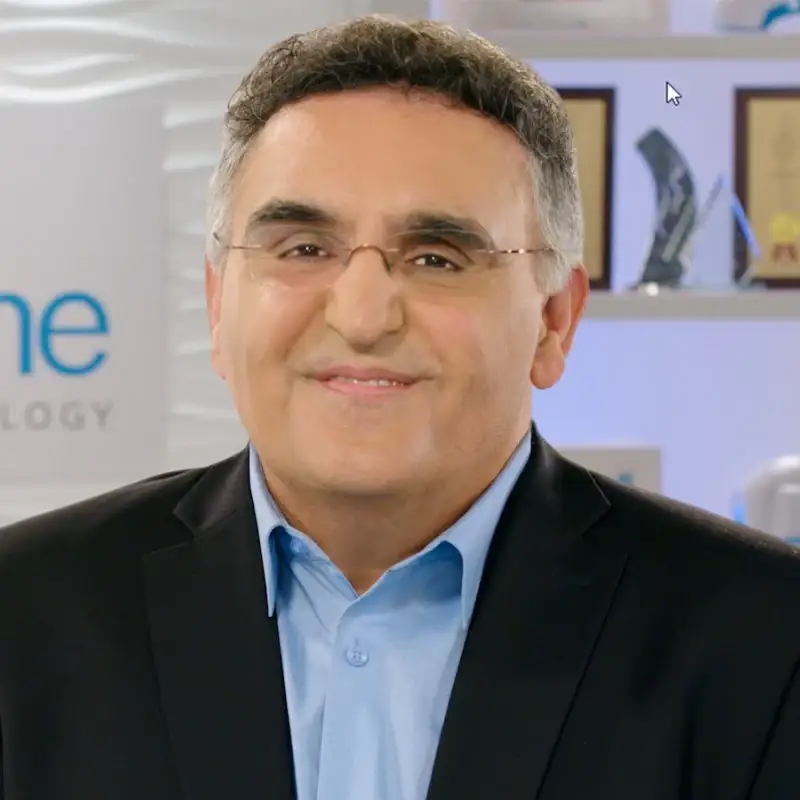
Guest Bio:
Some scientists stay buried in research. Others change the world. Tamim Hamid did both. With a Ph.D. in biomedical engineering and a history of designing life-saving lasers for astronauts, he set his sights on a universal problem: hair loss. Using decades of laser expertise, Tamim created Theradome, the first FDA-cleared wearable laser phototherapy (LPT) device to stop hair loss and regrow hair. It became the first medical device successfully crowd-funded, proving the demand for a real solution. From NASA to hair restoration, Tamim has achieved the impossible—putting more hair on heads than anyone, except God (Tamim is a very distant second... 😉) and he’s only getting started! 💪
Guest Contact Info:
- Website: https://theradome.com/
- LinkedIn: https://www.linkedin.com/in/tamimhamid/
- Buy Tamim's Latest Book, Grow It Back: How Laser Phototherapy Stops Hair Loss and Regrows Your Hair, on Amazon now: https://amzn.to/4eAj9nH