Click the play button (▶️) above to watch now! 👆
"Cancer is more like baseball. As long as you're still at bat in the ninth inning, you can win. So the mindset you want to establish is possible, not probable."
~ Steve Olsen
LISTEN TO THE PODCAST
Remarkable Guest Info:
Guest Bio:
Steve Olsen is a retired dentist, a high-performance coach, and a walking miracle. Diagnosed simultaneously with stage four lymphoma, stage one kidney cancer, and total kidney failure requiring dialysis, Steve was handed a grim medical prognosis. Refusing to accept the "probable," he relentlessly focused on the "possible". By combining traditional medical interventions with advanced mindset techniques, NuCalm neuroacoustic technology, and deep faith, Steve achieved complete remission within a year. Today, through his platform OptimalPerformance.cc, he coaches everyone from patients to race car drivers on how to control their thoughts, enter the flow state, and live a life of victory.
- Website: https://OptimalPerformance.cc (not .com)
- More Info: https://www.copingconqueringcancer.com
Steve Olsen is a retired dentist, a high-performance coach, and a walking miracle. Diagnosed simultaneously with stage four lymphoma, stage one kidney cancer, and total kidney failure requiring dialysis, Steve was handed a grim medical prognosis. Refusing to accept the "probable," he relentlessly focused on the "possible". By combining traditional medical interventions with advanced mindset techniques, NuCalm neuroacoustic technology, and deep faith, Steve achieved complete remission within a year. Today, through his platform OptimalPerformance.cc, he coaches everyone from patients to race car drivers on how to control their thoughts, enter the flow state, and live a life of victory.
Key Discussion Highlights & Takeaways
-
The Cancer Diagnosis: How Steve processed the devastating news of stage 4 lymphoma and kidney failure, and why he immediately rejected the standard terminal timeline.
-
Possible vs. Probable: The crucial mindset shift required to survive critical illness, and why Steve tells patients to actively seek out stories of people who beat the odds.
-
The NuCalm Protocol: How Steve used binaural beats and the NuCalm system to safely guide his brain into the Gamma flow state, allowing him to visualize his immune system destroying cancer cells.
-
Respond, Don't React: Why reacting is an emotion-driven survival reflex, whereas responding is a deliberate, calm, and practiced choice that lowers the body's toxic stress load.
-
The Black Door: A powerful illustration of why human beings often choose the comfort of known suffering over the fear of the unknown—even when the unknown leads to freedom
Key Timestamps & Moments of Gold
- 00:00:00 - Episode Intro & MyPillow Mega Sale
- 00:02:40 - Welcome Steve Olsen: The Importance of Mindset
- 00:05:00 - Steve's Early Life, Photojournalism, and Coaching Roots
- 00:09:10 - Facing Stage 4 Lymphoma, Kidney Cancer, and Dialysis
- 00:13:30 - Fixed vs. Growth Mindset and the Power of Definition
- 00:15:10 - The Bernie Siegel Story: How Words Can Kill or Heal
- 00:20:40 - The Gamma Brain Wave: Visualizing Healing and Flow State
- 00:23:00 - Using NuCalm to Warp Time Perception and Relieve Stress
- 00:30:20 - Stress: The Silent Killer and the "Respond vs. React" Framework
- 00:35:00 - Victor Frankl and Choosing Your Response in the Darkest Times
- 00:38:00 - Rebuilding Concrete Hope When All Seems Lost
- 00:44:00 - Entering the Gamma State Safely with Binaural Beats
- 00:50:00 - Connecting with Steve Olsen at optimalperformance.cc
- 00:54:00 - Final Thoughts, Taking Action, and Episode Wrap-Up
REMARKABLE SPECIAL OFFER(S):

MyPillow
Save 30% to 80% on EVERYTHING you order at MyPillow.com with Free Promo Code, “REMARKABLE“. Yes, that’s right! Use the best My Pillow promo code out there to save a TON of money on all 200+ quality, comfortable, cozy home goods at MyPillow.com/Remarkable, or by calling 1-800-644-6612. From sheets, to blankets, to pillows, to mattress toppers, be ready to sleep better and live more comfortably than you ever have before!

Console Vault
Your Exclusive Offer: Save Big on Your Console Vault In-Vehicle Safe. With our exclusive promo code, "REMARKABLE", you will Save 10% or more on all Console Vault anti-theft vehicle safes you order. And sometimes, you'll receive Free Shipping too! Just make sure to use the free Console Vault discount code, “REMARKABLE” at checkout.

Omaha Protein Popcorn
Taste the most delicious, nutritious, and highest quality protein popcorn on the planet at https://www.omahaproteinpopcorn.com! Not only will you, your children, friends, and loved ones enjoy this healthy snack immensely, but you'll all benefit from the 32-40g of the highest quality protein in the world PER SERVING. Use the Omaha Protein Popcorn promo code, "REMARKABLE" at checkout to save 10-20% off of your entire order, and Free Shipping too! 💪

Hunter's Blend Coffee
Stop wasting your hard-earned money on overpriced, corporate coffee that funds liberal agendas. It’s time to upgrade your morning routine with Hunter’s Blend Coffee! Hunter's Blend sources only the top 6% of specialty beans on the planet, precision-roasts them in micro-batches, and ships them fresh right to your door. This is quite possibly the smoothest, best coffee David has ever tasted—and it directly supports the values you live by, including pro-life organizations, veterans, youth shooting sports, wildlife conservation, and anti-human trafficking causes. Don't settle for mediocre, politically correct brew. Click here to order your fresh batch now and use promo code Remarkable at checkout to instantly save 10% and lock in Free Shipping! You will not be disappointed. ☕
Download the Full Transcript
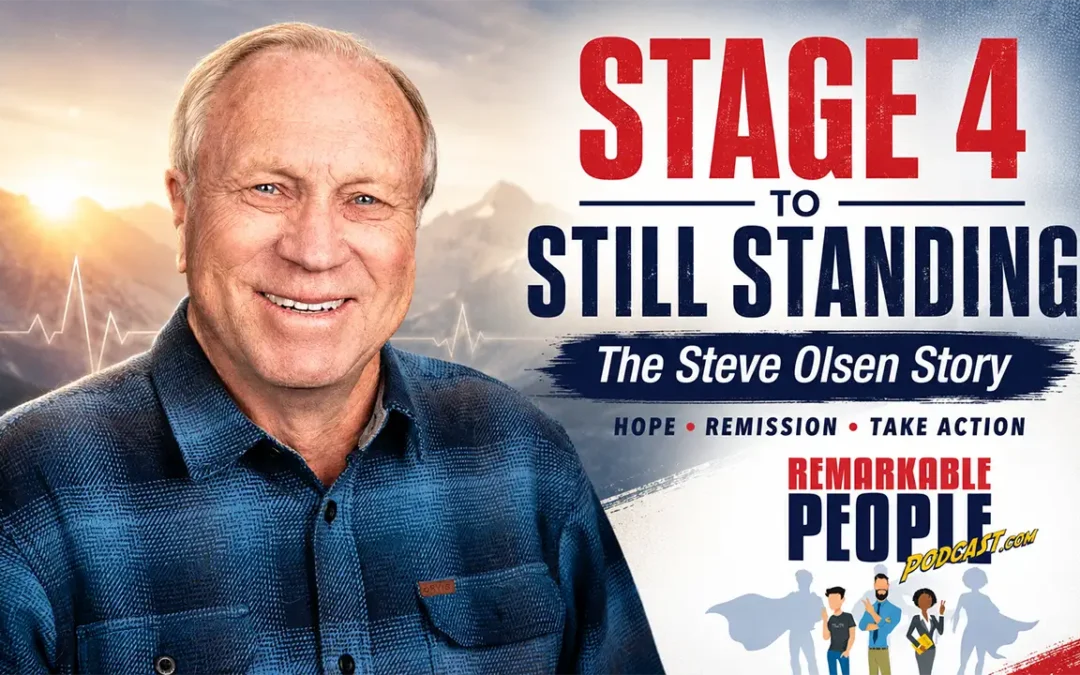
Stage 4 to Still Standing: The Steve Olsen Story of Hope, Mindset & Action
Thanks for watching the Remarkable People Podcast!: [00:00:00] The Remarkable People Podcast. Check it out. Remarkable People Podcast. Listen. Do. Repeat. For Life! The Remarkable People Podcast
David Pasqualone: Hello, friend. Welcome to this week's episode of the Remarkable People Podcast. Today, our special guest is going to talk to us about hope. He's going to talk to us about being ill and recovering fully from it, going into remission, and staying in remission. We're going to talk about his journey of how his life led up to this point where he had cancer of the lymphatic system, supposedly stage four, and it [00:01:00] was even in his kidneys, and yet he's living years later to talk to us about it.
And he's going to talk to us about how we need to take action, not just talk. So this is a great episode with our remarkable guest, Steve Olson, and at this time we're going to take a short affiliate break, and in 60 seconds you, I, and Steve are going to hopefully not only learn, but we're going to be able to find the steps to apply it, grow as humans, and just have a better life. All this and more right now.
Mike Lindell, MyPillow Founder & CEO: MyPillow's second annual mega sale is finally here. Get our patented premium MyPillows that adjust to your exact individual needs to give you the best sleep of your life When I got my pillow, I'm asleep almost immediately. I stay asleep at night, and I wake up more well-rested in the morning Now for the lowest price ever.
Kings, [00:02:00] $19.98, queens only $18.98. And Giza Dream bedsheets, the best sheets in history, for as low as $29.98. Lux Sphere six-piece towel sets, towels that actually dry you. What a concept. Now only $39.98. And our made-in-the-USA mattresses and mattress toppers as low as $99.98. So go to MyPillow.com or call the number on your screen.
Use your promo code to take advantage of our second annual mega sale. But that's not all. Order right now and we'll ship your order absolutely free!
David Pasqualone: Hey, Steve. How are you today?
Steve Olsen: I'm fabulous today. It's a great day where I'm living in Colorado.
David Pasqualone: Oh, beautiful. What part of Colorado?
Steve Olsen: I actually live outside of Denver, but that scene behind my background is actually up in the mountains in a place called Grand Lake, Colorado. It's one of my favorite places in the country.
David Pasqualone: Oh, yes. That whole [00:03:00] area is gorgeous. I got the privilege to live out there for about six months when I was in my 20s, and I absolutely loved it. Everything from Fort Collins to Colorado Springs, that whole chain in between is just breathtaking. So- I
Steve Olsen: agree. That's why I live here.
David Pasqualone: Yeah. You live in a beautiful place.
So I just told our listeners a little bit about you in this episode and what to expect. But right out of your mouth, we're going to hear your story and we're going to talk about what you're passionate about. But if you were to summarize and promise, if a listener is hearing your voice right now and they stick through the entire episode, what do you guarantee that they're going to get from this episode that y- they can apply to their lives and grow?
Steve Olsen: What I totally have, am passionate about is what I call mindset. Mindset is the key to how you look at everything and the results you achieve. As I look at mindset, I'm being a car guy, I look at mindset as [00:04:00] being the gasoline, or excuse me. The mindset is the power that goes it. The motivation is gasoline.
But g- gasoline either runs a lawnmower or a race car. So the key there is what are you going to run based on your motivation? And that's why mindset is so critical. I want people to realize how much they are in control of their own mindset and what the results can be, and we'll talk about a few examples of my own life.
David Pasqualone: Absolutely. So let's do this. You obviously came to this understanding, and you're passionate about it, and you're here today to share that with the world. But talk about your life. This show goes through your life from birth to today, and it's not about the sensational, but we will talk about the good, the bad, the ugly, the pretty ugly, 'cause everything that's happened to you, Steve, makes you the man you are.
So what has happened to Steve in your life? What have you learned, the hard way or the easy way, that [00:05:00] brought you here today, that mindset is such a key?
Steve Olsen: Oh, that's a great question. What I learned th- in my life, I had the privilege of growing up in Colorado, even though I was born in New Jersey, but I don't remember it.
And what I realized is, especially living in the mountains- That how critical it is that your environment can influence how you think. So part of the key is wherever you're at, you want to be in a peaceful, mindful location, even if you may not physically be there. Now, my own upgrade is that I've always been interested in coaching.
In fact, when I was in junior high, I was the captain on the winning junior high football team. I was going to be a super football player and a quarterback, and then I broke my two front teeth, and unfortunately, my mom said, "You aren't going to do this anymore." So that kinda changed things. So then I spent my summers up in the Grand Lake, Colorado, which is what as that background, and I actually loved it.
[00:06:00] And I- that's where I learned that you want to take initiative and do things that may m- many people say is not possible. I started working when I was 14, and my first job was cutting a two-and-a-half acre lot with a 19-inch mower. That was a challenge. And then I also taught water skiing, which gave me my passion for coaching.
And when I was in high school, I got involved in theater. Theater was interesting because it showed me how you can learn to be in different environments, and it was just great to be able to absorb that because I realized that my father was a workaholic. And so a lot of the things I did, I ended up doing on my own So then I ended up going to the University of Colorado, and I was there for four years, and I became involved in doing photojournalism.
Boy, I really enjoyed that because I put myself through school doing photojournalism. At the same time, I had another job in that [00:07:00] same location in Grand Lake, and I was coaching people how to drive boats and give tours. That really cemented my desire to be more of a coach. I ended up going to dental school at the University of Michigan, which is kinda interesting 'cause that was one of my first examples with possible versus probable.
Because what I found is that when I was trying to go to dental school, I was applying and all they did is they gave me a list of 150 spots, and only 10% were going to be out-of-state people. That made me one of 15 they were going to pick. And that was one of the first thing I looked at is that how critical it is to set your mind on certain goals.
And I ended up going to the University of Michigan. The other thing I got involved with during my whole career and then even more now was visualizing what you wanted to have happen. So I get to Michigan and I wanted to get a part-time [00:08:00] job. Lo and behold, the head of the research institute grew up in Pueblo, Colorado.
And he said, "I don't care what you do. Give this guy a job somewhere." So I was able to use my photographic skills at the research level. After I graduated from school, I ended up teaching there for a couple years. And the other one that was fun is that I traveled in Europe in 1972 for three months.
That's where I met my wife that I'm still married to. Boy, was that fun going through Europe that way. And so that's kinda shaped my other thing that I look at life as you, you need to look at all the possibilities, but the key is you also want to s- want to understand. And I've always used this through my life is that I'm a firm believer in whatever challenge you're facing, the solution is right in front of you.
The key is to see it. And so that really opens up your opportunities, and that [00:09:00] was really became important when I ended up having cancer a couple years ago. So I used that mindset to help me get through cancer
David Pasqualone: And talk about that. People get cancer of all types and all sorts and all severities- Yeah
or tumors or critical illnesses, and a lot of times, honestly, they just mentally accept death. They accept- Oh, big time ...
Steve Olsen: illness. Yeah.
David Pasqualone: And the doctors, that's what they push. They push- Yeah ... a medical system, not a health system, not a-
Steve Olsen: Oh I 100... they're called medical doctors. They aren't health doctors.
David Pasqualone: Yeah. Yeah. It, it- And it it used to be a medical practice Yeah. They recognized that they were practicing. Now it's a profession. Yeah. And there's a huge problem with that when you really think about it from the fundamental core. Yeah. Yeah. And I'm coming at this, for my listeners who know or don't know, I was sick my whole mostly childhood and teen years.
Had a tumor, grew back, took it out, grew back, took it out, grew back. Had radiation, and [00:10:00] then in my 30s I had a whole other critical illness. It started with a bad dental work and, you know- Sure ... just six years of just nightmare. But at the end of the day, God healed me, and He gave me wisdom and friends and people and things that I learned, but very little was actually out of the medical field.
Yeah. And the mindset, that belief, that trust, that hope is what I know God kept me alive. Yeah. So for you, talk about that. W- how did you find out you had cancer, and where did your life go from there, and how did that mindset play into it?
Steve Olsen: I what happened was is I've been ... Actually since about 2010, I've actually coached people on what I call optimal performance.
And the idea there is that you want to structure your mindset and how you do to optimize your performance. When I was diagnosed with cancer, what I chose to do is boost my immune system by the way things I [00:11:00] believed and the things I did. Now the first challenge with cancer is w- most people, they're diagnosed with cancer and either they ask or the doctor tells them you have six months to live.
You have three years to live," whatever. But the reality is cancer is more like baseball. The way they describe the time, it's like a football game. Are you in the second quarter, the first quarter, the two-minute warning? But in reality, cancer is more like baseball. As long as you're still at bat in the ninth inning, you can win.
So the mindset you want to establish is possible, not probable. And that is critical to be able to survive and also take action. And I also applied some principles that I used in optimal performance to boost my immune system. And one of the first things that's critical is learning to be calm because when your body is stressed, you can't really heal well.
And [00:12:00] calm is partly setting your mind, but also how you envision the future. And I'm a great believer in how you define what you do really results in the outcome
David Pasqualone: No, keep going. I agree 100%. Okay. I know both times, like I said, when I was ill it was for years, not days or months. It was years at a time. And I had the peace that I knew that no matter what happened, God loved me. Yeah. He's not vindictive. All the pain and evil comes from Satan. So God was allowing this to happen for a reason so I could get through it with peace.
And then when I was older, the same thing. I had a paradigm shift one day where I was suffering and I was... The doctors, multiple doctors told me to make out my will. Doctors told me to make out my will. Oh. Yeah. And one day I saw a boy in a wheelchair who was in his 30s, the parents were in their 60s. That guy never lived a day out of his wheelchair.
And when I mentally just [00:13:00] accepted, "You know what? I've had a good life." Yeah. "I've had ups, I've had downs, but I got children and I've got to do things. And that guy's never been out of a wheelchair. Who am I to complain?" And when I had that acceptance and that paradigm shift, I got better. I got better from that point.
Yeah. So you're right, that mindset's so crucial.
Steve Olsen: Oh it's... Yes. And that's... Mindset, you look at mindset and there's really two basic things people do. One of them is a fixed mindset, and another one is a growth mindset. And the possible versus probable becomes important in that r- arena. In fact, one of the things I greatly believe in is how you define what you do determines what and take action on.
I'm a big fan of history, and one of the things I remember hearing about was from the late '30s. DuPont Chemical invented a plastic that you could heat seal. You could take it from the freezer and drop it in boiling water and the seal wouldn't break. [00:14:00] So they took it to American Can Company, and the executives there look at it and said my, that's interesting, but we're in the business of making cans.
We have no use for plastic." They took it down the street to Continental Can Company. The guys looked at that and said, "Wow, we're in the business of packaging. We have a use for that." They changed their name to Continental Container Corporation. Another example is right after World War II, the railroads in this country were cash rich.
They had so much money they didn't know what to do with it. They looked at the fledgling passenger airline business and said, "Not interested. You can't make a train fly." They failed to realize they were in the transportation business. A more modern example is who knew 20 years ago that the least likely thing you'd do on your phone is talk?
So with those as background, whenever you're faced with a situation and a challenge, how do you define [00:15:00] success and how do you define your options? That's where it became critical with cancer, and like your own health challenge, your mindset as to how you look at things is critical. Now there's another interesting example that I like.
It's a guy by the name of Bernie Siegel, was a cancer surgeon in New Haven, Connecticut. And he talked about the importance of the mindset the patient has, and he used a couple examples. If you've ever had the experience of being in a teaching hospital, and they gather around you and they act like you're not there as a patient.
They use this lingo and terms. They were doing this with this woman that had a very minor heart arrhythmia called atrioventricular stenosis. And sh- they did their discussion and leave the room. She interprets that to mean she has a terminal situation, and she dies that night. Conversely, another gentleman had a very serious heart arrhythmia, and the [00:16:00] cardiologist was trying to describe to him how dangerous it was, and he said, "It's like a galloping horse."
Gallop gallop. He interprets that to mean that his heart's as healthy as a horse, and he gets better and leaves the hospital. So like with your example, whenever you're presented with, especially with somebody of authority tells you something, you really have to say, "Is this really the truth? And is it possible to be other outcomes?"
And that's what's ... I talk to people all the time about how passionate it is to understand that. Now, there are benefits to the medical system in that it helps you buy you time to find the real solution. And that can be critical at times with your total outcome
David Pasqualone: Oh yeah, agreed. If I didn't have those surgeries, I would've died.
Yeah. And that was, I guess God could have healed it completely and had a miracle, but based on, science, based on what we know about medicine and the human [00:17:00] body-
Steve Olsen: Yeah ...
David Pasqualone: that unless I had a true miracle, that at that point it wouldn't have reversed itself. So I needed the surgeries, and thankfully- Yeah
I got through it. Yeah. But then again, the surgeries didn't heal me. Neither did the radiation. It was changing my diet. So maybe I didn't need it. It- But it did buy me the time to figure it out.
Steve Olsen: Yes. The example I love is this guy's, his flood is coming through and he's sitting on his porch.
David Pasqualone: Yeah.
Steve Olsen: And the fire department comes along and says, "You need to get out of here." And the guy says, "The Lord will provide." And so he's sitting there a while longer and the water's rising until this rescue boat comes along. "Sir, you have to come with us." He says, "The Lord will provide." The water goes way high.
He's up on his roof, and a helicopter comes by and he says, "The Lord will provide. I don't need the helicopter ride." So he drowns, and he gets in front of St. Peter and he says, "Why did you let me die?" And St. Peter says, "I sent a firetruck, a [00:18:00] boat, and a helicopter. Why didn't you take advantage of any of those things I sent?"
David Pasqualone: Yeah, I've heard that before and it's very true
Steve Olsen: Yeah. Yeah. The, so you gotta look at that and say, when the opportunity comes along, you need to recognize it as the right kinda help
David Pasqualone: Exact- And when I say it's very true, the message is true, not the illustration. Yeah. Obviously that didn't happen. Yeah.
But all right, so now you are told that you have cancer. Yeah. And what did the medical industry diagnose you as, and what hope or lack of hope did they give you?
Steve Olsen: I was diagnosed with stage four lymphoma and stage one kidney cancer. At the same time, I had kidney failure, so I went on dialysis. And of course a l- a lot of people on dialysis never get off dialysis.
They're on there terminally.
And I said, "No, I don't want that to happen." So there's a few things I did with some other help from some more alternative-type medicine to help me [00:19:00] boost my issue. I'm no longer on dialysis. I'm in remission on both of them, which is what I help people with, how do you stay in remission?
But what amazed me is that I probably saw 20 doctors, and they were all amazed at the outcome, but nobody asked me what I did.
David Pasqualone: Isn't that crazy? Yeah. I've noticed that my whole life, and in friends I know. Yeah. The doctors will tell you how what you're doing is wrong, and then when it works, they never ask you what you did.
Steve Olsen: Yes. It's crazy. And- Yeah.
David Pasqualone: Yeah. And you also, I've asked doctors this, and they look at me like I'm crazy, and people look at me like I'm crazy, but I'm like, "What's your success rate?" Yeah. "How many patients did you see last year, and how many of them are actually recovered?" Okay, if I went to anywhere else in any other aspect, in any other industry, statistics are huge.
You're a marketing company. What's your return on investment? You're a mechanic. You fixed the car fully, right? Everybody's held to a standard, but medical [00:20:00] profession is when they charge you, and medical practice is when they have no liability, right?
Steve Olsen: Yeah. It's just it's just crazy when you look at how it's set up.
But then again, you want to look at them as a gift to buy you time and help you heal. 'Cause I've heard people that totally reject medicine, and it's kinda like the guy on the roof of the house. He says gee, why didn't you heal me?" Or, "Why didn't you save me?" You gotta look at what the opportunities that come down the line, and understand how you can take advantage of them.
And that applies to anything, whether it's your health or business
David Pasqualone: Yeah. But go on with you. Stage four lymphatic cancer is pretty serious. Yeah. Yeah. And to have kidney cancer, that's pumping blood. Those cancer cells rapidly typically go through- Yeah ... your entire body, your brain. W- Yeah ... how did you live and you're here today, Steve?
Steve Olsen: The other thing I did is I've learned that, in fact, most of you can look on- online with this. One of the [00:21:00] interesting things I did was that because of my work with brain chemistry and also brain frequencies, I found out that if you can get your brain in gamma, which is 39 to 40 cycles, and then you visualize your body killing the cancer cells it this research shows that there may be some indication to that.
And so I did that. Now whether that's the critical factor, I can't tell you. Because there's so many things you do, like you did with yourself. You still needed the surgeries to help you. But what finally turned the page so you're healed? And that's why you want to look at all different aspects and have a positive attitude about it.
David Pasqualone: Yeah, I agree. I actually remember, I never watched the episode, but remember when during the '80s they had a lot of talk shows?
Steve Olsen: Yep.
David Pasqualone: They'd show clips of the talk shows, and it was more informative, not like Jerry Springer today, where it's all completely BS.
Steve Olsen: Yeah.
David Pasqualone: But I [00:22:00] remember seeing a clip for a... I didn't even watch the episode, but I remember before I entered that time in my life, I saw this clip and it said, girl like little girl, like she was like 10 years old, defeats cancer that's impossible to cure, blah, blah, blah.
And I just remember the clip of her saying, "Yeah, I just pictured the tumor in my head and I pictured like Pac-Man in there eating away at it each day." Wow. And then she supposedly got healed. Again, I never watched that episode, but I remember when I was going through the surgeries- Yeah ... and the radiation, I was like, "All right, my body send all the good soldiers and eat that thing up away."
I did everything I could. As long as it was moral, I'd do it. Yeah. But that helped me. Did that help you?
Steve Olsen: Oh, big time. I'm here in a healthy state. One of the things I look at now is that remission, you're in remission how do you stay in remission? And one of the big factors is how you look at things, especially in your calm [00:23:00] versus stressed mindset.
David Pasqualone: And talk about that. How do you stay in the calm? How do you get in the calm and stay in it?
Steve Olsen: Yeah. The one I use is a system called nuCALM. It's N-U-C-A-L-M.com because what I originally did was I was... I've been with that company I was one of the advisory board members to help them develop it. The system was originally developed to treat PTSD.
And the... what I did as my s- as a dentist, I was using it to get, to treat people with dental anxiety because the benefit to it also is nobody loves to sit in the dental chair and it warps your time perception. So what was interesting is when I, my sister was diagnosed with stage four cancer.
She was given six months to live. Now she wouldn't do fully what I suggested she do, but we did put her on this nuCALM mainly to warp her time perception [00:24:00] while she's on chemo. And what was interesting is that they gave her six months to live. Two years later she was still doing relatively okay. But here's an interesting thing about life events.
Her son's golden retriever died and she was devastated because she was so much attached to that dog that she gave up hope. Because giving up hope can radically change how you look at things. In fact, one of my best examples from hope is the movie Dumb and Dumber. Okay, there's a... it's one of the few movies that has truth in advertising in the title.
But there's a scene in there where Jim Carrey is trying to date this woman and he says, "Will you go on a date with me?" She says, "Will you go on a date with me?" She kept saying, "No and no." He says, "Oh, please." She says, "One in a million." And he goes, "Yes," because it was possible. And that's the key is to find out what's possible, not what probable is[00:25:00]
David Pasqualone: Yeah, no. So you are going through this- Yeah ... and you're saying what is possible, and how do you translate that to reality?
Steve Olsen: You translate... See, when I work with people now on that, I say, "What I want you to do first is go find somebody who has outlived the odds with your condition." In fact, I have another friend of mine who was paralyzed when she was 12.
They said she'd never walk again. She found somebody that did, so now she did that. So that's the first thing, is develop concrete hope by looking for examples. And then you focus on what's possible, not probable And you still need to do other steps, like the, if you need certain treatments, yes, do that.
But the key to hope is incredible, how important that is, and faith really plays into that big time.
David Pasqualone: Yeah, and the Bible talks about how hope deferred maketh the [00:26:00] heart sick. A merry heart doeth good as a medicine, but but, when you don't have that hope, it's rottenness to the bones.
Steve Olsen: Yes.
David Pasqualone: All right. So talk about your actual journey into wellness.
Steve Olsen: Okay. My, my journey to wellness is I just decided that I was going to get healthy again, because I still wanted to snow ski and do all these other things I do. So I just took a step at a time, visualizing what I wanted to do, and then helping with mindset big time.
And th- that's basically got me through. Of course, I did some of the things they, they recommended, because it it was the logical thing to do. See, one of the keys with getting your system working well is your immune system is not a cause and effect. It's like a rain barrel you fill up. When it fills up and overflows, that's when problems show up.
So the key is to look at everything in the barrel and try to lower your body load. For many people, a [00:27:00] huge part of that is stress. Now, the key with stress is that it's not the event that's necessarily stressful. It's how you interpret the event that's the key. And it's interesting, because being a big time snow skier what I love is steep and deep and totally groomed.
Well, a lot of people would freak out at that on the surface, but to me it was what's called euphoric stress, not distress. And so the, a lot of it is, yes the event you're in is important, but the perception you have of the events really determines whether it's a distress or a euphoric stress.
David Pasqualone: And talk about that.
We want to be practical on this show, and we know every circumstance is different. But one, two, three. Some steps. Okay. Somebody's listening to you now, and they're like, "I'm in a terrible situation," whether it's physical, financial, they're in a bad situation. Their mindset is just bad.
Yeah. How do they reset? Step one, two, [00:28:00] three.
Steve Olsen: The keys to re- now, part of it is because PTSD, I've studied a lot of PTSD, 'cause I got involved with that, is that you, with PTSD, it's a dynamic that you generally need some form of outside help to break through, and there's a lot of good methods.
So one of the things to do is you look at, how can I help be this or how can I help myself? But the other part of that is when you're faced with an event, part of it is this too shall pass. And then you look at what is good in the event and what is, what gratitude can you generate with what is going on with what you're experiencing?
And that, that can be a first step because again you want to develop hope. Whatever it takes to develop hope is critical or vision. It's like in the Bible somewhere it says, "Without vision the people perish."
David Pasqualone: I think it's Proverbs 29:17.
Steve Olsen: Yeah. Okay. Yeah. It's... [00:29:00] So that's why that's critical to develop that vision and hope for whatever you're experiencing.
And then the third step is look for help, people that can help you. Because th- the tendency is people want to do it all by themselves and that doesn't necessarily work. We're a community
David Pasqualone: Now, when people are given, "Hey, your back's been hurting and you got kidney cancer and you got probably three months to live."
Yeah. That's a hard way to just be like, "I'm positive." So how do you practically help your clients, the people you coach- Yeah ... find that hope?
Steve Olsen: What I find is the k- is the key to that is getting your system to be peaceful and calm first. Now, what I find with it's the classic thing of prayer and meditation.
What my experience is that unless somebody's a good prayer person or a meditator before they get sick, they almost can't do it on [00:30:00] their own. They just can't learn it. That's why I use more advanced technology, and the one I prefer is that NuCalm because that gets your brain in relaxation and healing modes without you trying to learn all these techniques that the stress is causing you to trigger out on.
The other thing is that y- you also want to look at your s- at this, the life you're living and how much is under your control. And I remember ex- an example years ago about this father and his son was talking. The father had some super stressful job, and the kid was having challenges in school.
And he said to the father maybe you should get into a slower group. Get rid of the stress that you're under. And you may not be able to do it immediately, but you can look at the situation differently to see how are you taking this and personalizing it to make it distress."[00:31:00]
David Pasqualone: Absolutely. And, stress is a killer. Stress,
Steve Olsen: it'll- Oh, no question. Yeah. It's what's crazy is the most common time to have a heart attack is Monday morning between 2:00 and 4:00 AM. For most people, they're so stressed out about work it triggers a heart attack.
David Pasqualone: Yeah. And I've also heard the highest suicide rates, especially for men, are on Sunday nights.
I, yeah. 'Cause they don't want to go back to their life on Monday morning.
Steve Olsen: So you know that, I feel for people that are stuck in that, but they first have- they think
David Pasqualone: they're stuck ...
Steve Olsen: that's where your- It's mindset ... beliefs at become so critical, is you really have to look at what you're perceiving versus what is possible versus what you, what reality is at the moment.
David Pasqualone: Yeah.
Steve Olsen: It's kinda wild because being in Denver with the Broncos, I remember that one of the really gifts that Elway had is he loved being in a crunch the last two minutes. That was his mindset that made it almost fun, [00:32:00] where a lotta guys just implode when that happens
David Pasqualone: I hear you.
I'm from Boston, so I'm a Tom Brady fan . Yeah. And he, same thing, he loved that final two minutes
Steve Olsen: Because they, whether they're natural that way or they condition themselves, but I think it's a combination. Because part of it is that you want to have a certain level of confidence, but you don't want to be arrogant.
David Pasqualone: Yeah. '
Steve Olsen: Cause that makes a difference.
David Pasqualone: All right, so now you're getting well.
Steve Olsen: Yeah.
David Pasqualone: How long did it take you from the diagnosis to a clear bill of health?
Steve Olsen: About a year
David Pasqualone: Okay. And during that year, I'm sure there was ups and downs and hardships, correct?
Steve Olsen: There w- there was some... the, part of it was how do you endure it? But I always had a clear vision I was going to conquer this
David Pasqualone: And then what did you do to [00:33:00] safeguard that vision? 'Cause y- it quickly, people can come in your life and they're always negative and they suck the life out of you. Or you could be watching movies that are trash and it's showing somebody die from it. So did you safeguard yourself, people- Yeah
places, things?
Steve Olsen: Because whatever you-
David Pasqualone: Talk about that.
Steve Olsen: Talk about what
David Pasqualone: you did ...
Steve Olsen: Yeah. See the key there is whatever you observe or let yourself observe is that it's not what you're seeing that's the real challenge, it's how you interpret it and do you lose your hope over certain things.
That's why the clarity of your vision is critical, and you want to vision concretely in the future certain positive outcomes. I, th- see, the thing I find is this may not necessarily be easy, but you can do it because you can learn to be in control of your mind. See, brain surgery's not easy 'cause I wasn't trained for that, but training your mind to be positive and [00:34:00] open is a series that there's certain help.
But that's critical, is to develop the right mindset. That's why I'm such a big fan of that.
David Pasqualone: Yeah, the Bible talks about, Jesus talks about bringing your thoughts captive, to control your thoughts.
Steve Olsen: Yeah.
David Pasqualone: So real practical, what are some things you do to control your thoughts? 'Cause some things are easier said than done, right?
Oh- There's people whose mind race all the time- Yeah ... and there's people who are like a cricket. But for the, for either one, how do you control your thoughts?
Steve Olsen: That's why whatever happens to me, I look at what is going on? What am I contro- what I, what am I in control of, and what am I not in control of?
And so the thing to focus in on is what you can control, and it's actually a lot more than you think. The situations where you think you have no control, you're not looking at the whole situation. It's kinda Victor Frankl. During World War II he wrote the book Man's Search for Meaning.
And he realized when the Nazis were doing these [00:35:00] horrible things to him, they could control his environment but they could not control his response to it. And what he did is envision getting out of the prison and writing about it after World War II. That's where you get into without vision you perish.
And so it's just a matter of disciplining. I think I'm a big advocate of learning to be calm and relaxed. In fact I look at when I actually coach athletes and race car drivers how to be calm. Because part of the key there is whatever happens to you, learn to respond, not react And that's a step that takes some practice, but you can practice on everything.
One of the simple things is you're driving down the highway and road rage has become really a problem, and somebody cuts you off. The tendency is to go ballistic over some guy cutting you off. Another way to look at that is there [00:36:00] are people that their job is cutter-offers on the freeway, so he's just doing his job.
But you gotta learn to respond, not react. That's really critical when I'm coaching race car drivers. It's fun doing that, 'cause I say, "Whatever happens, s- respond, don't react." And that's something you want to practice every day of your life. Whatever happens, respond. Now, there are situations where you have to be in what's called monkey brain or amygdala-dominated in your brain.
Like your child runs out in front of the car, you don't want to sit there and think about it. You want to go grab them fast. You have to respond quickly. And then once the event's passed, you can go back. That's common in the animal kingdom. As humans, we tend to keep mentally rehearsing the what-ifs and the horrible things that could've happened But you, that's not easily...
It's like especially when you work with people like military with PTSD, [00:37:00] that's really a challenge to, to deal with that
David Pasqualone: Yeah, to get out of that fight or flight and the trauma- ... that they got burned into their brain.
Steve Olsen: Yes.
David Pasqualone: So if we were to kinda talk about let's really focus in on two core issues.
Steve Olsen: Okay.
David Pasqualone: Hope. To me, there's hope in the Lord. Yeah. And that, and I've always had that. That's why I got through everything in life, 'cause of God.
Steve Olsen: Yeah. Yes.
David Pasqualone: And we have people who are believers, and we have people who aren't believers that listen to our podcast. But where I put my focus on the Lord, and it's a true foundation, it's n- it's firm rock, right?
Steve Olsen: Yeah. Yes.
David Pasqualone: When you're teaching people this, not everybody believes in the Lord right now, sadly. So for the people who do or don't believe in the Lord, let's first, hope. You're working with me. I'm sad. I'm, like, scared. The doctors told me all these lies. Where would you start with me on hope?
Steve Olsen: You start with hope by y- again, [00:38:00] if it's, let's say it's back to cancer.
Now, I can tell them about people, but what I want them to do is actively look for people that have outlived the odds of what they're facing. 'Cause it's important that they get their own hope story. And so that, that's why they need to actively go... 'Cause I can tell them about it. I had a, another person who was 10% chance of surviving brain cancer and even learning to be able to walk again.
But she decided she wasn't going to give up. And so now she's walking. She has some issues of course, but she's alive and walking. And then part of that is, is that you want to look at what people say to you. I had another person I ran into that had survived some, I think it was prostate cancer for seven years.
So he goes to a well-respected clinic and the first thing the doctor says is, "I don't know how you've survived so long." The guy dies in three months [00:39:00] because he took away the guy's hope.
David Pasqualone: Yep.
Steve Olsen: So the hope is what you generate yourself. Like you're talking about the Bible and that type of thing. You ever had the experience that y- a football game's going on, but you really don't watch it till the end, so you know you're watching the replay and you already know the outcome?
You, when you watch the game from that point it's exciting to watch, but you're not as stressed out because you already know the outcome. So that's one way to look at as far as your faith in Christ, you already know the outcome.
David Pasqualone: Yeah.
Steve Olsen: So don't sweat it
...
Steve Olsen: But easier said than done.
David Pasqualone: Yeah. All right, so now we got that hope and talk about the vision- Yeah
the looking forward and then to visualize that future, right? That vision. Yeah.
Steve Olsen: Yeah.
David Pasqualone: So the... You said learn to respond, not react. Yeah. Satan's going to try to take us down. Somebody intentionally or unintentionally may be super negative [00:40:00] like that doctor- Yeah ... and that man died in three months. So how...
What are your steps to hear and change your paradigm, your thinking to respond correctly to it really is just data. It's just information. So it could be good, it could be bad, but it's just data. Yeah. How do you recommend your clients respond to data?
Steve Olsen: You want... That's why you want to practice ahead of time.
And one of the nice things is when you're on the freeway, don't get in a aggressive argument with the guy that cut you off. Practice responding to the situation, not reacting.
David Pasqualone: And how do you practice that? I had Dr. Phil Agrios. He's... He did great. He said, "That's interesting." Any time something happened that he would normally blow up about- Yeah
he teaches clients, "That's interesting." Yeah. And it would almost disarm him and he'd think through it. How- Yeah ... what do you recommend? What are things you've seen work with your clients?
Steve Olsen: What I d- what I recommend people do is, first of all, you want to... You familiar with Pavlov's dog experience, experiment years ago?
Yeah. Okay.
David Pasqualone: You can explain it quickly or [00:41:00] I can quickly just to our listeners. We have listeners all around the world, all ages. Okay. They may not be familiar. So basically what happened was Pavlov did experiments and he had a dog, and you can go ahead and explain it, but he basically combined the feeding with...
Was it a bell? Ding ding? Yeah. Was it a little
Steve Olsen: bell? Ringin' a bell and then he, the dog would salivate.
David Pasqualone: Yep.
Steve Olsen: So then what he did is he could just ring the bell without the meat around and the dog would salivate.
David Pasqualone: Yep, conditioned
Steve Olsen: response. And one of the things I recommend people do is couple relaxation with breathing.
And the simple way is to simply block breathe, which you breathe in, you hold it, you exhale. You breathe in, hold it, and exhale. But you want to practice that when you're actually either calm already... I use it big time when I do the NuCalm because that sets your brain in relaxation. And so then you've coupled the breathing with relaxing.
Now, that's nothing new. That's a common thing [00:42:00] they say. So that's why the first thing you want to do is practice it ahead of time. And then when you're in a stressful situation, breathe. 'Cause a lot of people when they're stressed out, they just hold their breath.
David Pasqualone: Yeah, I notice myself, I will not have a regular rhythmic breathing pattern when I'm working and I gotta stop and relax and then focus on my breathing for a couple minutes and then, everything goes great.
But I'll get all tense and actually get a neck ache or something and I realize, wow, I'm just like holding my breath.
Steve Olsen: Yes. Now the other thing you can do is if you're in a situation, you close your eyes also at the same time you're breathing, 'cause that helps put your brain in more relaxation alpha.
But when I'm working on a race car driver, they cannot close their eyes going 200 miles an hour. So they have to learn ahead of time to breathe but not close your eyes, and that requires [00:43:00] practice and conditioning And a lot of times... Go ahead.
David Pasqualone: Oh no. Go. Go on, "a lot of times."
Steve Olsen: A lot of times what it is that's why you want to practice on super non-critical events-
First, so you condition your body to be relaxed in a response mode rather than a trigger mode.
David Pasqualone: And to be real practical, that's going- Yeah ... through the drive-through and you get your order wrong, or the waiter takes too long to come to your table- Yeah ... when you're out to eat. Yeah. Or like you said, you're in traffic and the lights all turn red it seems, while you're trying to be in a rush.
Those are the types of things Steve's talking about. Correct, Steve?
Steve Olsen: Yes. You want to practice when it's super not critical. Because when y- when the critical times come, you want to be able to reset your mind to appropriately respond.
David Pasqualone: All right. And let's do this.
Steve Olsen: Okay ...
David Pasqualone: between your birth and today, we're going to f- ask the question, is there anything we missed [00:44:00] or anything else you want to talk about?
But before I ask you that question, you mentioned gamma w- state.
Steve Olsen: Brain wave, yes.
David Pasqualone: Okay? And there's all sorts of states of consciousness awake, and there's all sorts of state of sleep. Yeah. But if you don't hit these certain states, you don't rest and your body can't heal. So you mentioned that gamma was quite important, correct?
Steve Olsen: Yes. Gamma is what is commonly known in athletics as flow state.
David Pasqualone: Okay. So- How do you enter that? How do you teach your people to get into the flow, to get into- Okay ... the gamma?
Steve Olsen: The best way I've found is there's certain technology that uses what's called binaural beats. Binaural beats is where you put a frequency in your brain of, let's say, 40 cycles.
Your brain entrains to 40 cycles, which is gamma. And there's various technologies to [00:45:00] do that. The same thing is when you want to put your brain in alpha, you listen to tones. The classic thing with this is music. There's certain music that puts your brain more relaxed. A common thing is they, in like Buddhism, they tend to ring a lot of different bell sounds, 'cause the sounds is what starts to trigger your brain to go into different states.
David Pasqualone: So practical. I'm at my house, I'm feeling stressed, I
just listened to your interview. How do I get myself in this gamma state? Or you were talking about binaural beats. Yeah, the gamma- Where can you get a safe one? Yeah, the- how do you get a safe one? 'Cause there could be some nut job on YouTube putting out content and it's subliminal messaging and now I want to send him $500,000, right?
Yeah. How do we get a safe binaural beat? How do we get a safe gamma wave set up?
Steve Olsen: Okay. The quickest way I know how is to use the binaural beats. The best one I know is that NuCalm system because that makes a lotta [00:46:00] high-tech technology very simple to use. But the other way to do it is if you don't have that type of thing, you want to learn to breathe slowly.
That helps your brain relax. 'Cause what I find is if you want to be a super performer in gamma, the first thing you need to do is learn to relax. That's the first state you go for And there's, again, various technologies for some... Go ahead
David Pasqualone: No, let's talk about NuCalm then. I'm confused. I thought NuCalm- Okay
was some kind of supplement you were referring to. No. What is
Steve Olsen: NuCalm
David Pasqualone: and how do they get it?
Steve Olsen: Okay. NuCalm is a system that you basically put headphones on and you, it's an app that you put your brain in the frequencies that you want to do. Deep delta theta and alpha are like different sleep modalities.
Above alpha to about 28 to 30 cycles is beta. That's normal life. [00:47:00] Stress becomes about 28 on up to about 39. That's where distress is just destroying you. And then gamma is flow state performance. And there's ways you can... the classic way is to learn meditation, listen to bells and whatnot. There's a lot quicker way to do that, and that's what NuCalm does.
It's N-U-C-A-L-M on that. And it's- And is that
David Pasqualone: at the App Store? Is that a
Steve Olsen: website? Yeah, so you get it on an app through both through either Google or Apple Store And you take a look at that and-
David Pasqualone: Okay, NuCalm ... that, that's...
Steve Olsen: Go ahead
David Pasqualone: I just pulled it up on my phone. N-U Calm, and then it says NuCalm Sleep Recovery, and then that is an app, manage anxiety, improve focus.
Now, is this your app or is this just an app
Steve Olsen: you use? No it's the Cal- no, it's the one I use. The better way to really look at the whole system is to do it on a regular computer so you can get all the... Yeah, if you're into data [00:48:00] and that type of thing, there's a lot of huge research and background behind it and a lot of testimonials.
David Pasqualone: You can- Yeah, but there's a lot of people like me where it's okay, we've had this interview. I trust you. Yeah. Yeah. Where is this? Checklist. That's- One, two, three. One, two, three ... that's where it's at. Yeah At 8:00 at night before you go to bed, listen to this. I, I- Yeah ... we like checklists. We like fast.
Steve Olsen: Yeah.
David Pasqualone: That's it. But I don't want, I want to know who's putting stuff in my brain subconsciously, 'cause I don't want anybody in there subconsciously you know?
Steve Olsen: It's not sub... it's binaural beats. It's not somebody giving a subliminal message to send me 500 grand.
David Pasqualone: Yeah.
Steve Olsen: Even though that's been some interesting technology.
But it's just that. You can learn it on your own. See I'm a great believer in using what I call performance aids. And an example I'll do is if I'm with somebody in person is I'll put down a business card, a sheet of blank paper, and I'll say, "Draw a three and a half s- perfectly straight line."
Most people sit there and struggle to draw a three and a half inch line. I've only had two people do it right and they were professionally trained artists. After [00:49:00] they struggle, I take the business card, put it down on the sheet of paper, scribe the pen next to it, and it's a perfectly straight three and a half inch line.
That's because the business card is a performance aid. So that's where whatever you do, you first want to look at do I struggle or do I learn performance aids? One of the classic performance aids was doing visualization bas- baskets, and they found out that the people that just visualized what they were doing actually performed better later.
So th- that's where the mi- your mind is so powerful to be able to make things happen. But the key is to find the aids to help you.
David Pasqualone: Absolutely. And where... So is there anything we missed in your story up through today before we transition, Steve, into where you are today and where you're headed next- Sure
and how people can connect with you and find these aids?
Steve Olsen: I [00:50:00] think that's a g- pretty good overall statement. You can always talk forever, but I think that's- ... good enough for now. Yeah.
David Pasqualone: All right, then where are, where's Steve today? Where are you headed next? How can our listeners reach out to you-
Steve Olsen: Okay
David Pasqualone: and get ahold of you to find out about these aids and how they... Not aids. Okay. Yeah Not HIV, but performance aids, and they can grow and be better humans.
Steve Olsen: Yes. I have a website. I assume you'll post the website on the talk.
David Pasqualone: Yep. We'll put a link in all the show notes. Yeah. But it's
Steve Olsen: still
David Pasqualone: good, you can repeat it.
Steve Olsen: Yeah. Yeah. The s- the site that I use is optimalperformance.cc, not .com. That's a good source to see. I've got a guide there you can download that's the 4 Bs that talks about how you start this process and what I do. Yeah. But it's a... There's many sources. I would just like to make it easier for people to accomplish their goals.[00:51:00]
David Pasqualone: Yeah, absolutely. So they can go to that website. We'll put a link, ladies and gentlemen, in the show notes.
Steve Olsen: Yes.
David Pasqualone: And then, Steve, it's been great speaking with you today. Learned a lot. If someone did want to reach you, what's the best way for them to reach you? Is it through your website? Is it through social media?
Steve Olsen: Probably the website. Yeah.
David Pasqualone: Okay. And then just go to the website. There's a contact us page. They can reach out to you there.
Steve Olsen: Yes. Correct.
David Pasqualone: And then I guess any other final thoughts or suggestions or tips, or maybe something we didn't even talk about that you want to leave with our listeners before we close up this episode?
Steve Olsen: What I inspire people to do is help them... Like I said, mindset is super powerful, and the your mind with certain aids and certain outlooks, it really determines your whole life because it's the can versus the can'ts. And so I encourage people to... I'm a big reader. There's a lot of great people you can l- you can learn [00:52:00] from.
I like Jack Canfield. He's a great source.
David Pasqualone: Chicken Soup for the Soul, his probably best known work. Yeah. But
Steve Olsen: he has a
David Pasqualone: lot.
Steve Olsen: Yeah, he has a lot of things. Another one I like is a gentleman by the name of Arthur Brooks. He's actually a happiness... He st- he teaches happiness as Harvard Business School. Very profound, good writer.
That's one of the other sources. But there's many s- the part of the step is l- is take action, learn to take action, start.
David Pasqualone: Yeah. If you never take that first step of the journey, you'll never get to the destination.
Steve Olsen: Correct.
David Pasqualone: So
Steve Olsen: it's huge. They, and one of the, yeah, one of the fascinating things, I heard a story years ago that these two Mideast monarchs are talking about how they execute people. And the first guy says I just simply hang them."
And he says to his friend, he says to the second one, "What do you do?" He says, "I give them a choice. They can either be hung or they can go through the black door." [00:53:00] And the guy says, "What do most people choose?" He says, "Most people chose to be hung." What was behind the black door? Freedom. Most people are so scared of the unknown, they take the known at all costs.
So the key there is become comfortable opening black doors, 'cause you never know what's really behind them
David Pasqualone: Yeah. If you don't take that first step, as a Christian, I want to take the first step in faith- Yeah ... and by God's guidance and direction, not blindness, not being stupid. But I know what you're saying.
Yeah. If you're too afraid to take a step, you're never going to go anywhere.
Steve Olsen: Yes. One, one of them I like is just read the Bible with the red high- the red highlighted words in it. Start there.
David Pasqualone: Yep.
Steve Olsen: It's... Most people are into Cliff Notes and quick. That's a good Cliff Note version of everything
David Pasqualone: I agree.
I agree. Another good one is... all the Bible's good. But if you just read [00:54:00] a Proverbs a day, you're getting hit by 10 different thoughts in different areas of life. Yeah. That'll help you too. But the whole Bible's perfect and good. Yeah. So all right, Steve. Listen, it's been great- Absolutely
having you here today. I enjoyed having you on the show. Ladies and gentlemen, like our slogan says, Listen. Do. Repeat. For Life! Don't just listen to what Steve said, but do what you need to do each day. Repeat those good behaviors so you get habits that are positive so you can have a great life in this world, but more importantly, in eternity to come.
So Steve, before we wrap up this episode any other thoughts or anything we missed?
Steve Olsen: Take action.
David Pasqualone: All right. On that note, ladies and gentlemen, we're going to wrap up this episode. So start your journey. Take action. Check out the show notes. Visit Steve's website. Reach out to him or I if we can help you in any way.
We love you. Share this with your friends and family, and we will see you in the next episode. Ciao!
Steve Olsen: Thanks, David.
[00:55:00]
David Pasqualone: Ladies and gentlemen, I sincerely hope this show has inspired you. The whole purpose of the Remarkable People Podcast is to inspire you, to motivate you into action, to help you have an even better life, to overcome things you've not yet been able to overcome, or to grow to the next level that you never thought possible.
And all of this, not just to benefit you in this world- ... but to have you come to a relationship with God where it grows every day stronger. And not just this world is blessed, but your eternity is blessed. And we sincerely want to do just that and to glorify God. And we hope with this episode we accomplish that.
If we did, please let me know. It's great to be encouraged and to spread the word to our remarkable guests that it helped in your life. If we didn't, let me know. Write me an [00:56:00] email. You can go to davidpasqualone.com, go to our Contact Us page and let me know what you think. I got tough skin. Let it rip.
Anything you can think of to make this a better podcast to help you grow and to glorify God, I'm in. So that's it. Thank you for listening to the podcast. Thank you for sending us feedback. If we can help you in any way, let us know. And if you can spread the word about the Remarkable People Podcast, share the episode to your friends, your family on social media, it would be a huge honor and blessing.
Again, I'm not trying to be the most famous podcast in the world for my benefit. I truly want a podcast that's the best podcast in the world to help as many people as we can to have a better life, come to know Christ, to grow in the Lord, and to have that salvation so they can be with God in peace and joy and eternity.
And right now we're together on this [00:57:00] earth, so let's do everything we can to work together and help each other grow. Like the Bible says, love the Lord thy God is the first commandment, and the next commandment is to love thy neighbor as thyself. So let's do it together. I'm David Pasqualone. I love you, not as much as God loves you, but if I can help you in any way, just ask. And again, please share this to your friends and family so we can help them too. Ciao, and see you in the next episode!
Thanks for watching the Remarkable People Podcast!: The Remarkable People Podcast. Check it out.
Remarkable People Podcast. Listen. Do. Repeat. For Life!
The Remarkable People Podcast
Episode / Guest Frequently Asked Questions... and Answers!
How did Steve Olsen recover from Stage 4 cancer?
Steve Olsen achieved remission from stage four lymphoma and stage one kidney cancer by combining traditional medical interventions with advanced mindset conditioning. He utilized NuCalm technology to reach gamma brain wave states, lowered his body's stress load, and actively visualized his immune system defeating the cancer cells.
What is NuCalm?
NuCalm is an advanced neuroacoustic software system, accessible via a mobile app, designed to safely guide the brain into specific healing frequencies using binaural beats. Steve Olsen used NuCalm to lower stress, enter deep relaxation, and maintain a calm mindset during his cancer recovery.
How does Steve Olsen define the difference between responding and reacting?
Reacting is an automatic, emotion-driven survival reflex often rooted in stress, whereas responding is a deliberate, calm, and practiced choice. Steve coaches individuals to practice deep breathing and remain calm during minor daily inconveniences so they can successfully respond rather than react during critical life events.
What is the Gamma brain wave state?
The Gamma brain wave state, typically hitting around 39 to 40 cycles per second, is commonly known as the flow state in athletics. Steve Olsen teaches that accessing this highly focused state through binaural beats can optimize human performance and aid the body's natural healing processes.