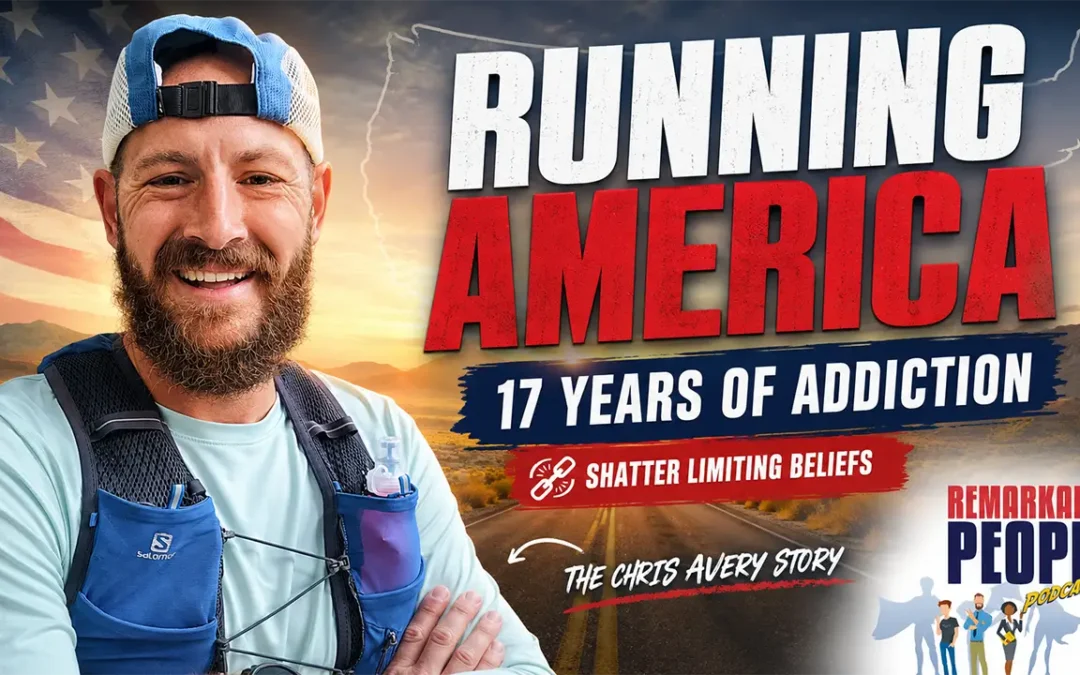
Click the play button (▶️) above to watch now! 👆
"The key is letting go. The key isn't holding on, the key is letting go. And so I realized if I wanted to move in a new direction in my life, I had to let go of some of these things in the past."
~ Chris Avery
LISTEN TO THE PODCAST
Remarkable Guest Info:
Guest Bio:
Chris Avery spent the first part of his life battling the dark shadows of childhood molestation, physical abuse, and a 17-year addiction to drugs and alcohol. Realizing he needed to change his trajectory, Chris immersed himself in personal development, faith, and mentorship, ultimately transforming his life and achieving sobriety. Today, Chris is a dedicated coach, husband, and father. He is currently preparing for a monumental physical and mental feat: starting January 1, 2027, Chris will run the entire perimeter of the United States, completing an ultra-marathon (31.1 miles) every single day for 365 days. Welcome to Chris Avery running America on the Remarkable People Podcast!
- Website: https://OptimalPerformance.cc (not .com)
- More Info: https://www.copingconqueringcancer.com
Chris Avery spent the first part of his life battling the dark shadows of childhood molestation, physical abuse, and a 17-year addiction to drugs and alcohol. Realizing he needed to change his trajectory, Chris immersed himself in personal development, faith, and mentorship, ultimately transforming his life and achieving sobriety. Today, Chris is a dedicated coach, husband, and father. He is currently preparing for a monumental physical and mental feat: starting January 1, 2027, Chris will run the entire perimeter of the United States, completing an ultra-marathon (31.1 miles) every single day for 365 days.
Key Discussion Highlights & Takeaways
- The Power of Environment: How Chris found sobriety by changing his circle, attending leadership events, and listening to over 10,000 hours of personal development audio.
- Redefining Forgiveness: Why Chris views forgiveness as a tool for his own freedom rather than for the perpetrator, and how seeing the humanity in others helped heal his deep anger.
- Shattering Limiting Beliefs: The incredible story of how Chris ran a full 26.2-mile marathon with absolutely zero training just to prove that our minds hold us back more than our physical abilities.
- The "One Mile" Strategy: How Chris built the discipline to run around America by setting a goal so small—running just one mile a day—that it was impossible to fail.
- The 5-Minute Marriage Hack: The simple nightly gratitude journaling practice Chris and his wife used for a year to save their struggling marriage and shift their focus to love and appreciation.
Key Timestamps & Moments of Gold
- 00:00:00 - Welcome to The Remarkable People Podcast
- 00:02:21 - Sponsor Read: Upgrade Your Truck with Maxzina
- 00:03:44 - Chris Avery’s Origin Story: Childhood Trauma & Abuse
- 00:08:14 - 17 Years of Drug and Alcohol Addiction
- 00:11:57 - The Turning Point: Finding Mentors & Personal Development
- 00:16:12 - Stepping into Leadership & Finding Sobriety
- 00:27:00 - How to Truly Forgive and Let Go of the Past
- 00:43:00 - Moving to Utah & A Crazy Marathon Proposition
- 00:48:45 - Running a Marathon with Zero Training to Break Limiting Beliefs
- 00:52:19 - The Next Massive Goal: Running the Perimeter of America
- 00:54:12 - Starting Small: Building Trust with One Mile a Day
- 01:03:00 - How a 5-Minute Nightly Gratitude Journal Saved Chris's Marriage
- 01:08:48 - Connect with Chris: ChrisRunsAmerica.com
REMARKABLE SPECIAL OFFER(S):

MyPillow
Save 30% to 80% on EVERYTHING you order at MyPillow.com with Free Promo Code, “REMARKABLE“. Yes, that’s right! Use the best My Pillow promo code out there to save a TON of money on all 200+ quality, comfortable, cozy home goods at MyPillow.com/Remarkable, or by calling 1-800-644-6612. From sheets, to blankets, to pillows, to mattress toppers, be ready to sleep better and live more comfortably than you ever have before!

Console Vault
Your Exclusive Offer: Save Big on Your Console Vault In-Vehicle Safe. With our exclusive promo code, "REMARKABLE", you will Save 10% or more on all Console Vault anti-theft vehicle safes you order. And sometimes, you'll receive Free Shipping too! Just make sure to use the free Console Vault discount code, “REMARKABLE” at checkout.

Omaha Protein Popcorn
Taste the most delicious, nutritious, and highest quality protein popcorn on the planet at https://www.omahaproteinpopcorn.com! Not only will you, your children, friends, and loved ones enjoy this healthy snack immensely, but you'll all benefit from the 32-40g of the highest quality protein in the world PER SERVING. Use the Omaha Protein Popcorn promo code, "REMARKABLE" at checkout to save 10-20% off of your entire order, and Free Shipping too! 💪

Hunter's Blend Coffee
Stop wasting your hard-earned money on overpriced, corporate coffee that funds liberal agendas. It’s time to upgrade your morning routine with Hunter’s Blend Coffee! Hunter's Blend sources only the top 6% of specialty beans on the planet, precision-roasts them in micro-batches, and ships them fresh right to your door. This is quite possibly the smoothest, best coffee David has ever tasted—and it directly supports the values you live by, including pro-life organizations, veterans, youth shooting sports, wildlife conservation, and anti-human trafficking causes. Don't settle for mediocre, politically correct brew. Click here to order your fresh batch now and use promo code Remarkable at checkout to instantly save 10% and lock in Free Shipping! You will not be disappointed. ☕
Download the Full Transcript
17 Years of Addiction to Running America: Chris Avery’s Blueprint for Shattering Limiting Beliefs
Thanks for watching the Remarkable People Podcast!: [00:00:00] The Remarkable People Podcast. Check it out.
Remarkable People Podcast. Listen. Do. Repeat. For Life!
The Remarkable People Podcast.
David Pasqualone: Hello, friend. Welcome to this week's episode of The Remarkable People Podcast. Today, we have with us Chris Avery. Chris, welcome to the show.
Chris Avery: Thanks, David. I'm excited to be here, man.
David Pasqualone: Oh, we're excited to have you. And ladies and gentlemen, when you're listening to this, you're choosing the time to share with us, and we value that.
And we want to make sure we bring you the very best episodes, so you can not only be entertained or [00:01:00] intrigued or to learn something, but we want you to be inspired to grow. Like our slogan says, Listen. Do. Repeat. For Life! So Chris, today we have listeners from all around the world, male and female, different financial situations, different cultural situations, different life situations.
But as humans, we all have that common thread. So no matter who we're talking with today, what do you guarantee they're going to get if they listen to your episode if they stick all the way through?
Chris Avery: Yeah, I love that question. I think the key is all of us, no matter where we are, we have... We put limits on our abilities.
And we're going to see today through consistency of action not doing anything extraordinary, but doing the ordinary extra, how you can shift your life and destroy those limiting beliefs and overcome them, like layer after layer. 'Cause even if you get to a million dollars, that's your new limit. So once you get there, how do you bust through that again? And I think that's what we'll really get and give them to take home [00:02:00] today.
David Pasqualone: Awesome, ladies and gentlemen, you heard it from Chris himself. We're going to go through his story, how this became so important to him, how he learned to not only utilize it in his own life, but how he learned to help others shatter those limiting beliefs, right?
So we're going to take a short commercial break and come back with our friend Chris Avery.
David Pasqualone: If you are one of the millions of auto enthusiasts with a Ford Bronco, Ford Maverick, Ford Ranger, Ford F-150, Jeep Gladiator, or Honda Pilot, you need to check out Maxzina.com, M-A-X-Z-I-N-A.com. They have amazing auto parts that I have been getting on board with recently and absolutely loving. From a headrest extender in my Ford F-150 to a tailgate extender that turns into a camping table in the [00:03:00] Jeep Gladiator.
These are unbelievably well-constructed products and very inexpensive compared to competitors out there with lesser quality. So go to maxzina.com, M-A-X-Z-I-N-A.com. Use promo code "REMARKABLE" and save 10% or more on everything you buy, and plus sometimes they throw in free shipping, too. So again, Maxzina.com. You will love them.
And check out the notes for this episode and I'll put links to other reviews we've done for Maxzina.
David Pasqualone: Welcome back to the show, ladies and gentlemen. At this time, we are going to get to the good stuff. Chris, let's talk about your origin story. Good, bad, ugly pretty ugly. Everything that made you the man today, let's go to it.
So where did Chris's life begin?
Chris Avery: Oh, man I got a lot of the ugly. So h- hopefully we won't spend all the time there, but we have plenty of it. [00:04:00] Man, I was really just a rambunctious kid. I had a ton of energy, I think as most kids do. And as my mom said, I stressed her out 'cause I asked why about everything.
And that curiosity led to... I actually got molested when I was a kid, and then there was some physical abuse. And in that time, I lost myself. You don't... When you're, when you get those things that, and they happen to you as a kid, you don't really know how to handle those, and I don't think a parent knows how to handle those with the kid.
So that quickly turned into my teenage years of doing drugs and alcohol, and I spent 17 years just really in the weeds of feeling lost, feeling like the world was a negative and bad place and that it was taking advantage of me, and I, I, it was in the victim mode. And so I spent about 17 years there into my mid-20s, and that's really the origin of the story.
I'm sure you have some questions, and I know I just jumped, 17 years on you quickly. But that's- Yeah, no,
David Pasqualone: for all-
Chris Avery: Yeah ...
David Pasqualone: for all of our listeners, sadly, way too many people have stories of [00:05:00] molestation. Yeah. Some are by neighbors. Some are by, quote-unquote, "friends." Some are by family members. Some it's a one-time event.
Sometimes it's repeated for years. What was your situation like?
Chris Avery: Yeah, so I was raised in Arizona, and we would come up to Utah every year because we had a lot of family up here. My grandma lived up here. And there was a small town. And, you wouldn't necessarily say, necessarily think a small town, they're very tight-knit, but it was a cousin.
And we would come up here. And so from 5:00 until about 7:00, we'd come up here for most of the summer. And it was a great time, but there was that, the dark side of it, which was the molestation. And, especially as a man, when s- another man touches you... for me, my family always, my mom and my aunt raised a lot, raised me a lot of my life.
They were very good examples in very poignant parts of my life. And when I was growing up, they would always say, you have sex or you connect with a person, the one that you love, and that's the person you have that sexual connection with." And so when your first sexual [00:06:00] connection is some man touching you that you, that's way older than you, that you don't know how to handle, that you don't even really know, or at least I didn't understand what was even going on, it just happened that around the second or third summer, I told my mom "Hey, this is what's happening," or, "We're playing this game, and this is what's happening with me and the guy." And she... And then that's when it all really got exposed, 'cause I didn't even know 'cause I was five, six years old, so I didn't even understand what was fully going on. So it was a cousin and I think that's very common. And, that, that's what happened. I'm happy to share any more that you want to dig any more deep in the weeds on.
David Pasqualone: As you go through your story, obviously, like you said, we're wired a certain way, how God made every human.
Chris Avery: Yep.
David Pasqualone: And when that's broken at an early age for children, it rewires things in negative ways. So I'm sure it didn't just go away and everything's happy, like you can erase a chalkboard. I'm sure it had, effects. Oh- So as you go through your story, talk about the effects it had. Yeah, absolutely. And more importantly, we'll get into how did you [00:07:00] overcome those negative, miscrossed wires?
Chris Avery: Yeah, absolutely. And I'd love to say, I'd love to say it did go away, right? It got exposed, so the molestation stopped, but the re- residue is what I like to call it, the residue stayed. Yeah. And so as the years went on, that led to negative- Understanding what sex was, it was a n- it was a negative thing.
It felt dirty, it felt weird. So that connected me deep into porn. And then that also connected me when I was connecting with women, that I thought it was just this sexual experience, and it w- became this very much of you get hurt, so you hurt other people. And we've all heard that, right? Hurt people.
And so it, it was just... Man, the mindset around sex and the mindset around what it was just this dark, dirty thing, and it was this thing of I was perpetrated on, so it felt like that's what sex was, is you perpetrated on others. And I never molested anybody, but certainly I could have treated women better, and I know that as I, [00:08:00] looking back.
And the, as the years went through, middle school, high school, 'cause I started hooking up with girls in middle school. Then high school came along and then I, continued that. And that's really where Again you feel dis- you almost feel disconnected from your soul, like from who you are.
'Cause you have this, as a kid, you have this vision of "Here's who I want to be. Here's what I want to do with my life. Here's... I want to have the family, the four kids," whatever it is. And I lost that along the way, and then, like I said, in high school, that's where I really started to numb out with drugs and alcohol, and that became my new identity source, was the darkness, and then that connected really well with drugs, and then I found those good people, where j- where they, your parent says, "Hey, don't hang out with Johnny."
I was Johnny, and then I found a lot of other Johnnys to hang out with. And so we just, we perpetuated that within each other. And so that's really how the, it continued. And then I'm happy to tell you about the healing side if you want to move to that, or if you have other questions you want to talk about the dark side.[00:09:00]
David Pasqualone: No, man, this is your show. Good. So we're all listening to you, and we all have sadly seen, heard, or been part of something like this.
Chris Avery: Yeah.
David Pasqualone: So for those of our listeners who have been there and maybe still haven't had victory over it, what were the steps?
Chris Avery: Yeah, you got it.
David Pasqualone: Even the... What's the word?
Sometimes we get to a head and things get terrible before they get better. What was the progression of your life-
Chris Avery: Okay ...
David Pasqualone: so you were able to face the molestation and get through it?
Chris Avery: Yeah, okay. So I will say I think it's like a two-headed snake almost, right? Because the drugs and alcohol were their own separate darkness, and then there was the molestation, pornography, the sex side of it.
And really about in my early 20s, I... It- it's funny, 'cause I look and I was a pretty innocent kid in my, early, and then I get into my teenage years and that's where I feel like I became less innocent and was much more about "Let's just [00:10:00] do naughty things and be naughty and not be a great person," a lot.
And then about, I got out, roughly getting out of high school I gained much more of a consciousness of "I gotta be a better person. I gotta figure out life. I gotta do a better thing." And I love to say that was the turning point where everything got better. It wasn't. In my early 20s, that's where I really got deep into alcohol, was in my mid to and early 20s, and that's where that darkness it washed over me, and it was literally through those years, crashing cars, doing all the...
Never got arrested from the grace of God, never got in troubles with the law. Yet in my mid-20s, I went, "Man, I have a couple choices." I either got to figure something out... And, like when I was younger, my mom always was like, "Do you want to go to a therapist?" Because my parents got divorced at a young age, right?
Ri- right around when I was getting molested, my parents got divorced as well. And my mom was always asking if we wanted to go to therapy. Then she found out I was [00:11:00] doing drugs and alcohol in high school, so she wanted to take me to re- you know, not rehab, but she wanted to take me to see people that go down that path.
And of course, my arrogance was like, "No, I'm good. I don't have any issues with that," blah, blah, blah. But I get into my mid-20s and I think, "Man, I really got to figure this out. I have a couple options. One is you take the bullet train and you get out of here and y- you end your life. Or the other one is if this if this is what life is going to be like for the rest of my life, is drugs and alcohol, I got to...
I'm going to get out of here, because I don't want to live." Or the other choice is I really got to figure this out. And luckily, around that time... and I li- I always love the saying that the teacher appears when the student's ready. And David, I finally felt like I was ready. And so s- a few people stepped into my life, and I was involved in a couple of different groups at this point.
Like some with some political stuff some with just personal development stuff. And these people came in and were like, [00:12:00] "Hey we have these incredible things called books and CDs." Th- back in the day, they used to have these CD players. I'm really old it was like jet powered, you had to start them up. And I listened to 10,000 plus hours of audios, because they just kept giving them to me. "Hey, listen to this good leader. Hey, good l- listen to this good leader." Because I had no idea this material was out there. I was just living the standard crappy life. And so I started reading books, started listening to audios, and I started to see a better view of people, and that there were people that had gone through the same experience that I had, and they had figured it out.
So I get involved with these two different groups, and really that was like the first turning point. It was like the... It's almost where you have a vase and there's a crack now, and the light can come through the crack, and I could see some light. And so at that point, then I started, implementing some of the things I read in the books.
And then through that group, we had these leadership web- or seminars that we'd go to every Saturday. And so then this [00:13:00] other guy came to our s- event. He's "I know this guy named Michael. He's absolutely incredible. Would you want to like, come to his event?" And I was like, "Nah, man, I'm good. I got all the stuff I need."
That gentleman followed up with me for 13 months, about every month. "Hey, how you doing? What's going on?" And he is one of the first people that I admitted to that I had a drug and alcohol problem. Him and my mom were the first two people. And so he's "Man, Michael doesn't necessarily just help people with drugs and alcohol, but he's helped people get over drugs and alcohol.
So why don't you jump on the phone with him, see what a- one of his calls is if you enjoy it, if it adds value to you, continue on." And I got on a call. And thank God I did accept finally after, after 13 months of his consistency. And then ag- and if this is... if you guys are taking notes, start to open your mind is for what I had to do, is open my mind to opportunity, open my mind to good people.
Opening my mind that everybody that was asking for me to buy [00:14:00] something or for me to be part of something wasn't out to get me. 'Cause I was... That was the victim mind and the worried mind I was in, 'cause it felt like I was perpetrated a lot when I was young. And so I finally was open enough, and I was like, "Yeah, I'll come to the event."
So I go to that, and I'll be honest, I went to his first live event, and I was drinking the whole day. 'Cause I knew the event started about 3:00 in the afternoon, so I just drank all day. I remember even being passed out and I'm like, "I'm going to show up late to this thing. I, I know they're going to put me in a room with people.
I don't want to talk to anybody. I don't want to be around people, so I'm going to show up to that event." So I show up to the event and, I walk in and they're still... they pull tricks on you, so they... There's still a big group of people and everybody's talking. I'm like, "Great. This is the last thing I want."
I go into the event and I leave inspired that my life could be different. We go through that whole weekend and things started to change That was a, another catalyst or a piece to it. And then what the next thing [00:15:00] that happened was you get to come back to the event if you want. So I came back to the event several months later, and that was really the game changer.
What happened was I hadn't stayed sober every day of my of my presence at... from those months, I didn't stay sober every day, but I started to get gaps of sobriety. And man looking... When I was in that bubble, I went, "Man, how do I keep failing? I just keep, I, I'm messing up." I'll use the nice words.
I'll edit my language. But man, I really wanted to be sober, but I just couldn't figure it out. But I could recognize at one point, I thought I would never be sober for a day, and now I could finally start to see days. I had finally started to see a few weeks here and there sober. And I went "Okay, there is something possible.
I, I am... I can do it a little bit longer than I thought." So I go back to his event, and this time you come back as leadership. And that was a game changer for me because now I got to come back and the few little things that I had learned and implemented, I got to [00:16:00] share with others. And you see that light kick on in somebody's eyes.
And when you see that light kick on or you feel like that heart-to-heart impact that you made to somebody Man, that's when I went "I got to figure out how to do this for the rest of my life." If I can do better for myself and I'm doing better for myself and because I'm going to help other people do better, man, that's what I want.
I want that healthy pressure. It's we always say the pressure refines or makes a diamond. But we have to find ways, or I had to find ways to put that healthy pressure on myself. Because when I did and it wasn't just about me, now I was willing to perform better. And so I... And then I came back again and I got to help more people.
And I went "Man, this is something I really got to figure out how to do for the rest of my life because it's making me better and it's helping me make other people better, and this is the best kind of drug I can have." And so that, through that process of going back to those events was really what helped me with the molestation.
It's really what helped me become a better person. It's what helped me get [00:17:00] sober and still sober today, nine years later. And those are really the big transformations, was putting healthy pressure on yourself, finding good people that you can, that like you can be around, that you can trust, that can breathe life into you.
The first group of people that got me to Michael, they spent a couple years just breath- breathing life into me. "Chris, man what is your vision? Man, what do you want life to look like?" They brought back some of those visions and desires that I had when I was a kid that I'd lost or I wouldn't say lost, I just shoved down.
I suppressed them because I thought, "No way this is going to happen. No way is that life." But they breathed life into it again, and that like little burning like flame is hard for us sometimes to sustain ourself. But when we have other people that can help us sustain it and grow it, that was such a key.
So those people got around... Then I got around Michael, then I kept cam- coming back and helping people, and those were really the things that helped heal, was understanding [00:18:00] How to give, like from the things that we think are bad, how do we give from those? And at the end of the day, looking back, the biggest thing that was a healing source for me, and this may sound very weird, I have people get...
Some people get super pissed at me when I say this, I'm grateful for the molestation. I'm grateful for every day of the drug use. Because when I look back, I go, "Man, this made me who I am," and I'm grateful for who I am, but I'm also grateful because now I can bring it up to men, because men don't like to talk about molestation.
So when I can talk about molestation or my drug use or any of those struggles, and I can be a source for people to see it or inspire other people that they can do it too, now you become grateful for those things. And that's the biggest healing that I did, was understanding how to shift from, "Man, I hate this," to it being more neutral, to now becoming grateful for it
David Pasqualone: Yeah.
And then for those listening, when you were going to those conferences, they were paid too, right? It wasn't free?
Chris Avery: Oh. Oh, yeah. No, yeah, they were [00:19:00] absolutely, Everything, every group that I was involved in like even the group where they gave me books and audios, like that was part of... It was an MLM, if you want to know.
But, and I will say I think I made, very little money from the MLM, and most people go "That's really stupid." It was worth every penny because it, when we make it about money we stop ourselves from doing things. But when we understand the value we're getting from it and we understand man, the money is just a s- a tool, a resource that we can use.
Those books and audios that I paid for gave me thousands and thousands of dollars and thousands of values in my life that I would have never had without them. So absolutely. And then I went to Michael, and it cost even more, and it was worth every penny, right? If you want to know, it was about, I think, 15K that I p- eventually ended up investing over the years with Michael.
And I, and when I say investment, people go that's an expense." Okay to me, it surely was an investment 'cause I know where I would be without this stuff. [00:20:00]
David Pasqualone: And I know- Oh, no, I believe- Yeah ... I agree with you completely, and I believe it is an investment, but it's like anything else. You got one solid individual really bringing content that has value, and you have nine people who are thieves.
So thankfully you got in with people who are giving value- Absolutely ... not just selling, 'cause that is a real danger. A lot of people- it is ... can get mixed up in the everywhere from just false charlatans to literal cult leaders. So you gotta be careful, and I'm glad you ended up on the right side of that.
Chris Avery: Yeah. Thanks. Me too.
David Pasqualone: So now you're... We're talking in generalizations, and now you're at the point, and you're like, obviously you don't want to go back through it. You don't wish on anybody, but you're saying that even the molestation made me the man I am. It's made me stronger, right?
Chris Avery: Yeah.
David Pasqualone: So now with that said, what are some of the practical things you learned, like hands-on, that our listeners can hear straight from you, Chris, that they can maybe try?
Chris Avery: Yeah, great question. So like I said, I think one is- [00:21:00] Make sure as you look at people that you start to become more open to opportunity. And when I say that, like start to look for opportunity. Like your brain has to shift from I am... Or from my brain had to shift from I'm scared and I'm afraid of people to these people aren't going to hurt me.
So you have to, like for me, I had to slowly walk myself through a process of, okay, let me put a- when I was open and vulnerable and I told somebody I was, had issues with drugs and alcohol, that was a very scary spot. But first you have to build that courage in. And when you say "How do you do?" You Man, I was scared 99% of the time.
But luckily I just was willing enough to do 1% when that courage finally came up. 'Cause, man, there were so many times I wanted to tell people that I had issues with drugs and alcohol, but I was scared of how they would judge me, and I was scared of how I would look to [00:22:00] them. But when I had that one moment of courage, you got to grab it, and when you grab it and you see somebody else accept you, now you have more openness to s- tell somebody again.
So one, I think you have to look for those moments of courage, and even if you, if that moment of courage seems like it goes away because you didn't take advantage of it, you can either wait for it to come back or you can look at yourself and go "Okay, I'm going to jump back into that." Who can I...
so look for one person that you can have courage with to shift, because we all need that accountability. We all need somebody that we can share that dream with, that they can go "Hey, that's possible. You can do it."
David Pasqualone: Yeah. So I think
Chris Avery: that's-
David Pasqualone: And that lines up str- that lines up... Everything I filter, I put all the information through the Bible.
Yeah. And there's a bunch of verses, Old Testament, New, but one verse in the Old Testament says, "Commit commit thy works unto the Lord and thy thought shall be established." So by doing it, even if you're afraid, you push through and it starts changing and healing your mind.
Chris Avery: Absolutely. [00:23:00] Absolutely. Yeah.
And then the next thing was looking for... I had these limiting beliefs of, man, I can't go a day without drinking, but I had to test the system, right? I had to test those beliefs. So I, another thing was I started to write down a few beliefs here and there, a few beliefs that I was going to test and see could I break them?
And so I would test... And when I say beliefs, just keep that in mind. When I say belief, I mean limiting beliefs, because I, all of our beliefs limit us i- in a sense to some level. They make us, but they can also limit us. So I write down my limiting beliefs, like I can't go a day without drugs and alcohol.
When I wrote that down, it gave my mind a clear picture of what I, of the Goliath I'm facing and then where the false- like, falsities of that Goliath are. Then I went with, man, what is one thing I can do different today? And I'll be honest, the craziest part was it wasn't... When I came home [00:24:00] every day, 'cause I had a job every day of my life while I was drinking, yet when I came home from my job, I knew that's when I would start smoking and drinking.
So when I got home, I would now no longer just go straight to doing that. I would go take a nap. 'Cause what I realized is throughout the process of understand- writing down my limiting belief of, that I had to drink every day and I couldn't go 24 hours, I realized man, one thing that I really feel every day when I get home from work is exhaustion, and then I go pick up alcohol and drugs to switch that feeling inside me.
So when I saw that and realized like, man, I'm just trying to change a feeling, I would go home and take a nap And then when I'd wake up from my nap, a lot of times I wouldn't drink. There's s- there's still times I would and there's still times I'd give into that, but it started to create a bigger and bigger gap.
So that helped me stop drinking as often and start- stop doing drugs as often. So that gave me a gap. Then another piece was I started to look for... Just going [00:25:00] back to even where I said you gotta find that person, I started to look for other teammates, right? So then Michael came in. But then while the group over here that was breathing life into me, giving me audiobooks and CDs, then I had Michael all at the same time.
Then I also found God at this time, 'cause I wasn't... my parents talked about God. We went to church on Christmas Eve to listen to some good music with my mom, 'cause my parents were divorced at this point we... But we weren't regular churchgoers. I remember them saying "I believe in God," c- once a year.
So I finally found another group of people that could... and if you keep in mind when I'm saying these three groups of people, realize they facilitate different things to my life. They facilitate different things that I needed in my life. So the other piece was I started to find God, and I started to build a community of people that were sober, 'cause I tried the AA route, and the AA route felt like I was back in high school.
Everybody was screwing each other. Everybody was out there drinking energy drinks the... and coffee like they were going out of style. And no judgment if you're doing that. They were [00:26:00] smoking cigarettes like they was going out of style, and that wasn't me. So I felt like I was just in high school again, where everybody was complaining about each other and drinking.
Or j- I'm sorry and having sex. So I go- so I got left AA 'cause that didn't work for me. But then I found this church and so they had a community of younger people that I could hang out with, and they were sober, and they weren't sleeping together left and right. And so that made me start to have that group.
And so each group started to, again, challenge beliefs, 'cause again, my belief was everybody's either sc- screwing each other or everybody's drinking or everybody's doing some sort of vice that they have, so nobody's living a good life. Then I found these church people. So all three of these group facilitated different pieces to me.
And I think that's again where I say start to have your brain look for opportunity. And those are good ways to find different groups that facilitate different things that help your healing. And all three of those pieces happened... one happened after the [00:27:00] other, but they certainly all came together, and that was really what helped the healing and finding God and understanding His grace and His forgiveness.
Man, I didn't understand forgiveness for myself or for others. When I learned to forgive the guy that molested me, that's 'cause I f- learned to forgive myself first. Then I realized man, the stu- the w- And I learned some stuff from Michael, and I go "Man, the only reason I'm holding onto this is 'cause I want to be right and because I want to have a reason to be the way I am."
And when I realized I didn't want to be the way I was anymore, I could let go of the past things, because those, all those things kept me stuck in the past, the way I was holding onto them. So I either had to change the perspective or I had to let them go. And that's another key piece, is start to write down the things that you're holding onto.
'Cause this... I like to say it like this. If we're cr- Like, if... We've all done this. We've all gone to the playground as a little kid, and there's these things called monkey bars, and you climb up them, and you grab on [00:28:00] one handle, and you grab the o- you put your hand on the, you put your other hand on the ha- you know, on the bar, and your feet are still on.
But at some point you gotta step off. And when you step off, you gotta let go of one hand and move to the next monkey bar. And the key is letting go. The key isn't holding on, the key is letting go. And so I realized if I wanted to move in a new direction in my life, I had to let go of some of these things in the past.
And so letting go, changing perspective, and healing those is what happened when I finally found God.
David Pasqualone: And talk about that. For myself, for other people, it's not that you don't want to forgive, but sometimes it feels like you don't know how. Or, you forgive and then they do something and you pick it right back up again.
So how did you find to truly let go?
Chris Avery: Yeah, that's a great question. Man, I will say this, David. It is a l- like, I like to think of it layers of an onion, [00:29:00] right? Once you peel back one layer, there's another layer of the onion. So it is not... I don't think it... i've never come, had that moment where it's like just come to Jesus where oh my goodness, I heal this or I forgive this guy and it's just completely gone forever.
I feel like it's more layers. There still may be somewhere inside me where I have more layers to go, to be honest, and I just want to be, fully authentic on that. We could... I had... This is going to skip forward, but I had a little girl. My first child was a little girl. And I remember we, me and my wife we live out of state, so we don't live any, near any of our family, so it's really me and her and my wife, and we are finally going to let somebody babysit her.
Thought these people were incredible, totally trustworthy. And yet when we gave, like, when we let them babysit her, my first thought was, man, I hope she doesn't get molested, and I'm j- like, I hug my wife and I'm just bawling. And I'm like, man, I just thought I thought I'd, let this all go. But that showed me a different [00:30:00] side where I go man, I still have healing to do.
Now luckily, through the four years of having her, I've had more healing. But I don't think when I look at healing and we can go back to the forgiveness and let it go, but I want to stay with healing for a second. When I look at healing- You go through life experiences and they show you different pieces of yourself.
And when we are intentional in those- ... and we slow down in those, we understand it is not a, "I did the work and it's done now." There is... And I think, again, looking at God and scriptures, we know that. This is a continuous pro- it's a refining process. And so to me, when I look at that, it is less of, "Man, have I healed perfectly?
Is everything done?" And it is more of a process. Just like forgiveness, like I said, forgiveness started with me, and it started with a lot of prayer and a lot of understanding of God's grace. And when I understood God's grace and why we... And [00:31:00] that there's purpose to go through all these things that we're going through, man, when I, when you understand there's a purpose to it, you can start to define that purpose inside yourself and inside your story, 'cause it's all a story.
Just what I'm telling you right now. When I forgave my cousin, that was through a process. One thing that helped me was Michael, when we were in the Michael thing, and this may sound stupid to most people, but I finally realized forgiveness wasn't for him. Forgiveness was for me not to carry that burden around any longer.
He doesn't... i've never talked to him since. I've seen him one time, I'll be honest. But I didn't talk to him I didn't go up to him and go "Hey, you molested me. Remember that?" It was more of a, I don't know what he remembers. I don't remember what, the person that physically abused me remembers.
But what I remember is the lightness meaning lighter weight I felt when I go "Man, this person-" I don't know what they went [00:32:00] through. And that, that's part of my key of healing is looking at the other person going like, "I don't know what they went through." Man, imagine if this is what they did, imagine what happened to them.
And now you start to see humans as other humans. One of my favorite quotes is from Abraham Lincoln. He goes, "I don't like that man. I better get to know him better." Every time I haven't liked somebody since since this healing part has happened, I go and get to know them and I go wow, man, they're just another human being going through the same struggles and the same hardships in life, and now I feel more connected.
And that may sound really weird, but when I go and I can go in my mind and look at my cousin that molested me and go man, imagine what happened to him. Imagine how he was feeling. Imagine what was going on in his life. Imagine how confused he was. I go, I can relate to every one of those, 'cause I was that too.
And when I can relate to that, I no longer see him as a monster. I see him as a human that I have compassion for, that I care about, that I go man, I see me in him. [00:33:00] So if you're looking at, like, how things heal and how things... and my process of healing, this is how it worked, was starting to break down their story in my own head.
And I don't know if it's true, I'm just telling you my story that I make up for them, but I look at them and go... and I start to see the human instead of the perpetrator. And when I see them as a human, now we're on level playing grounds, and now I see their- my heal- I see my- me in them and I see their healing in me, if that makes sense.
David Pasqualone: Yes. But I do need to clarify something for- yeah ... our listeners. I'd be irresponsible- Yeah ... and you can chime in, Chris. What Chris is talking about is an inner journey between God himself and the past. That doesn't mean he's going to trust his cousin to let him watch his daughter.
Chris Avery: Absolutely.
David Pasqualone: Yeah.
Yeah. That doesn't mean the ex that cheated on you 15 times, or one time, one time's too many, that doesn't mean you go back and you go back to that relationship. [00:34:00] You may- Of course ... but typically a cheater's a cheater, right? So what Chris is saying, I don't want to put words in your mouth, he's trying to understand everybody is who they are for a reason.
That doesn't give them a green light monopoly pass go. That j- he's just saying, "I can understand how they got there, so I have more compassion to them," but that doesn't justify any of their evil actions. Is that correct, Chris?
Chris Avery: Y- yeah, absolutely, David. So I don't think it justifies it. It helps me understand them, right?
And and I'll be honest I'm not- I just don't like it, David. I don't like the commun- or the world we're in now where everybody has a bad dad or a bad mom or a bad sister and you just cut them off. I think there's... I think that's, there's toxic- toxicity in that and lack of healing in that.
So I'm
David Pasqualone: not saying- Oh, 100%. That's the most foolish thing in the world. That, and that's what I was getting at. I don't want to cut you off- No, go for it ... but it ties into what you're saying. Balance is what God talks about in the Old Testament and the New. A [00:35:00] false balance is an abomination to the Lord, but a just weight is His delight.
Within the church even, and heal- now, when I say church, I don't mean the real church of God. The buildings that people go to. Yeah. Yeah. You have all these people who say they're Christians, and they're not Christ-like at all, and they're teaching that you forgive everybody for every reason, even if they're not f- they're not sorry.
They're not asking for forgiveness because they're truly repentant. They're doing it because they got caught or they're trying to look good, right? It's false. Yes. And that's Satan. That's lies, right? And then on the other hand, what you were just talking about is you have people who have committed truly heinous crimes, and there's no consequences.
So that's what I'm saying. There has to be a balance of wisdom and good judgment, and you want to forgive and oh, and I want you to get into that. You letting go for your freedom, right? But I do want to definitely address that there are so many people that preach a [00:36:00] false truth that like, oh, you just forgive blindly, and everything's okay, and act like it never happened.
That is not what Jesus says anywhere in the Bible. Yeah. 1 John talks about bringing things into the light so you can heal, not hiding them in the darkness. So I just want to be real clear on that because you have a great attitude, and I don't want people to think, "Oh, I just have to forgive and meditate, and I'm okay."
Yeah. That's not how it works, ladies and gentlemen.
Chris Avery: No. No, and it shouldn't. I think that if that was me, I would feel there's still a lack of healing or more layers of the onion to be peeled back for me. And I think there was at one point when I first started the journey of shallowness of like I'm just going to forgive everybody.
But then I... But then you get back to humans, and you realize there's a reality that I think it goes back to Ronald Reagan said years ago, "Trust but verify." Yeah. You can ex- you can look and go, "I still forgive somebody." That doesn't mean I forget or I don't check to see who they still are or who they've become.
The person that had physical [00:37:00] abuse in my life, I watched him transform his life. I understand his past at a deep level, and I can tell you who he is if that's helpful. It's my father. Yet so there is a built relationship and a mending that we've had from those experiences.
Because I've seen his transformation, I've seen him grow from... I'm 40, I just turned 42 a few da- or a week ago. And so when I see that, I go man, from when I was five or six and younger and how he handled himself and what he was going through in his own life and understanding how his parents treated him, to moving forward to where he is now, I see his growth.
And I'm not... I'm never looking for healing or safety in somebody expecting them to be perfect. What I'm expecting them to do is have some transformation and some growth, because that's where you know there's humility. That's where you know there's some going on your knees and looking for forgiveness.
And when you see that, that doesn't mean you let everybody back in your life. It means that you [00:38:00] heal yourself and you learn from those experiences you had with them so that you understand they're like checkpoints in a race. Oh, man, if I see this come up in somebody, that doesn't mean they're going to be the molester, but it means I certainly should have a higher alert around this person if my kid's around this person.
Oh, okay, I'm not letting you alone with my kids. I will be around with you with my kids. And there is a higher level of I need to work with this person and get to know them better to see if there is a reason to trust them. So certainly you do not want to go with the blanket of, "I'm just healed and everybody's perfect and I forgive and we meditate, and man, it's just the energy I'm putting out there."
That is certainly not the world I live in, and i- if I'm wrong, then somebody can comment later and tell me how wrong I am and hopefully I'll learn that over the next 20 years.
David Pasqualone: No, you're spot on. You're spot on. And same to the other extreme, where somebody's you have somebody that loves you deeply, so they're like, "Stop doing that.
That's wrong. You're going to ruin your life." They're saying it 'cause they care about you, and that person in the insanity, [00:39:00] in the sin, in the situation, whatever you want to call it, they're like, "That person's toxic. They make me feel bad." Yeah. Listen, buddy, if you're a crackhead and abandoning your family, that's wrong.
And if somebody calls you out on it and you feel bad, you should. Yeah. And that person's the one that loves you, and the other 100 people are the ones that don't care. Yeah. So you're dead on, man, when you talk about, how the society is, Just miswired. I forget how you phrased it, but the society is darkness have blinded their eyes.
Chris Avery: Yeah, absolutely.
David Pasqualone: So but, but- Yeah, go ... and keep going on. Keep going on. Talk about that letting go, getting to that point of letting go, how you do it for you.
Chris Avery: Yeah, so again, to me, mine starts with anger, 'cause that's the emotion I'm so connected with. So I go deep into anger and frustration. And then when I go m- when I...
Again, I'm always about pulling things apart. So if you guys remember, I talked about writing a few limiting beliefs down and then testing them. So I like to go into where the anger is and go "Okay, what..." First of all, I'm [00:40:00] getting something from being angry. It's bringing me some value. It could be comfort, 'cause I'm used to being angry, and then when I don't feel angry, that feels uncomfortable, and that feels like a weird, my central nervous system feels un- like it's regulated when I'm calm, but it feels un-normal to me. So being anger, being angry feels more normal. It's more homeostasis, so that feels more normal, so I want to be angry. But I like to go into the anger I have at those people and then start to understand what is really theirs, what is really mine, and then understand, start to this is really the way I do it, is develop a new story around it. Because the story I told myself happened far more times than the times I was molested. The times I told people I was molested or thought about being molested was thousands and tens of thousands of time in my mind, and I got molested over...
And I'm not trying to downplay this by any means, but it was, a few summers, and it was a few times through those summers. And, [00:41:00] or at least what I remember. But yet in my mind I tell myself a lot. So therefore I go into my story and I start to go like where is the anger for this person?
Where is the anger for myself?" Because the anger wasn't just for him, it was for me. It was for me being in the situation. It was for me allowing that situation. It was for me being like at my mom somewhat for putting me in that situation. And then I had to start pulling that apart and start to shift the story that I saw in it, and start to shift the story of, man, I can tell myself it's this way or I can also tell myself it's this way.
But which way brings me more value? Which way brings me more peace? Which way allows me to let go of this more? Because again, going back to the monkey bars, if I'm holding onto it, I can't grab onto something new. So that was really the process of tearing apart like the layers or the weeds and starting to pull the weeds and starting to see the flowers.
And once you start planting more flowers and you keep pulling the weeds, you start to have a better view of it and a, and I think a more realistic human view. It's almost when [00:42:00] you... I don't know. I, again I'm... David, how old are you, man, if you don't mind me asking?
David Pasqualone: No, I'm 49.
Chris Avery: Okay, so I'm 42. Okay. So you've seen the Batmans with like Michael Keaton, yeah?
David Pasqualone: Yes. Yep.
Chris Avery: Okay. And the Joker's just a bad guy 'cause he got strapped to the thing and he's just bad, and it's just, there's, it's very simple. I think it's very kiddish, right? There's good and then there's bad. And then you get into the Christopher Nolans with Christian Bale, and then you realize there's layers to people.
And man, I think that's the most beautiful thing about aging is you realize there's layers to all this. And when you stare at the layer and you go "I'm good, they're bad"- It makes an un- an untrue perspective. But then when you get and this goes again going back to understanding people better, when you start to pull back the layers and you go "Okay, here's where I had a part in it.
Here's where they had a part in it." Man, am I really just angry at this person 'cause I'm just angry? And then man, maybe I just need to heal my, some of my anger, and some of it'll just naturally go away. Okay man, I'm going to [00:43:00] work on being less angry. I'm going to work on seeing a better perspective of the world.
I'm going to work on not thinking everybody's out to get me. Those pieces just naturally start the healing, and they naturally start to pull some of that angst you feel around from those experiences. And so to me, that's really what the bigger steps it was to get there. I h- I hope that helped and I hope that gave a clearer perspective.
David Pasqualone: Yeah, and absolutely. And for our listeners, always check the show notes. You can see how to connect with Chris, continue the conversation. We're going to get there at the end, but I'll mention that now too. All right, so now bring us through the rest of your life from that point to today.
Chris Avery: Yeah. Yeah. Hopefully this will get a little bit lighter and more of applying some of the things we learned from the darkness that we now apply to the light. So man, late 20s, finally, getting sober. Early 30s, get- getting fully sober. Finally went back and that was where Michael was like, "Hey man, whatever you want to do, you should do it."
And I was like, "I just want to help people." And he's "You should [00:44:00] go do that." And so I start coaching people and I meet this young lady from church and, she's 10 years younger than me. I'm like, "No way. Never going to date a girl that young. That's crazy. That's, I'm, that's way too young." And somehow, I just was in- so intrigued by her and we kicked it off and we start dating and she is going to move...
I, like I said, we're both born and raised in Arizona, Phoenix, Arizona, so she's going to move to Utah for school and some friends that she has along the way. And I was just the person that was never willing to do that. I had girlfriends that lived out of state and I was never willing to travel to them.
They always had to travel to me. And this time I was finally a different man because I was sober, I had been around good material, I'd been around good people. And she's "I'm going to move to Utah," and we were dating for a month and I said, "You know what? I'm willing to let my job go that I've had for nine years.
I, I want to start this coaching thing and I'm starting this coaching thing anyways and it's starting to be part of something I think is my future. [00:45:00] So I'm willing to let that go and move to Utah." And she's "You are?" I was like, "Absolutely." I'd rather look ba- I finally became the man that said, "I'd rather look back in 20 years and say I did it than say what if."
So I'm, she moves up to Utah a few-
Months later, I move up to Utah, and that's really where the next steps in the process started. I met her, and she was going to run these things called marathons, and I hated running. I ran five times in 20 years. I hated it so much. And she... And I was like, "How far is a marathon?" And she's "Oh, it's 26.2 miles."
And I said, and you pay somebody to do that?" And she said, "Oh, yeah, it's going to be so much fun." And I said no, I'm not, I'm never doing..." I was a bad teammate, and I said, "I'm never doing that." We get married and she's going to... She ends up saying, she's coming to me, she's "I'm going to run my last marathon."
And she had some friends that were going to run it with her. Her friends call her about a month out and, are talking and they're like, "Yeah, we're not really trained enough. We don't think we're going to run it. We think we're going to postpone ours. Do you want to postpone yours?" And she's "No." [00:46:00] And she comes to me, go...
And she says, "I think I'm going to drop out, too." And I said, "Absolutely not." I want to... At this point, I'd been through enough coaching, I'd coached enough people, and I always want to be the leader. I always wanted to be testing the systems before I suggest them to somebody else to use them, and I wanted to see what I was really capable of.
'Cause I w- at this point when we were married and she said she was going to run her last one, I thought, "Man, you know what? I think I can mentally do it, and I want to see if I can mentally do it." And so I said, "Hey, you know what I'm going to... I don't want you to drop out.
I
Chris Avery: want to be a good teammate. I want to see you finish your last one."
And she's "You do?" And I was like, "Yeah, absolutely." So I, I said, "My only stipulation is I'm not going to train. I'm going to get some running shoes, I'm going to walk in them for the next month. I want to prove almost your friends wrong that said, 'Oh, we haven't been training enough.' I want to s- prove to them you could've still done it.
You dropped out 'cause of limiting beliefs, not 'cause of your abilities." And so that day was really a test of, is it our limiting beliefs that win or is it our abilities? And if we [00:47:00] feed our inabilities, our, and our limiting beliefs, they will always win. But if we feed our abilities and what we're actually unlimitedly capable of doing, those win.
So I get the shoes, walk for a month. We get up and we're driving there. And I... If you've never ran a marathon and you're listening to this, you- most marathons are pretty ear- early. They're like 6:00, 7:00 start o'clock, starts in the morning. And I'm not the guy that gets up at that time.
We get up at 3:00 'cause you gotta drive there and then you gotta get on a bus, and after you get on a bus, they take you to the start line. And so we get up around 3:00. I'm like, "What the hell are we doing up this early?" "What are we doing?" And so we're driving there and I'm like, are we...
We're going to... So we're going to do this? We're still doing this thing? I didn't know if we were just, getting a free T-shirt and coming back home or how this works, but we're going to do this. Okay." So we get there, we drive, and there's a guy named James Iron- Iron Cowboy, and I don't know if you know who he is, but he...
At this point, he had done 50 triathlons in 50 states in 50 days. It's a great documentary if you ever want to watch it. It's called 50/50/50, [00:48:00] but it's called Iron K- and it's... If you can't find that, look up Iron Cowboy. And I'm watching before we go to the run the night before. I'm watching and this documentary and he's talking about everybody's heart is different.
He's talking about his mom, where he's running a full marathon every day, but she really has this limiting belief of she can't run, she's overweight. And so she would really come out with him and run a few 5Ks. While he was doing this experience. And he just kept saying "That's her heart."
So she's beating her... she's overcoming that limiting belief of her heart. And so that really became a motto for me when we got up to the starting line, is choose your heart. Choose your heart that day. And we started, and I'm running. And we're running and, because we're starting the marathon, and I'm about eight miles in, and my first thought is like, "I could quit.
This is about the farthest I've ever run in my life. I did it. Nobody would ever say a word to me because I came and did this with no training." And I went, "Man, but is this where you want to finish? Is this how you want the story to finish?" And if you guys look back [00:49:00] through a few of the things I've talked about, I'm a big fan of experiences and stories.
People tend to think about life as "Should I do this or shouldn't I?" And I tend to look and go "Man, what is the way to mo- create the most legendary story?" So we're running that day, and I'm like, does the legendary story end with I ran eight miles and I quit? Or does it say you found a way to keep going?
So I keep going. And, my wife sold me somewhat on this marathon of it's... You start up in the mountains and you go downhill. That was far from the truth. There was a lot of ups and downs. You did come down. Also, if you're ever running a marathon, just keep in mind the downs are harder than the ups, 'cause they kill your shins, your quads, and your knees, because of just the downward impact over and over.
And people don't tell you that either. So we get there, and
David Pasqualone: I was about- and just to clarify- yeah ... was your wife, were you pacing with your wife or was she on her own trajectory?
Chris Avery: [00:50:00] Great question. So I... David, I'd love to tell you I was a good guy and stayed with my wife. We've even talked about this just recently even.
We were on our own pace, right? There was no... We were start- We went to it together, but we had no intention of staying together or finishing together. So I-
David Pasqualone: Did you even think you'd finish? Because common sense based on logic- ... of man, if you don't train for a marathon, you're not finishing.
Yeah.
So-
Chris Avery: So wh-
David Pasqualone: But y- I know what you're saying ... We'll do it ... is you're resetting that belief system, but that's the elephant tied to a rope. That's the lie we believe.
Chris Avery: Absolutely, it is the lie we believe. That's what I was hoping to crack for everybody today and back then. So no, my wife trained, so she thought she'd be...
it was somewhat a running joke for that month of "Oh, you'll be so far ahead of me, but I'll finish, but it- you'll be so far ahead of me." And we found that not to be true. I finished before her. I actually... Her feet were so blistered up and so damaged I came, I ran back on the course to get help [00:51:00] find her and get her and make her sure she finished.
But that day, just going through the miles, man, I remember being 13.1 miles in, which is a half a marathon, and I remember pulling out my camera and filming, going "Man, I'm so hungry," 'cause I had no idea how to pace. I had no idea how to fuel. And I am, like, far from fast, but I could... Man going through this experience, I feel so dang proud of myself.
Then 17 miles, then 18 miles, then you get to a mile marker and you start to flip it off and go "F you," and you keep going and you go "Man, I am now fighting these miles and I'm ready to conquer this." So t- point two, so you get to the mile, 26 mile marker, you know there's point two left, and that's w- where I pulled out my camera and went "Man, if I die today-" I'd be okay with it because I feel so proud and so full and s- that I accepted such a big challenge, 'cause that was one of my biggest challenges at, up to that moment, like physically.
And I remember crossing the finish line and getting the medal, and realizing the medal didn't mean [00:52:00] anything, the journey of finishing meant something. And then it meant even more when I got to go back when, I called my wife and she's "Hey, I'm just really suffering. Can you come back?"
And we came back and helped her. And so those two things were huge in my journey of moving forward, in life and conquering limiting beliefs. And we did several other challenges. We did 60,000 pushups and pull-ups in 90 days after that. But really what it became much more of understanding how to start to speak your ability into yourself.
'Cause most of us look at things in business and we go "Oh man, like I'd do that, but it's going to cost this." Or, "Man I gotta do this, but I can't do that right now. There's no way." And I like to say, "If you gotta fire bullets and not drop bombs." And most of us look at these big things and I'll get into this with the run I'm doing right now, is most of us look at these big things...
'Cause I'm going to run the perimeter of America. So next year, January 1st, I will start in Arizona, and we will run a 50K, which is 31.1 miles a [00:53:00] day, around the border. So we'll start in Arizona, we'll go all the way down to the bottom of Florida, up the East Coast, all the way across the top, back down the West Coast, and we will come back into Arizona December 31st of 2027.
We will finish it to almost 12,000 miles. We'll run over those 365 days, and we'll run a ultra marathon a day. And so that all stemmed back though from me doing the one marathon run, me still hating running and being inconsistent with running even after the marathon. And then I woke up on January of 2022, and I said, "Man, I can talk about the big goals of running, but I'm not doing them when I set out to do them."
So what I realized is I gotta make it, this so small that I believe and I trust that I can do it. So we started January 9th of 2022 with one mile a day, and I started running one mile a day every day. 'Cause I'd never run more than four consecutive days even after the marathon run. [00:54:00] I'd never run more than four days in a row.
So then I was like, "Okay, let me see if I can run seven." Then I ran... Then I went to 90 days. 90 days, one mile. And then I was like, "Okay, every 90 days I'm going to go up a mile." And that's really started to formulate again the story of, okay, should we go across America? And this is some probably arrogance, but we looked at it and we went, there's 250 plus people that have done that.
We want to be more unique. We're not doing that. It's only 3,300 miles. That's not far enough. Let's figure out a different way to do it. So then we're like, do we run there and back? And through the years of the training to run, going up every 90 days a mile- We were about, I would say, probably in the eight-mile range, and I come home late night from a run and my wife goes, "Hey, I know we've talked about running a V through the United States running a W to make it longer, to make it different.
What if we ran the perimeter?" And I was like, "Oh that's genius. Let's do it." So she quickly looks up, and there'd been, like, three people that have run around the United States, but nobody had done it [00:55:00] consecutive days. Nobody had done ultra-marathons every day. So we were like, "That, let's do that.
That's our thing." And it took all those years to formulate this plan and to come up with it, and it took all those years to crack the belief that I could run more than four days. It took all those years to crack the belief that I could be the person that could trust himself enough to show up every day no matter how I felt, no matter if my kids were born, no matter if I had shin splints for a straight year, no matter if hernias popping out of my lower abdomen.
Any of those things in the past would've stopped me. But because we started small and we gradually built up through the one mile a day, we built trust. We built belief. We built those days where it just sucked. We built those days where I had heatstroke and I was running with slides, like sandal slides, taped to my feet because I had a blister on the side of my foot that was about this big.
All those things led to the greatest discovery and [00:56:00] connection to God. It's the greatest connection and trust I've had in myself. It's, I'm the best father and best husband because we took on this massive thing, and we could've easily spoke to our inability as though man, we never will be the people that can run around America, 'cause we weren't those people when we started.
But when we started so small, we could start to see little increments. We put, I like to say, deposits in the bank account, and we kept putting deposits in the bank account that we'd do it. We'd do it. We'd do it. We'd figure out ways. We'd figure out ways. We'd figure out ways when we were almost financially broken and ruins.
We'd figure out when the kids, we had the hardest births. It feels like my wife has incredibly hard births and sometimes the births went over 24 hours. We figured out how to do it on the day where I walked out 'cause my b- son was born and in the NICU, and I walked at 11:59 PM, 'cause I had to start by 11:59 PM, out of the sliding glass doors, and I went and finished a half a marathon that night because that was just what I did for 90 days straight, is a half a marathon.
And so those are the pieces that really I hope people can see some light between [00:57:00] where the darkness was and what you can become And then I'm happy to go into any more detail on any of that, and I know that was a quick just glimpse of where we are now, but that's what we're doing now, and that's the ramp-up of how it looked and what it took.
David Pasqualone: Yeah, no, the show format is we go from your birth through today, and then where you're headed next, and we've hit all that.
Chris Avery: Yeah.
David Pasqualone: So ladies and gentlemen, like we mentioned, like you know our slogan says if you've been with us on the show before, listen to the great information and advice Chris is giving.
Do it, and like he did, form a healthy habit or healthy habits. Repeat those good things you need to do each day so you can have a great life in this world, but more importantly, in eternity to come. Chris and I both have a relationship with God where he's trust- we've trusted him as our savior. The Bible says, "For whosoever should call upon the name of the Lord shall be saved."
That's the most important thing, and that's where we both get our core strength from. So Chris, between your birth and today, is there anything else that [00:58:00] we missed in your life that you want to talk about, or any final thoughts to share with our audience?
Chris Avery: Yeah, I'll give you a few. I know I j- and I said this quickly, like we started with a mile.
And what I want to represent is if y- so for me, between the marathon and when we started the 1,600-plus days, the four and a half years that we've been running straight now- There was a lot of times where I thought "Man, I'm going to, I'm going to run consistently. Man, I'm going to go out and do this." And even after the marathon, we ran a 50-miler during COVID, just my wife supported me, we ran it.
But after that I took off months without running. And what I realized was every time I did a big thing, I would set this big goal of "I'm going to run this amount of miles this week or this day," and then I would keep failing at it. And what I would encourage anybody to do, i- if you are like, "Man, I keep...
Chris, I keep doing this thing and I keep failing at it. I just can't get myself to be consistent," make it [00:59:00] smaller. Make it smaller and smaller, and make it so stupidly small, 'cause that's what we did with the mile. I literally said to myself, it takes me about 15 minutes to walk a mile, about seven to eight minutes to run a mile if I am only doing one mile.
So I said, "There's no way that I don't have that time in 24 hours." So I'm going to give you that first, make it so stupidly small that you laugh about it. You go "Oh, my goodness." The hardest thing in that 90-day cycle was to stay at a mile, because I go "Oh, I could run more than a mile. Oh, I could definitely run more than a mile."
But I knew if I re- started to go more than miles and then it just became crazy, eventually one day I'd be, feel tired and I wouldn't do the next day. So m- so the restraint on you and the hard part is make it so small that it's so stupidly that you laugh about it and you go "I could definitely do that."
Because when you tell yourself you can definitely do it, now you've sold your identity to yourself. "I can definitely do that." Okay, cool. So you've told yourself that, you've made it really small. You laugh about it, have a good little joke with yourself and go "Okay." Now make sure you commit and you [01:00:00] stay at that small thing.
Small thing long enough where you can take another small leap to do... we went from one mi- we didn't go from one mile to 19 miles like we're running right now. We went from one mile to two miles. So make it so stupidly small, and then make the jumps so stupidly small that you keep building that belief.
Then I'll tell you the biggest secret, and I didn't realize this for a while, is I looked for a thing inside myself, and I realized every time that I got outside my front door to run, even when I was inconsistent, I would run. I'd get the miles done. So if it was like, "Hey, I'm going to go out and run five miles today," as long as I could get myself outside my house, I would run those five miles
Then I looked and I started to program myself "Man, Chris, you do a mile." And as long as you get outside it's not even about the mile. It's not even about running the mile or the two miles or the 19 miles. But I knew if I can get myself to start, [01:01:00] meaning if I can get myself outside, I will finish that, 'cause that's the type of person I am.
And I started to feed my identity to myself. "Man, Chris, every time you get outside and you start a mile, you'll finish a mile." "Man, every time you start a 19 miles, Chris, and you say you're going to do 19 miles you'll finish 19 miles." Because it grew over that. But I started to feed my identity and a belief about myself is that if I get started, I do it.
For me, the hardest part was getting started, so I made it super small and super easy to get started, and then I fed to myself that I'm the person that does it until it's finished after I get started. And that's now applied to, a good marriage. That's applied, even when my, me and my wife thought we were going to get divorced at one point through this journey we, we found a way to stick with it and a way to heal ourselves, which we can go into in a d- a different podcast if you want.
Yeah. But these pieces is what's made my business grow. It's what made my relationship remarkable, and it's what made this run happen So that's something I would give you [01:02:00] guys.
David Pasqualone: Absolutely. And no, we can talk about that. All areas of life work together, and they all hinge on each other. Yeah.
Some more so than others. So what was going on in your life that
Chris Avery: you were able to- Sorry, I didn't mean to derail this. I know you were going to end it, but I just thought this could be fun to talk. Yeah,
David Pasqualone: no, that's just it. This show has no time limit because- Okay ... it's all about glorifying God and helping people grow.
Chris Avery: Yeah.
David Pasqualone: So in your life, you're having a lot of success now, but there's also struggles. It's not like a vacuum and everything's perfect. So talk about how your wife and your relationship deteriorated and how you were able to bring it back.
Chris Avery: Yeah. So again we take on these things and there's this... I really think when people...
You look at marriage, kids, anything like that, I always say thank God we really don't know all the work it's going to take to run. We, thank God we don't know all the work it's going to take, because we'd never get started. And so me and my wife were... i'm doing this run thing, and there's a lot of pressure from that, a lot of stress around money, especially in the beginning.
[01:03:00] But we start to have a relationship where we start to look at each other's faults. And so we're getting in disagreements almost every day. And we're both very connected to God, but we weren't turning to him enough. And then the other piece was we were just picking at each other. "Oh man, I don't like you do this.
I don't like you do this." And this was, I would say, about four years, five years into our marriage. And I'm running one night, and I just have this, I, I feel it from the spirit start to journal with each other. So we... and I'm listening to marriage stuff. Listening to audiobooks trying to figure out how to get better in our marriage.
And so I, I put these things together and we start to sit down every night. And I buy these special journals. They have a nice little thing that says something on the cover. It's great. I give her one, I give me one. I say "Hey, let's start journaling." So every night we start to journal one to three things.
They have to be different every night, but one to three things that we love, we adore, we admire, we're fond of, we appreciate, or we're grateful for about the other [01:04:00] person. Could be from that day, could be from the past, could be how we see each other growing in the future. So we start to journal these one to three things each night, and then once we journal them, I take the time and I read mine to her, and then she reads hers to me.
So we get a little bit of love appreciation. And what it does is it primes and prunes our brain to start to look for those things, 'cause now each day we realize we have to write down one to three things about each other. So now each day through our interactions, instead of looking at the things that we pick at about each other and that we don't like about each other or we don't like how we handle things, now we start to look at the things we love about each other, the things we adore about each other, the things we're fond of, the things I admire that she did that day.
And we did that for almost a straight year. Every day we would journal. Every night we would journal. 10... And i- if you guys are like, "Wow, that's just way too complicated," five minutes at night, that's all it takes. Five minutes to write them down and read them to each other. If you get crazy, it takes 10. If you get crazy, you give each other a kiss [01:05:00] afterwards, so maybe it takes a, 11 'cause it's a long kiss.
But really that's what it was. It was us journaling for a year, and it primed and pruned our brain to start to look for those other things For the positive things. And that shifted our marriage, and it has been incredible since. And are there times when we still get down? Yep, and we still go back to the journals.
And we, a- and that is such a profound piece to me is understanding how to, when we get in the down times, 'cause during the runs, there's those down times. But when you realize you can start to shift your brain, and if you give yourself about 20 to 40, 24 to 48 hours, and you start to look for the things that are good in life, your brain will start to pull itself up and to let go of the anxiety, the stress, the depression, and it'll start to look for the things, the light, as I like to call it.
And so that was something that really helped our marriage and shifted our marriage, and has made us a unit that's, I feel like, almost unstoppable, [01:06:00] and that we, work really well together with the business, 'cause she's helped me with the run and all the business as well. So I, I love just if anybody is struggling in their relationships, please take that piece.
Please implement that. Anybody, any of the guys I coach that I've given that to and they start to implement in their marriage, I, within a week I see their marriage almost flip. And granted it's a week, but do it for longer than a week. But them start to interact with their wife differently, and there's something amazing about that.
David Pasqualone: Yeah, 100%. So many people in our society, they focus on the bad, and that just is what consumes them and what grows, what they water. Yeah. And if they just focus on that good and the 100 things you love about that person instead of the two things that are annoying, your relationship will flourish, and- Yeah
it's gratitude and appreciation and thankfulness.
Chris Avery: Absolutely.
David Pasqualone: So man, I appreciate you, Chris, and being here today. Again, it could be five seconds, five minutes, or 50 minutes, but is there anything else you want to share before we wrap up this [01:07:00] episode and end it with how people can contact you best and where you're heading next?
Chris Avery: I'll just encourage anybody, wherever you're at I think David just nailed it, man. It's what we water. And for me, I was such a negative person and such a pessimistic person for so long that every... and I can't tell you it started with this or that necessarily, but it all formed a world and view of myself and the world.
And I will tell you, it's exactly what David said start to water new things. Start to choose one thing that you can look for today that you're grateful for, that, that makes you excited, that makes you have a little bit of joy in the darkness. And once you do that long enough, you're priming and pruning your brain, which just means you're pruning anything negative, and you're priming your brain to look for the good.
And once you do that, it shifts your perspective of the world. So it... No matter where you're starting or where you're at right now, if it, if your life's going great, it can get even better. If your life is going not great you [01:08:00] have the capability inside yourself, and if you get the right people around you, and for us, God is included in that, life will get tremendously better.
Just trust in it, believe in it, and keep taking the steps forward in faith
David Pasqualone: Amen. And Chris, if somebody wants to get ahold of you just to continue the conversation, have a private conversation, or maybe get you for some coaching, what's the best way for humans to connect with you?
Chris Avery: Yeah, great
David Pasqualone: question. So- I say humans meaning our listeners are not AI bots, so-
don't
Chris Avery: give your email address. So I, I can definitely give you my email address, so there's two options. No,
David Pasqualone: Don't give an email address- Don't
Chris Avery: do that. Oh, okay. ... 'cause the AI bots read and they'll spam the crap
David Pasqualone: out of you.
Chris Avery: Okay,
David Pasqualone: yeah- But for
Chris Avery: real sh- I don't want to do that ...
how does a human connect
David Pasqualone: with you?
Chris Avery: Got it. So the best way is you can go to chrisrunsamerica.com. There it tells you the whole story about why we're running, it tells you the charities and the sponsors we have with us. It- if you want to be one of those, you can message us through that. Also, it sh- gives you all the [01:09:00] social media links.
So Chris Runs America on Instagram or Chris Avery Coaching is the two best places to DM us if you want to connect and talk, and then when I know you're not a bot, like David said, I can give you my email and my phone number and we can actually have a real conversation, 'cause there's nothing more authentic than sitting down even if it's on Zoom, like eye to eye, face to face, looking at each other and having a real conversation about the kind of human beings we can become in this world, and the light we can be in this world.
David Pasqualone: Amen. Ladies and gentlemen, thank you for being here today. Chris, thank you for being here today. I appreciate you, brother.
Chris Avery: You're welcome. Thank you, David. I appreciate the opportunity, man. I love this.
David Pasqualone: Yeah, no, it was amazing. So our slogan has been "Listen. Do. Repeat. For Life!" for nine years, since day one.
Chris and so many of our other guests talk about listening to someone, doing what they learned, repeating, forming those good habits so they can have a great life [01:10:00] in this world, but most importantly in eternity to come, 'cause again, like Chris said, money's a tool. Money is a tool, and on Earth we make money so we can do things or help people or help ourselves even, right?
You like to eat, I like to eat. But money's a tool. We don't want to obsess about the here and now 'cause the average life's only about seven- 75 years, and we're not guaranteed that. So what's going to happen in eternity? Do you have that relationship with God? Do you have that peace? Do you have that joy? Reach out to Chris or I to learn more about that, 'cause that's the most important aspect of this conversation.
But Chris, thank you again. You're remarkable, my friend. I look forward to doing a follow-up after you've run or while you're running across, around the perimeter of America.
Chris Avery: We'll do that for sure, David. I hope to do that, for sure. We could do it while I'm running. That'll be fun. I'll run, I'll be running while we're talking.
That'll be a good one.
David Pasqualone: Yeah, we'll do a Forrest Gump. I'll grab a T-shirt- ... and wipe your face, and I'll have a genius idea.
Chris Avery: I love it.
David Pasqualone: All right, man. Ladies and gentlemen, we love you. Share this with your friends and family so hopefully they will be [01:11:00] encouraged too. Hopefully it changes a ton of lives, and we can all give the glory to God. Chris, thank you again for being here, and ladies and gentlemen, we'll see you in the next episode. Ciao!
David Pasqualone: Ladies and gentlemen, I sincerely hope this show has inspired you. The whole purpose of the Remarkable People Podcast is to inspire you, to motivate you into action, to help you have an even better life, to overcome things you've not yet been able to overcome, or to grow to the next level that you never thought possible.
And all of this, not just to benefit you in this world- ... but to have you come to a relationship with God where it grows every day stronger. And not just this world is blessed, but your eternity is blessed. And we sincerely want to do just that and to glorify God. And we hope with this episode we accomplish that.
If we did, please let [01:12:00] me know. It's great to be encouraged and to spread the word to our remarkable guests that it helped in your life. If we didn't, let me know. Write me an email. You can go to davidpasqualone.com, go to our Contact Us page and let me know what you think. I got tough skin. Let it rip.
Anything you can think of to make this a better podcast to help you grow and to glorify God, I'm in. So that's it. Thank you for listening to the podcast. Thank you for sending us feedback. If we can help you in any way, let us know. And if you can spread the word about the Remarkable People Podcast, share the episode to your friends, your family on social media, it would be a huge honor and blessing.
Again, I'm not trying to be the most famous podcast in the world for my benefit. I truly want a podcast that's the best podcast in the world to help as many people as we can to [01:13:00] have a better life, come to know Christ, to grow in the Lord, and to have that salvation so they can be with God in peace and joy and eternity.
And right now we're together on this earth, so let's do everything we can to work together and help each other grow. Like the Bible says, love the Lord thy God is the first commandment, and the next commandment is to love thy neighbor as thyself. So let's do it together. I'm David Pasqualone. I love you, not as much as God loves you, but if I can help you in any way, just ask. And again, please share this to your friends and family so we can help them too. Ciao, and see you in the next episode!
Thanks for watching the Remarkable People Podcast!: The Remarkable People Podcast. Check it out.
Remarkable People Podcast. Listen. Do. Repeat. For [01:14:00] Life!
The Remarkable People Podcast
Episode / Guest Frequently Asked Questions... and Answers!
How did Chris Avery overcome his drug and alcohol addiction?
After 17 years of addiction, Chris Avery got sober by opening his mind to new opportunities and surrounding himself with positive communities. He listened to thousands of hours of personal development audios, attended leadership seminars, connected with a supportive church group, and relied on his faith in God.
Why did Chris Avery run a marathon without training?
Chris Avery ran a marathon with zero training to prove to his wife and her friends that limiting beliefs are the real barrier to success, not physical abilities. He wanted to demonstrate that if you feed your abilities instead of your doubts, you can accomplish incredible things.
How is Chris Avery preparing to run around America?
To prepare for running 12,000 miles around the perimeter of the US, Chris started by making his goal incredibly small: running just one mile a day. By starting small, he built consistency and trust in himself, gradually increasing his mileage every 90 days.
How did Chris Avery fix his struggling marriage?
Chris and his wife improved their marriage by committing to a five-minute nightly journaling practice. Every night for a year, they wrote down and read aloud one to three things they loved, admired, or appreciated about each other, which trained their brains to focus on the positive aspects of their relationship.