“Forgiveness is a process which no one fully understands. A process, not an event.”
~ Doug Noll
WATCH THE PODCAST
Click the play button ▶️ above 👆 to watch now!
Please Note: You can skip any ads after 5-seconds by clicking, "Skip Ad" in the bottom-right corner of the video window. These are not ads we control, or necessarily endorse. They are delivered by the video hosting company, YouTube or Rumble. Thank you for understanding.
LISTEN TO THE PODCAST
Episode / Guest Frequently Asked Questions… and Answers!
Q1: What is Affect Labeling?
A1: Affect labeling is the act of recognizing and naming the emotions another person is feeling. According to Doug Noll, this technique bypasses the rational brain and speaks directly to the emotional centers, de-escalating anger almost instantly.
Q2: How do you de-escalate an angry person quickly?
A2: Instead of arguing back or being “rational,” ignore the words and reflect the emotions. Use phrases like “You are really angry,” or “You feel disrespected.” This validates their experience and calms the nervous system.
Q3: Can emotional intelligence be learned?
A3: Yes. Doug Noll emphasizes that emotional intelligence is a skill set involving self-awareness and empathy that can be developed through practice, specifically through active listening and emotional validation.
What does Mike Lindell himself have to say about the My Pillow promo code, "Remarkable"? Watch Now!

For more information, visit https://davidpasqualone.com/partners-and-affiliates/mypillow/official-mypillow-promo-code-verified/.
The Art of Peacemaking: Doug Noll on De-Escalating Conflict and Human Connection
We live in a world of increasing noise and conflict, but what if you had the “superpower” to stop any argument in under 90 seconds? Today, Doug Noll joins David Pasqualone to share his journey from a high-stakes trial lawyer to a master peacemaker. Doug’s story begins with overcoming significant physical challenges at birth, which forged the mental resilience he now uses to de-escalate some of the most dangerous environments on earth.
Affect Labeling: The Science of Emotional De-Escalation
Doug breaks down the neurological secret to calming an angry person: Affect Labeling. Instead of using “I” statements or trying to be rational, Doug teaches us how to validate the emotions of others to literally shut down the “fight or flight” response in their brain.
-
Listening Others into Existence: Why true connection starts when you stop talking.
-
The 90-Second Rule: How to pivot a heated confrontation into a productive conversation.
Overcoming the “What Are We Going to Do With Him?” Mindset
Born 70 years ago with club feet, bad vision, and poor hearing, Doug was a child many discounted. He shares how he focused on the strengths of his mind to become a successful attorney, only to realize that true peace comes from service and conflict resolution. This episode is a roadmap for anyone looking to improve their relationships, leadership, and inner peace.
KEY TIMESTAMPS & MOMENTS OF GOLD
-
00:00:45 – The Guarantee: Why this episode will change your relationships forever.
-
00:05:10 – “What do we do with him?”: Overcoming birth defects and early physical obstacles.
-
00:15:30 – Leaving the Law: Why a successful legal career wasn’t enough.
-
00:28:45 – The Science of Affect Labeling: How to quiet an angry brain.
-
00:42:15 – De-Escalating at Home: Using these tools with spouses and children.
-
00:55:20 – The Prison Peacemaking Project: Teaching life-term inmates to mediate.
-
01:08:10 – Final Words: How to start “listening others into existence” today.
REMARKABLE SPECIAL OFFER(S):
 REMARKABLE OFFER 1: Save 30% to 80% on EVERYTHING you order at MyPillow.com with Free Promo Code, “REMARKABLE“. Yes, that’s right! Use the best My Pillow promo code out there to save a TON of money on all 200+ quality, comfortable, cozy home goods at MyPillow.com/Remarkable, or by calling 1-800-644-6612. From sheets, to blankets, to pillows, to mattress toppers, be ready to sleep better and live more comfortably than you ever have before!
- REMARKABLE OFFER 2: Your Exclusive Offer: Save Big on Your Console Vault In-Vehicle Safe. With our exclusive promo code, “REMARKABLE“, you will Save 10% or more on all Console Vault anti-theft vehicle safes you order. And sometimes, you’ll receive Free Shipping too! Just make sure to use the free Console Vault discount code, “REMARKABLE” at checkout.
- REMARKABLE OFFER 3: RPP listeners get free access to Doug’s Digital De-Escalation Advisor, an AI-powered tool that helps you calm any intense situation with confidence and clarity.🎁 Access it here: https://chatgpt.com/g/g-6824eda869208191b952f75291e1d0bc-digital-de-escalation-advisor Additionally, Remarkable listeners will receive 10% off my Emotional Competency Video Course by using the code “REMARKABLE10” at checkout.
Full Episode Transcript
De-Escalate Anyone: Doug Noll on Affect Labeling, Emotional Intelligence, and Overcoming Physical Adversity
David Pasqualone: From club feet to bad vision to bad hearing and more. Today’s guest talks about how he was able to overcome the physical obstacles in his life, focus on the strengths he had with his mind, and go from a child 70 years ago that was considered. What are we going to do with them? To a successful attorney, and then he talks about his inner struggles and how he’s looking for peace and how he sees so much conflict in what he does and how he leaves a successful practice and law and starts exploring peacemaking and how between then and today, his new practice has become just an expert source for accepting.
Peace and joy and love within yourself and to help others. He’s gone into prisons with people who are on death row, people [00:01:00] who had no hope of ever seeing the light of day. Men, women, boys, girls, teens, older, everything in between. And he’s seen the techniques that he’s going to teach us today, the how tos.
Work and forgiving and finding that happiness and joy in our life. And he talks about how it’s a process for some people, it’s very quick. For some people it takes a long time. But our guest today, Doug Noel, is going to share with you all sorts of insights that can act not only as a catalyst, but truly as a point of healing in your life journey.
So check out this Remarkable episode now.
Thanks for watching the Remarkable People Podcast!: The Remarkable People Podcast, check it out,
the Remarkable People Podcast. Listen, [00:02:00] do Repeat for Life,
the Remarkable People Podcast.
David Pasqualone: Hello Friend. Welcome to this week’s episode of The Remarkable People Podcast. Today we have Doug Noll with us. Doug, how are you today?
Doug Noll: I am excellent, David. How are you?
David Pasqualone: I am Remarkable.
Doug Noll: I’m Remarkable. I love that.
David Pasqualone: I’m super excited to have you on the show. You and I met a few weeks ago, and for our audience, we have listeners who are amazing, Remarkable. They’re Remarkable too, and all around the world. They’re tuning in to spend time with us today, and they’re going to get a ton of gold and wisdom for your life that they’ll not only be inspired by, but will break it down to the practical steps of how you did it.
So our listeners can too. But if there’s one thing that you guarantee a listener that if they [00:03:00] stick with this episode for the 30, 60 minutes, whatever ends up being, what is that one thing you guarantee your life will exemplify and they will benefit from?
Doug Noll: I will introduce you all to a simple, counterintuitive, counter normative skill that if you practice it and master it will allow you to never have a fighter argument again in your life with anybody for any reason, unless you want to.
David Pasqualone: Well, in a hostile world that’s been since the creation through today, I think that’s going to be a great lesson and thing to learn. So ladies and gentlemen, get your favorite beverage cup of coffee water, whatever it is, get your notepad and pen. And right after the short affiliate commercial, we’re going to spend time with Doug and he’s going to share how this skill.
How he learned it in his life, why it’s so important, and how you can apply it to your life too.
David Pasqualone: In today’s episode, we’re [00:04:00] talking about healing and part of the healing journey is being able to pillow your head at night and sleep great. This is an emotional, spiritual, and physical process. So much more rolled up into one for me. One of the great physical changes I made was I bought a MyPillow pillow sheets and mattress topper.
They have dramatically changed the physical and physiological aspect of how I sleep. Go to their website, mypillow.com/ Remarkable. Use the promo code Remarkable, and you too can get 30 to 80% off everything on their website. Blankets, towels, sheets, mattresses, mattress toppers, everything you buy with promo code.
Remarkable. You get 30 to 80% off. So on your journey, the better you sleep, the more [00:05:00] energy and. Clarity and peace you have during the day. MyPillow on as a physical component has truly taken my life to the next level, and I know it will yours too. So go to mypillow.com/ Remarkable and by the best quality home goods you’ll probably ever sleep on at night.
You’ll sleep better and live better now. Enjoy the rest of this Remarkable episode.
Alright, ladies and gentlemen, we’re back. Doug, this is a huge episode, how to avoid conflict and arguments. It sounds impossible, but walk us through how, what’s your upbringing life?
Everything that happens to us. Good, bad, ugly. Pretty, pretty ugly. It makes us who we are today.
Doug Noll: Yeah.
David Pasqualone: So we don’t wanna blow in the past, but we wanna learn from it. So where did Doug come from?
Doug Noll: Doug comes from a really interesting and challenging background. I was, I, I’m 75 years old. [00:06:00] I was born in, into affluence in Southern California, but I was born with a number of disabilities.
I was born with two club feet, almost blind, partially deaf, bad teeth, and left-handed. And in the 1950s people were not, didn’t know how to deal with kids like me. And so I had teachers and coaches basically abandoned me saying, you’re too hard to teach. And I became emotionally isolated. My parents didn’t know what to do with me, and so I had a pretty rough emotional childhood.
However, I did get in line for brains and had a pretty once, once they figured out in the fourth grade that I, that I would, my vision was bad and they gave me glasses. I advanced three grade levels in one summer and, and I managed to get myself admitted to Dartmouth College and attended Dartmouth as an English major, and then came back to California, went to law school and [00:07:00] graduated from law school with honors and ended up in Central California.
And in 1978, after clerking for a year for a judge, I entered, I joined a firm as a young lawyer in September of 1978 and tried my first civil jury trial at the end of October of 78. Which was unheard of in those days. Usually you spent years and years and years apprenticing before you ever stepped inside of a courtroom.
Not, not my firm. They threw me in feet first and said, sink or swim, buddy. So I swam, and for the next 22 years I was a, a commercial and business trial lawyer here in central California. It’s the, it’s the agricultural center of the world. So there’s a huge amount of money, wealth here around agriculture and financing and all kinds of very complex problems that I represented both plaintiffs and defendants and jury trials, arbitrations, bench trials, federal court, state court, bankruptcy court, you name it, all over the place in the, in the nineties.
[00:08:00] I had a change of heart and I won’t go into all the details of what caused that, but I ended up going back to school in my late forties to earn my master’s degree in peacemaking and conflict studies. Because I had determined that being a trial lawyer was no longer my calling. And that course of study completely changed me because I now began to see that there were other ways of resolving conflict other than through combat, whether it be combat in the courtroom or or violence or, or other things.
I could not come to agreement with my partners on the direction of the practice that I wanted to take versus the direction they wanted me to keep going. ’cause I was the second largest revenue producer in the firm. So ultimately, in October of late October of 2000, I walked in to the firm administrator’s office along with a managing partner and said, here are my keys, here are my credit cards.
Here’s my cell phone. I quit. And I gave one week’s [00:09:00] notice, left $10 million on the table and walked out. And on November 1st started my me peacemaking and mediation practice. And obviously that was a massive change in direction for me. And then so I started mediating cases and I really specialized in non what we call non-litigation cases.
These would be family business conflicts, partnership disputes anything not involving lawyers and courtrooms. The reason being is that I figured if I could help people stay outta court and stay away from lawyers, they would preserve their wealth and preserve their relationships. The one thing I didn’t have was a way to calm down angry people.
I tried active listening, nonviolent communication, whole bunch of other techniques that people were teaching out there for all of this stuff. None of it worked and everybody knew it didn’t work, but they still taught it anyways. During my master’s degree studies, I became interested in neuroscience because I had the insight [00:10:00] that all peace and conflict starts in the human brain.
So we ought to be understanding what the, what’s going on in the brain. And that led me to thinking a lot about emotions and what emotions are and why people get emotional in conflict and trying to understand the, the neurophysiology of all of this, which led me to a mediation in 2005 between ex-spouses who were fighting over an $18,000 problem.
They’d each spent $50,000 in attorney’s fees trying to destroy each other. They didn’t just justice like each other. They sped each other. And I’m sitting there watching them screaming and yelling and wondering, what the heck am I going to do with this? And the thought came to me, listen to the emotions. So that’s what I did.
I had them stop. And one side, John told his story and I said, Susan, what is John feeling? At first, she was very defensive when Y, but Y, but Y, but, and I said, no, no, no, no, no spin. What is he feeling? And eventually she was able to do it. John, you’re [00:11:00] frustrated. You’re angry. You feel disrespected, you feel ignored.
And as she started saying those words, you could see John visibly relaxed. And in two or three minutes, he became perfectly still and quiet. And Susan went from being totally victimized to be totally empowered. So they went on like this back and forth for four hours, one side listening and naming the other person’s emotions.
And at the end, John put his faces hands and started sobbing. And he looked up at her and said, that’s the first time you’ve listened to me in 25 years. And they settled the case and got out and walked out, holding hands. And my jaw, you could’ve picked my jaw with a forklift because four or five hours earlier had there been knives on the table, there would’ve been blood on the floor.
And that’s when it all started. Two years later, a brain scanning study came out of Matthew Lieberman’s lab at UCLA. And in that study they basically put people into imaging machines. FMRI [00:12:00] brain imaging machines showed people angry and upset and emotional faces tracked what was going on in their brain and asked people to label what they were feeling.
And what they learned was that when you label emotions or you name emotions, the amygdala is quieted amygdala activity diminishes. And the part of the brain called the right ventral lateral prefrontal cortex is activated. And it turns out that’s the part of the brain that’s in charge of emotional regulation and emotional control.
So the part of the brain gets that gets us very reactive. Fight or flight is the brakes are put on it and we put pump on the gas on the part of the brain that’s in charge of controlling everything. And it has the counterintuitive effect of calming people down in 9,220 seconds so that they are no longer angry or no longer upset.
So this helped explain what I had been observing, that when you name emotions, you calm people down, completely [00:13:00] counterintuitive to everything we’ve ever learned about how to prevent fights and arguments. So I started teaching it and it was getting a lot of pushback from people. ’cause the whole idea of listening to emotions really freaked people out.
And that led to 2010, actually 2009, getting a call from my dear friend and close colleague, Laurel Coffer, who said, Hey, I got a letter I need to read to you. And so she reads this letter to me from a woman who’s serving a life sentence without possibility of parole in the largest, most violent women’s prison in California, actually in the world, which is here in California.
And she, that woman was asking the world to come in and teach lifers how to become peacemakers to stop the prison violence. She said, what do you think? Well, eight months later, in April of 2010, there we were the two of us standing in front of 15 women, all lifers and long-termers, white, black, Asian, Hispanic, angry, skeptical, stony faced.[00:14:00]
I knew what I represented to them. They white Anglo-Saxon man. I was the ma. I was the evil incarnate to them. But they were also curious and so we began to teach them. I wasn’t sure whether or not our teaching was going to work until five weeks into the program. We show up in the conference room, but believe me, teaching in prisons is not teaching in a nice corporate.
Conference center, a beautiful hotel. It’s pretty grim. And it’s old school you, no electronics allowed. So everything’s white, white sheets and markers and really old school. We walked into the conference room and one of our students, Sarah, was sitting in a chair with a piece of paper on her hands, kind of crumpled in her hands, and she was crying.
And we walked up and Laurel knee next to her and said, Sarah, what’s going on? And Sarah told us this story and she said, I’ve been in prison for 18 years. I’m serving a 25 to life sentence for a DUI. I killed four people as a drunk driver. I wasn’t hurt, but I killed a family [00:15:00] of four. I had to give up my 3-year-old son 18 years ago to my sister to raise.
I’ve written him every single week for the last 18 years. He’s never visited, he’s never called, he’s never written back. Last week I decided to write another kind of letter. And in that letter I thought about how he must have felt and how he feels about his mother being a convicted, convicted felon, serving a life sentence in prison, abandoned, rejected, betrayed, confused, alone, angry, frustrated, scared, terrified.
And so I wrote that everything that I could imagine that he might be feeling, not about me at all, just about him. And today, for the first time in 18 years, I received a letter back from him and at the end of the letter he said, mom, I love you. I’m bringing my girlfriend. We’ll come visit you in three weeks.
And she was holding the letter in her hand and it was crumpled and stained with tears. And her thumb was over the word [00:16:00] love. Like she couldn’t believe that it was so real. And she told us this story and I just, I was stunned. What are we doing here? I realized that what we were doing is teaching these women, all of them lifers and long-termers, a foundational skill of life that completely transformed them.
And of those first 15 women, all but three had been released and are doing amazing work outside of prison. Well, from there, we expanded to other prisons until 2017, found us in Corcoran State Prison in California, which is one of the supermaxes. And we were in D yard training men coming outta violent gangs.
And our first encounter with those men were 15 cages in each cage. A man shackled at the wrist, shackled at the angles. Men who were hard, who had learned not to [00:17:00] feel in order to survive. And we were there to teach them how to listen to emotions and become peacemakers to stop prison violence. Different prison, different types of people, same results, same transformations, same stories.
And that led to the, my fourth book, deescalate, how to Calm an Angry Person in 90 seconds or less. And sort of launched that whole process from 2009, actually from 2005 to 2017, taught me that all these skills and I made it my life’s mission to teach as many people as possible how this all works. So that’s a long-winded story, but that’s my background and I’m sticking to it.
David Pasqualone: All right, well, we got a lot to cover. Let’s do it. So let’s start off as a kid, so many people put athleticism and looks at the forefront. That’s, and you come off outta your [00:18:00] mom and you right off the bat. You said you had all sorts of obstacles against you within your family. ’cause you know, when we, we were growing up back then, and you’re a little bit older than me, back then, even your own family, it was almost at times a shame.
Or some families were the rarity where they were supportive. So was your family supportive or were you like the black sheep? Like, what’s wrong with this kid?
Doug Noll: They were, I would say they were ne, neither supportive, nor was I ostracized as the black sheep. They measured, they, first of all, they told me, suck it up.
They had no idea how much pain I was in physical pain as well as emotional pain. They just didn’t know. And I didn’t have any way of expressing it.
David Pasqualone: Mm-hmm.
Doug Noll: So they just said, they just treated me like I was normal, even though I was very obvious that I was not. And they measured, you know, as everybody did in those days, I was measured by, accomplishment. [00:19:00] And to your point, being athletic and being good looking and getting good grades was the, the measure of being a good person, being a good kid. And I got, okay, I got, obviously got decent grades, but I was not athletic. I couldn’t run, I couldn’t walk until I was three years old, four years old.
So I was developmentally way behind everybody else. I don’t know whether I was good looking or not, but by the time they figured out in the fourth grade that I had bad vision, I got these black plastic Coke bottle lenses, which, you know, it didn’t become cool to be geeky until the.com crash right In 2000.
So I was wearing these really thick glasses, which just made me really geeky and ugly. And so I had no social life to speak of. So it was pretty brutal.
David Pasqualone: And so did the academics, did that just come naturally or is that something that, it did come naturally, but then you strived ’cause that was your, that was your a game.
Doug Noll: Well. I wasn’t the smartest kid. I was very smart, but not the smartest. I [00:20:00] grew up in a community of very, very intelligent, motivated people, and there were a lot of my high school peers. There were, I was in the top 10%, but there were some that were, were really good. I was smart and intelligent, but not the smartest and not the most intelligent.
I obviously, I did well enough to get admitted to Dartmouth but there were people who had smarter me and, and nothing, nothing. Nothing came easy to me. I had to struggle for every single little success, whether it’s academic success or physical success at doing something. It was just always a struggle.
Everything. I had to just struggle for everything. Nothing came easy, which is, I guess, how I learned to be disciplined and persistent and patient, which were attributes that really paid off many years later as a trial lawyer.
David Pasqualone: Let’s actually make that our first like talking point for people listening who have a bunch of just obstacles or challenges or you know, for them [00:21:00] to do the same thing as quote unquote everyone else, it’s five times, 10 times harder.
Doug Noll: That’s right.
David Pasqualone: What kind of looking back, like if you could talk to yourself or you’re talking to them now, what kind of things and what kind of, whether it’s a technique, whether it’s just a phrase, whether it’s just pure grit, like what is it that you’d say to yourself back then or our listeners now to help them persevere and work through the hardest part to get to the summit?
Doug Noll: You are loved. You are a being of love and light. You have enormous strength and power. Lean into that and be patient and just keep working one step at a time. Don’t look for monumental wins. The smallest win is the biggest win. Most importantly, know that you are loved and know that you are a being of light and just, and that’s your strength.[00:22:00]
David Pasqualone: Yeah. And like you said, nothing came easy, and when things come easy, we don’t get tough. So you go right into one of the most kick back, just the easiest industries. Everybody’s real chill when you’re an attorney. Right?
Doug Noll: Are you kidding me?
David Pasqualone: I’m being sarcastic. I’m being ladies and gentlemen around the world that was pure sarcasm.
Attorneys are the most, I mean, you guys are pretty aggressive, cutthroat, brutal, right? That’s right. I mean, you describe it. That’s
Doug Noll: right. So, so what happened was is that the way I dealt with all this inner pain was to become arrogant and, and aloof and detached and emotionally uninvolved and highly intellectual.
Which are perfect attributes for being a successful lawyer, horrible attributes for being a human being. And I cultivated those [00:23:00] attributes. It led me into success as a trial lawyer and continued my misery for 22 years as a lawyer.
David Pasqualone: Yeah. And isn’t that interesting? I, I hope our listeners understand you could be successful at something, but be miserable.
Doug Noll: Elon Musk said last week, I read, I read a statement from his saying, I am not a happy human being. I may be the wealthiest man on the planet, but I’m one of the most unhappy men on the planet. And I find this true to be a, a almost everybody that I’ve encountered who has enormous wealth is profoundly unhappy.
David Pasqualone: Yeah. Yeah. I mean, I think you can be sick and poor and happy. You can be wealthy and healthy and be happy. You can be any combination. But it, there’s this, actually, you know what I wanted take it back. I think, and you correct me, you don’t have to agree. I think [00:24:00] money does buy happiness, but it doesn’t buy peace and joy.
You know,
Doug Noll: I, I don’t think it buys happiness. I think it buys time,
David Pasqualone: time, time,
Doug Noll: money. When you have, when you have a lot of money, then you, then you have, it buys you time and freedom.
David Pasqualone: Yeah.
Doug Noll: And I wanna share something with you. I have, in my podcast last week I interviewed a guy and he told me about his turning point, which was, he had made a bunch of money selling, he had an exit from a startup and he made buckets of money and was looking around, what do I do now?
And decided that he joined a group that went to, I think Kenya and into a village in Kenya where they were going to introduce technology. And he said he was shocked. These people were impoverished in the sense that they had nothing material, but they were the happiest people he had ever met.
David Pasqualone: Mm-hmm.
Doug Noll: And he started spending his time trying to [00:25:00] understand what makes these people, I’m a billionaire, these people have nothing, I’m not happy.
And they are. What’s the difference? And so he spent a considerable amount of time and effort figuring it out and
David Pasqualone: Yeah. And the more he tries to help them, the more he actually hurts them.
Doug Noll: That’s right. And he learned that very quickly. And so they stopped trying to introduce technology to the village.
That’s not what those people needed. They, they needed, they a little bit of a tiny bit of financial help made a huge material difference in their lives. But they didn’t need wealth. They just needed a little bit of capital for a, well, for a plow, you know, for a donkey.
David Pasqualone: Yeah.
Doug Noll: I mean just, but they were still incredibly happy people with nothing.
David Pasqualone: Yeah.
Doug Noll: And
David Pasqualone: that, that’s so true.
Doug Noll: It was amazing. And it changed his life.
David Pasqualone: Yeah. And that’s good. That is good. ’cause that’s what we need to know, our priorities, you know, this life is [00:26:00] short and they want an eternity. So it’s like where you spend that attorney is what matters. And this life, it’s just like a quick, quick, short, short interview.
But yeah, that story. So I remember one time in business hearing a story about a really wealthy man. He’s on vacation, he sees a guy fishing, and, and then there’s this whole story. But end of the day, the, the billionaire is telling this fisherman how he can become this huge empire and make all this money and then he can enjoy his life when he is 70, right?
Doug Noll: That’s right.
David Pasqualone: And the guy’s like, well, what would I do then? Exactly. It’s like then can do whatever you want. You can go fishing every day, you can hang out with your family. And the guy’s like, that’s what I do now.
Doug Noll: That’s right.
David Pasqualone: So it’s like why live somebody else’s standard. That’s right. But all right, so now you’re growing up, these obstacles are actually a blessing ’cause they make you just stronger and then your makeup, like anything else, God gives us all gifts and you can use ’em for good or for evil.
And you didn’t necessarily use yours [00:27:00] for evil, but you became a successful attorney. But then you were like, what am I doing? Is this really helping? So you decide to become a peacemaker, right? So now you’re developing this and you’re seeing success and you’re seeing it, whether it’s men or women in prison outta prison.
You’re seeing this just great transformation. But one of the things you mentioned is people stuck in fight or flight. Does your method work? ’cause there’s some people that don’t have conflict necessarily with others, but inside they have 24 hour a day chatter in their brain. Conflict. Conflict. Conflict.
Doug Noll: That’s right.
David Pasqualone: Does your method work with that?
Doug Noll: Yes, you can do. You can engage in naming your own emotions called self affect labeling, and you will literally calm your own brain down by simply naming your emotions.
David Pasqualone: Can you walk us through an example of that so people can
Doug Noll: get Sure. Imagine the last, imagine the last conversation you had, David, that was a little bit tense [00:28:00] or uncomfortable.
Just think about that for a second and think about the emotions that you felt around it, and now say to yourself, I was really angry. I felt frustrated. I was disrespected, I was dismissed and ignored. I was really sad because I felt no connection. And I felt abandoned, rejected, betrayed, lonely, and unloved.
What shifted in your body as you said that to yourself,
David Pasqualone: kinda like takes it down a notch, like
Doug Noll: Exactly. Takes the edge off and that’s that. Even though you’re not right now, all it was is just a memory. It still had a little bit of a charge, and by sim, simply epic labeling you quiet the amygdala [00:29:00] reactivate the right, ventral lateral prefrontal cortex and it calms you down.
The other advantage of doing this is that it builds up your own emotional competence because you’re, you become emotionally self-aware, which allows you to emotionally self-regulate, and that strengthens your emotional intelligence. You can do this just by engaging in self affect labeling, you can rapidly strengthen your emotional intelligence till it comes.
It measures out at a very high level. It doesn’t take long. I mean, we’re talking less than eight weeks. But the transformations are just so profound and fast. It’s, it’s unbelievable how you can completely change who you are as a human being just by engaging in this practice.
David Pasqualone: I’ll edit that out.
Doug Noll: Having an allergic reaction to [00:30:00] this, huh?
David Pasqualone: Hold on. I will edit this right when we’re at like this intense moment, I have a sneezing fit. Hold on a second. I’m sorry.
Doug Noll: That’s okay. That’s okay.
So, believe it or not, that sneezing fit occurred. Because you started releasing a lot of unknown unconscious emotions, and sneezing is a way of releasing neural pathways. And so really you just reacted, your body was just reacting to the ethic labeling you were doing to yourself.
David Pasqualone: Alright, ladies and gentlemen, that
Doug Noll: was not, that was not coincidental.
David Pasqualone: Okay. So I originally was going to edit out a sneezing fit I just had, but Doug is explaining that that may have been part of the cleansing process. That’s right. So let’s, let’s back this up. You can have conflict with a third party. That might be just a workplace issue. You might have conflict with a friend.
You might have conflict, [00:31:00] huh?
Doug Noll: Yeah. With your spouse, with your children.
David Pasqualone: Well, yeah, with someone close to you. It just every level, it just keeps getting, you know, closer and more personal. And then you may have these repeated conversations, like obsessive thought that
keep you into fight or flight or irrational fears like you obsess about your blood pressure.
So when this is happening, I was just doing that little exercise with you and I really wasn’t fully connected ’cause there’s so much going on. But in that little bit you’re saying that that sneezing fit that I just had was a release.
Doug Noll: That’s right.
David Pasqualone: All right. So walk me through that. What happened?
Doug Noll: Take, take, take.
Before we do that, take stock of how you feel now. How much more relaxed are you now than you were say five minutes ago?
David Pasqualone: So it’s kind of mixed bag. Yeah. Like I have, right now, I have a little bit of a headache and I feel like I’m going to cough. So it feels like I’m still struggling with
Doug Noll: You got a lot of stuff you’re processing out.
David Pasqualone: Oh yeah. I got a ton. I got a ton. So, so let’s release this stuff. [00:32:00] I, I don’t wanna puke on the camera, but how do we get rid of it?
Doug Noll: So there you’re holding onto memories probably that have a lot of emotional charge to you. And so you what the, my recommendation is to take the, take the most intense recurring memories that come up for you and, and then feel into what are the emotions that are associated with that memory. I, and then, then there’s going to be, there are six layer, six layers of motion.
So we’ll start with anger. I’m really pissed off, I’m angry, I’m frustrated. And then the next layer is just respect. Since I, I feel invisible. I don’t feel heard. I don’t feel appreciated. I don’t feel supported. The next layer is fear. I’m worried, concerned, anxious, maybe deep down I’m terrified. Then you go to the next layer, which is disgusted.
I’m offended, appalled, disgusted at how [00:33:00] I was treated, or I’m disgusted with myself in the way that I behaved, but I feel disgusted. The next layer below that is shame. I’m embarrassed, humiliated. I feel shame around all of this memory. This memory brings up tons of shame. I deal with that a lot. Then below shame, I feel sad.
I feel lost, depressed, miserable. I don’t feel the connection.
And then below that, I feel completely abandoned. I feel all alone. I feel unloved and unlovable
and just sit with that. And as I do it to myself, I feel myself relax. And I’m not even bringing up a memory, but I can just feel the settling effect. [00:34:00] And that’s just with one memory. Every time you have an adverse thought or an adverse memory, just work through the six layers and name those that are most dominant,
and you’ll feel the settling. And the next time an intrusive thought comes up, do it again. And you’ll just do this over and over and over again all day long. And over a period of days and weeks, the thoughts will become less and less intrusive until they’re finally gone.
David Pasqualone: So you’re not necessarily,
Doug Noll: you’ll have the memory, but there’ll be no charge with it.
David Pasqualone: So you’re not necessarily trying to do anything or process things or solve things?
Doug Noll: Nope.
David Pasqualone: You’re just saying, okay, I had this happen
Doug Noll: and I had this memory and these are the emotions that came up around it.
David Pasqualone: Yeah, I was angry. And then you go through the layers angry. Respect. Fear, disgusted, shame, sad and abandoned.
If, I mean, if you have them, that’s,
Doug Noll: that’s right.
David Pasqualone: And then you, you don’t try to resolve it or you don’t do anything [00:35:00] with it. Just
Doug Noll: you don’t do anything. You do not do anything. Where we get into trouble is we try to problem solve too early. We feel in the motion, either ours or somebody else’s, and our brain does not tolerate anxiety.
Anxiety comes up around the emotions, and now we are struggling to deal with it. And, and, and the anxiety is driving us to take action. So we engage in early problem solving and that, and it, it does not work. All you have to do is name the emotion to defang it. Once you’re calm, you can think about problem solving.
So when I’m teaching, my mantra is deescalate. Then problem solve. Don’t problem solve. Deescalate. You can’t, you can’t persuade somebody into safety and you can’t logic them outta fear doesn’t work. [00:36:00]
David Pasqualone: So what about stuff that can’t be solved? That’s some, that’s always like, what do you do when a problem can’t be solved?
It’s just outta human control.
Doug Noll: So the, the, there are a couple of situations that are like that. One is you may be dealing with a polarity, which is, for example, in a workplace it might be we want everybody to be entrepreneurial and own their work, versus we want everybody to be on the team and doing the same thing.
Well, you can’t have both. You can’t be entrepreneurial and be on a team. Individualism versus collectivism, that’s a polarity and that needs to be managed. It’ll never be solved. There are other injuries, psychic and physical and emotional injuries that we might suffer. And those, there are some wrongs that can never be made right?
And so we just have to acknowledge that there is no way to right this wrong. If it’s, if, if you have [00:37:00] suffered that kind of in, in, in injury, then the only real solution is to learn how to forgive. And that is a process that nobody understands. That is life changing if you understand what forgiveness is and how to go about doing it, which again, is not something that anybody, I won’t say anybody ’cause obviously I learned how to do it, but that it’s a, it’s a process, not an event.
And we can talk about that if you want, but forgiving learning forgiveness allows you to let go of the charges, the emotional charges around an unrightable wrong. And that’s, that’s how you do that. And that’s the only other real solution is to let it go. You have to let it go emotionally. And the way you do that is through this process, three step process of forgiveness.
David Pasqualone: Yeah. Let’s go through that, if you don’t mind, because I’m sure not at all. If you were in the prisons, you know, people judge, you [00:38:00] know, the Bible says, judge, not unless you be judged.
Doug Noll: Mm-hmm.
David Pasqualone: But it also says two judges. There’s a whole book called Judges and Cover to cover Old Testament and New. So having good judgment is biblical.
Right. Judging on our opinions is wrong, but somehow our society has that all screwed up. But the, oh, go ahead.
Doug Noll: I was going to say the problem with scripture. It’s exhortative, it tells us what to do, but doesn’t, there’s nothing in the Bible that tells us how to do this stuff.
David Pasqualone: Mm-hmm.
Doug Noll: And so it has all this advice and all these exhortations, but absolutely no instructions on how to do it.
It’s like, if, and that’s why, that’s my huge criticism. People read these scriptures and it tells you what to do, but because it doesn’t tell you how to do it, people interpret scripture in their own ways and they, and they fail miserably at achieving the effects that this [00:39:00] exhortation is designed to elicit.
And that’s a huge problem. Huge problem.
David Pasqualone: Yeah. No, and working with people, w why I brought that up is because in the prison system, you know, you don’t know what that person’s gone through. And that doesn’t give anybody, like if I went through the worst circumstance in the world, that doesn’t gimme the right.
To take actions in my own hands and do certain things.
Doug Noll: Right.
David Pasqualone: But there is a lot of times they’ve had such an abusive, horrible life that it, oh,
Doug Noll: every, without exception, every single, every single person I’ve met, the stories they bring to to, to their lives are so
David Pasqualone: horr. They’re horrifying. They’re horrifying.
Doug Noll: Beyond horrifying.
David Pasqualone: And if, if somebody who was judging them had that same, a third of that life, they would’ve been 20 times worse. So, that’s right. That’s where I was going with that. But now let’s talk about this thing. So you’re dealing with, you’re dealing with our audience, you’re dealing with a death row inmate, it doesn’t matter.
What are the three steps? Your take? The Bible says forgive, [00:40:00] but you’re saying there’s a lack of maybe direction. How, okay. So talk about what you think the process is. So
Doug Noll: there, there are three steps in forgiveness. The first step is to forgive yourself. And that might take a day, it might take a lifetime.
But when whether we are an offender or a victim. We, we are going to be shamed by culture and we are going to have a lot of aversive emotions come up around whatever event caused the injury. And so, for example, for people who are victims, they are shamed by people around ’em saying, well, if you just hadn’t done this or that, or for women for example, who have been sexually abused or raped, if you didn’t wear that skirt and attract a man you would’ve never been raped.
Horrible, horrible judgment. And yet our culture persists in that [00:41:00] because what’s happening, we invalidate the feelings of victims emotions they have, including offenders who are victims because it’s too much emotionally for us to deal with the anxiety that their injuries. Produce inside us. ’cause there’s nothing we can do about it.
And so it makes us very, very anxious. So what do we do as outsiders? We dismiss them. We invalidate them. We make and, and we shame the person who’s been hurt so that we don’t feel shame ourselves. So the person who’s been victimized, again in any kind of victim offender situation, there were always two victims.
We, the first thing you have to learn how to do is to forgive yourself. Forgive yourself from the shame that society and others have put upon you. Even though [00:42:00] as a victim, you’ve done nothing wrong. You are going to be blamed and you’re going to be blamed because other people can only deal with your circumstance by blaming you so that they don’t have to think about the fact that maybe this could happen to them someday.
So it’s a way of minimizing cultural anxiety. So you forgive yourself. And the way you forgive yourself is by just saying, I forgive myself, I forgive, I forgive myself for whatever shortcomings I’ve had, for whatever, whatever happens, I’m letting it go. It was outside of my control. Or maybe not, but whatever happened happened, I can’t change it, but I can forgive it.
I can forgive myself for, for having suffered through this event or this life or this whatever. And you just do that and you [00:43:00] literally forgive and, and just, you don’t forget. Forgiveness is not forgetting. You don’t for, you don’t forget, but you let go of the emotional charge. So you can say, I forgive the fact that I feel shame.
I forgive. That I felt abandoned. I forgive myself for feeling nauseated and disgusted because culture tells us we should not be feeling these emotions, and yet you do so, so what you’re doing is letting go of the judgment. To your point, you’re letting go of your own judgment about yourself and you’re letting go of the judgment of others about you.
And just doing that is extremely liberating. So that’s step number one. And it’s obviously a cognitive process that you engage in. Step number two is to forgive the event. What is it that caused this unrightable [00:44:00] wrong? And so you, you, you recall the event, you look at it, you examine it, and then you, then you say, I forgive the event.
This was most of the time, it’s random. It appears to be random. It’s something over which we have no control and yet we’re judged for, should have, should have had control and we didn’t. And you forgive the event. And again, the emotional, you lift the emotional charge, you epic label around it. Think about all the feelings that you had, label them as much as possible and, and take the charge and neutralize it.
And then the third, and again, it could take a day or it could take a lifetime. You don’t move on step by step by step until you for completely completed the the preceding step. So you can’t move to the second step until you forgive. You’ve gotta forgive yourself first. Only after you forgive yourself.[00:45:00]
David Pasqualone: Now what about do you do this? Do you write this down
Doug Noll: write? You can journal it, you can think about it. It doesn’t matter the process. It’s a cognitive process. You can, you can just meditate on it. You can journal on it, you can talk to a therapist about it. It doesn’t really matter, but you do have to process it by thinking about it.
And then the third step, which only occurs after you’ve successfully completed steps one and two. And again, it takes a day or it takes a lifetime. Nobody knows. And you don’t know either is you can forgive the other person for what happened, but you, you’re not in the position to forgive the other person until you’ve forgiven yourself and you’ve forgiven the event.
And then only then can you turn and start doing the same process for the other person. What are all the emotions that come up around it? Affect, label them, get rid of the charge, and then eventually. You can forgive the other person [00:46:00] and then it happens. And then you’re free. You’ve set yourself free.
David Pasqualone: So forgiving the event would be like the murder, the rape, the adultery, and the marriage.
That would be the event.
Doug Noll: That would be
David Pasqualone: the, but then going to the forgive, step three is the actual person or persons involved, like the gang that raped the man doesn’t have to be a woman anymore.
Doug Noll: That’s right. That’s exactly right.
David Pasqualone: And then you process those by just going through like step one, forgiving yourself.
You’re saying, I forgive myself for, but then you go through the steps above like, you know, angry. I’m angry about it, I’m shamed about it. Is that what you’re saying? You do.
Doug Noll: Yeah. You, you go through and release the emotions. I forgive myself. I forgive myself for feeling angry. Culture is, everybody’s telling me I have to forgive and I, it’s not right for me to be angry and upset, and I’m being, I’m being judged and shamed for feeling these very [00:47:00] normal, horrible, adverse feelings.
So I’m going to forgive myself for all of that. I’m going to let, I’m going to say it’s okay. These are the emotions that I experienced. They were real. They’re mine. I accept them. And any judgment I have of myself around having this experience, I’m going to let go of it.
It’s no longer important. Yes, it changed my life. Yes, it will always be with me. Yes, the event will never go outta the memory, but it’s no longer important to who I am.
David Pasqualone: And this is, oh, go ahead.
Doug Noll: I was just going to say it’s, this is not an easy process, by the way. It’s fairly easy to describe. Just because it’s easy to describe and we can take 10 minutes and kind of unpack. It does not mean that it’s an easy process to go through. It’s not, yeah. Many people, many people fail at it.[00:48:00]
David Pasqualone: And so earlier when we were doing that exercise of just, you were walking me through
Doug Noll: emotions mm-hmm.
David Pasqualone: Emotions, and I started sneezing. I know the body’s all interconnected, right. At a cellular level, I know we’re frequency and energy and that’s just how God made us. But what happens? So like our listeners, maybe they start sneezing or coughing or whatever they’re feeling.
Doug Noll: Right?
David Pasqualone: Right. What, what’s going on in our bodies and how do we, because I’m going to be honest with you right now, I feel kind of sick. Yeah. So, yeah. I got a lot of crap. I’m carrying it, I guess so not, I guess
Doug Noll: I’m so here. So you’re feeling right now, you’re feeling a little nauseous?
David Pasqualone: Yeah. I got a headache. I feel a little nauseous.
I can feel one behind my right shoulder. I just
Doug Noll: don’t, all of a sudden, here’s the body. The body keeps the score. There’s a, I think there’s a book to that, to that effect. We carry a lot of memory somatically. By somatic I mean physical. We carry it in our muscles. We carry it in our, our connective [00:49:00] tissue.
We carry, we carry it. It’s not just the brain. It’s our, we’re not just a brain. We’re, we’re an entire being. And we carry this information, experience this energy everywhere, in every cell, in every body. And so when you release it, it’s like you’re starting to release this energy. And not only do you release it from a, let’s just say a cognitive perspective, but it also begins to release somatically in your body.
All the things you’re experiencing. Headaches, nausea, coughing, sneezing. These are all just manifestations of how the energy is being released. And it’s like a spring. It’s been wound up really tight and now it’s starting to unwind. And as it unwinds, different things happen in the spring and that’s what’s going on with your body.
And so you, so, so having physical manifestations is not unusual.
David Pasqualone: How do
Doug Noll: you
David Pasqualone: finish
Doug Noll: the [00:50:00] process indicator? It’s an indicator of unwinding, which is good.
David Pasqualone: Yeah. Well, how do you finish the process? Dump the bucket, clean it out, you know,
Doug Noll: it, it, it is, it it, it takes time. And you, what you do, you get into the discipline of, as you go through.
For example, if we weren’t, if we were just talking right now, I’d say, okay, David, what I want you to do is go in, go into, let’s go into your nausea. What are the emotions that are coming up around that? Well, nausea, disgusted, primarily offense. Alright. Feel into that. Dive into it, feel it, jump into that hole, expand the hole, envelop yourself in the disgust or whatever is causing you nauseous, and it’s going to feel like an existential threat.
It’s going to feel like if I jump into that hole, I’m going to disappear and never come out. But you won’t. You jump into that hole, you feel it, you experience it. And what are all the things that are causing me to feel this way? And you sit and you sit and you sit and it gets really terrifying. But you sit and you say, I [00:51:00] can, I’m strong.
I can, I can go through this. I’m not going to deny it. I’m not going to fight it. I’m just going to be with it. And I’m, I’m strong enough to be with it and it’s not going to eat me and obliterate who I am. And then about a minute later, it’s gone. It disappears and you come out and you feel completely different and you’ve let it go.
Where we get into trouble is we have feel that nausea. We repress it or we fight it or reject it, or we judge it rather than accepting it and diving into it and finding out what, okay, what’s behind all of this? And just being with yourself. And as you feel the emotions come up, you just label them, name them.
And that allows your brain to process this information and process the experience in a way that it hasn’t been able to process before. And it starts to reorder things and, and then it loses its charge.[00:52:00]
And that’s the secret to all of this stuff. And I had to go through, I had to do it my, I had to learn how to do it myself. Nobody taught me how to do this. I had to figure it out on my own.
David Pasqualone: Yes.
Doug Noll: And it wasn’t easy, but I figured it out. And because I’m a teacher, a natural teacher, I was, I was forced to do that.
’cause when I was a kid. Nobody taught me how to do anything. I had to figure it, figure it out. They just go, hit the ball. What? How do you hit the ball? I can’t even see the damn thing. You know? I mean, come on, gimme a break. And no one would give me a break. So I had to learn how to teach myself. And I swore as a kid that if I, if I ever taught anybody, I would never coach them the way that I was coached.
I would take them from wherever they are, step by step by step, even if we’re tiny little steps, and teach them the next step and, and help them and support them as they practice that step [00:53:00] and then move on to the next step. So that I never talk about the what. I always talk about the how. Here’s how you do it and here’s what you’re going to experience.
So now try it yourself and give it a try and let’s see what happens. That’s how I am.
David Pasqualone: I mean, you have myself and listeners all over the world, gave us a lot to think about and process, and you also gave us hope. So let me ask you this, Doug, between your birth and today, is there anything that we missed in your story or is there anything else you want to talk about to continue this conversation or expand on it that you’re like, you know, this is really important.
We didn’t talk about it, but you need to know.
Doug Noll: Well, I, I do wanna talk a little bit about how to stop fights and arguments from escalating outta control, which is a very, it’s a, it’s another aspect of all of this. Typically what happens in a fighter argument, and we’ve all been there, is that [00:54:00] you’ve got two people and one person says something and the other person becomes defensive or offended and says something back and.
Then the voices start to rise until finally you’re in the explosion. Why is it that voices rise in an emotional fight or argument? And why do we insult each other in a fighter argument? It goes away from the, an immediate topic, almost always into insult, where we’re trying to put the other person down and hurt them, and we’re doing all of this unconsciously.
David Pasqualone: Mm-hmm.
Doug Noll: It’s caused by one simple idea. All we want is to be heard and validated. That’s all we want. And in any fight or argument, all people want is to be [00:55:00] heard. All people want is to be validated. And the one thing that would turn the fight away and turn the, turn the fire down and get rid of it, is the one thing we can’t do until we’re trained.
Because it’s the one thing we want ourselves and we want the other person to validate us, and the other person wants to be validated by me. And so we’re both fighting to be validated. No one’s validating the other person, and the fight just keeps escalating and escalating and escalating, or it keeps recurring over and over and over again.
Same fight, different day because neither side is taking the time to listen the other person into existence to make them feel heard and visible. So to stop that, you engage in a three step process. First of all, you have to decide that it’s more important that the other person be heard [00:56:00] and be validated than it is for you to be heard and validated.
You have to sub, you have to subsume your own needs for a moment and decide it is more important right now. This person be heard than it is for me to be heard. I can get my needs met later, but right now I have to stop and not be selfish and take the time to listen. So that’s your first mindset shift,
and you have to recognize that there is no such thing as rationality. We are emotional beings, and every behavior we engage in, every decision we make, it’s all emotional. Rationality does not exist. In fact, there’s not even a good definition for rationality. So we have to, words don’t calm. Feelings.
Feelings, calm feelings. And so we have to be willing to, to abandon [00:57:00] the teachings of Western philosophy that say, what separates us from other animals is rationality and reasoning. We have to abandon that idea. And say, what makes us human is emotion. And when somebody else is really emotional, I have to be emotional with them.
I have to be emotionally present for them. So that’s the mindset. And then the practice is name the first emotion that the other per that you see the other person experiencing. And you’re going to use a you statement, not an I statement. You’re going to say you’re angry. Very simple. You’re not going to ask a question, are you angry?
Never ask that question. And you’re not going to problem solve. And you’re not going to direct calm down. Don’t be such a drama queen. That’s invalidating. We’re not going to do that. We’re going to say you’re angry and you’re frustrated. Pause. Let them process that. [00:58:00] You’ll see a nod of the head. Yeah. God damn right.
I’m angry. You’re really pissed off. Yeah. Good. You’ve got the first layer anger now just start working through the layer and you feel really disrespected. Absolutely. And you feel invisible. Nobody’s listening to you. Yeah. You’re ignoring, you feel ignored. Yes. You’re ignoring me. What’s your problem? You’re ignoring me.
You feel really ignored and you keep going through the list and it really makes you anxious. And worried. And concerned. Yeah. And you really feel embarrassed and humiliated about all of this. Well, yeah.
And you just keep working through it. So the next layer would be disgusted. Maybe you, you really disgusted and appalled and offended. Yes. And it really makes you sad. ’cause you want connection. You’re not getting it. [00:59:00] So you’re upset and you’re miserable. Yeah. And you feel completely abandoned. Rejected and unloved and unlovable.
Yeah, that’s exactly right. Okay. What do we need you to do to make things right between us?
And that’s where the real conversation starts.
And that’s how you do it. Name, pause, name, wait for the body’s. Yes. Nodding of the head, dropping of the shoulders, sigh of relief. Some, sometimes a verbal response like Yeah. Or exactly. Don’t worry if you get it wrong, you probably didn’t. But they can’t process the emotion that you labeled. So just keep going and then come back to it.
You’re really angry. Heck no, I’m not angry. Oh, you’re really frustrated. Yeah, I’m frustrated and it really pisses you off. Yeah, it really pisses me off. It happens all the time. It’s not about you being right or wrong, [01:00:00] it’s about you taking the time to validate and listen the other person into existence.
And we don’t worry whether or not we make mistakes. That’s just not, people do not get upset if you mislabel an emotion. They’re more concerned about the feeling validated and just by making the effort, you calm people down. And if you engage in this practice,
you’ll never have to fight or argument again in your life.
David Pasqualone: It’s so much to think about. I mean, this works for a stranger in a public setting that starts a conflict to a family member. You love that. There’s years of dysfunction.
Doug Noll: That’s right.
David Pasqualone: So, so if someone wanted to learn more for them, whether it’s through your books, your classes, whether through it’s private coaching, [01:01:00] what is the best way for them to start this journey, Doug?
That’s
Doug Noll: great. There are a lot of different pathways on this. Let me give a couple of pathways. One, of course, you can go to my website, doug noll.com. Another is to join the Deescalate Academy, which which is free. This is just a service that I provide. And that is school.com, SKOO l.com/deescalate. DE dash, escalate and free to join tons of resources and a lot of people who are on this path from all walks of life who come into the Deescalate Academy for support, to share stories, and to coach and help other people on the journey.
Third step, you can buy my book, my fourth book, deescalate. How to call an angry person in 90 seconds or less. It’s available in paperback and Kindle and audiobook off the Amazon, of course, or any other bookseller. It’s [01:02:00] publisher, Simon and Schuster. So it’s you big publisher. And of course you can reach out to me and my email address is Doug DOU g@dougknoll.com and I answer all my own emails.
I’m a solo practitioner. I don’t have a staff of 10,000, you know, so, and I, I respond to questions and if people want, I, of course, I provide coaching and workshops, and I speak on this topic. I’m giving, I’m actually doing my first TEDx talk in April, so I’m really excited about that.
David Pasqualone: Congratulations.
That’s a big deal.
Doug Noll: Yeah. It’s, it’s going to be, it’s a big deal. And I’ve got a really powerful talk that I’ve developed around everything we’ve been talking about, so I’m excited about that. So if you have, you know, if you have, if people are listening and they say, I wanna learn more about this, or I think my team needs to learn about this, or, you know, you need to come into my organization, you know, reach out to me and we’ll talk about how that, how we can make that happen.
Because I’m at a place in my life where it’s more important for me to spread these ideas [01:03:00] than it is for me to do anything else. This is, this is, this is the way we’re going to change the world. You know, we look, we live in this really politically polarized environment right now, which is horrible. Just horrible.
We’ve got these assassinations that have occurred, you know, we’ve got the government overreaching with ice. I don’t care what your view on immigration is. We, we have no business having a Gestapo in our cities. And that’s exactly what we’ve got. I’m watching what’s happening on these videos and I just, it’s horrible.
It’s not going to stop because politicians stop it. It’s going to stop because we start listening each other into existence. We don’t have to dis, we don’t have to agree on stuff. We can have radically different beliefs and values, but we can still validate each other because all of our feelings are real.
And really all this is all about all this political polarization is just about people saying, I [01:04:00] want to be heard. And there are voices that say, no, I’m not going to listen to you because you are not believing in my values. And if you think about that broad statement and take, whether it’s MAGA right or progressive left, they’re saying the same thing.
Political correctness is saying, no, you can’t have that thought because you’re not validating me. And on the far right they’re saying. Progressives are calm me idiots. But the Richies thing is you are not listening to my values and validating who I’m as a human being. And it go, it’s so obvious when you, when you learn it and see it.
And the solution is so simple, David, I can listen to you all day long and validate what you feel. And we can still not agree on any of the big social issues, but it doesn’t matter as long as we feel heard, [01:05:00] we’re okay. And in fact, we find out that we have more shared values than we have differences. And that allows us to approach those differences non defensively and talk about, all right, can we compromise on this?
Can we find a way to, to walk through this in a way that honors all of us? But we can’t get there until we start listening to our emotions. So my job and my mission is to teach people how to do that. And what I’ve learned working in prisons. I was in a prison on Friday, first time I’ve been in a prison in six years.
I was at a graduation of 12 men who had gone through the training a year’s worth of training to become certified mediators and peacemakers through prison peace in this prison. What we have seen in prison, after prison, after prison is that when we teach less than 1% of the people on a prison yard [01:06:00] how to become peacemakers, how to listen to others into existence, the violence drops dramatically.
Imagine if we could teach even one or two or 3% of our population how to listen in this way. It’s my belief that we would live in a radically better culture than we live in right now.
David Pasqualone: Yeah. And I always think about why not they teach us in school, like the public school system. I don’t, again, I’m not, this isn’t, don’t
Doug Noll: even get me started.
David Pasqualone: No, it’s broken. It’s broken. The fundamental things people need is communication and well, I mean, basic math and, you know, skills we don’t to get through life.
Doug Noll: We, I, I think we could probably agree that it’s a, it’s a really broken system.
David Pasqualone: No, but that’s what I’m saying. If they were teaching what you’re teaching
Doug Noll: That’s right.
And they are,
David Pasqualone: they wouldn’t end up in prison.
Doug Noll: Well, that, well, we would hope that if families could learn how to do this, you know, I, I’ll never forget when I was working in Corcoran State [01:07:00] Prison back in 20 17, 20 18, working with these guys, coming outta gangs, all of them violent. One day asked, well, what was the dominant emotion in your family?
And one guy set up the dominant emotion in my family was anger, anger and hatred. And I felt anger towards me and hatred towards me as a child. And that’s what drove me into the gangs. I thought mistakenly thought that the gang would provide family and connection, and it turned out it was just anger and hatred in a different way.
But I mean, as long as we’ve got that kind of dysfunction we’re going to have, we’re going to have people coming out who are going to do antisocial stuff. Murderers are not born. They’re bred. Criminals are not born. Babies are not born to be criminals. They’re acculturated into crime. They’re acculturated into violence.
It becomes their only form of conflict resolution. And what’s amazing is that you, when, when you walk into a prison yard and offer up some ideas about how to resolve [01:08:00] conflict and how to stop fights and arguments without violence, most of these people block to it like ducks to water because they really don’t like violence, even though violence is a way of their lives and what caught ’em into prison.
David Pasqualone: Hmm.
Doug Noll: It’s pretty powerful.
David Pasqualone: Well, it’s been an honor to have you on the show today, Doug. And for our listeners, like our slogan says, Listen. Do. Repeat. For Life!. Don’t just listen to this great advice Doug sharing, but do it. Repeat it each day so you can have a great life in this world. But most importantly, a turn you to come check out the school.com, deescalate, get into that free academy.
Look at Doug’s books, reach out to him on his website. And Doug, from your birth through today to where you’re heading, any final words for our audience or anything we missed that you wanna share before we wrap up the episode?
Doug Noll: No, I mean, I think in, in our conversation, [01:09:00] David, we’ve covered the basics of a lot of things.
We, I mean, we’ve talked about how to deescalate, we’ve talked about the strength of emotions, how to forgive how to be present with other people. And it’s not hard. It does take a little courage in the beginning and a little vulnerability, but once you start doing it and you see the effects that it has on people and people are actually thanking you for listening to them, then it becomes a self-affirming practice and it becomes really easy to do.
It’s just overcoming that initial fear and awkwardness of naming somebody else’s feelings. And once you overcome that inside yourself, then you literally set yourself free. And it’s an amazing experience that we can all have, cost us nothing, cost us nothing to listen to another person into existence,
David Pasqualone: man.
Well, hopefully for my listeners, myself, for all of us, we can all have that experience and have [01:10:00] just that freedom that God intended us for us to have. So Doug, thank you today. It’s been truly an honor, my friend. I appreciate you very much.
Doug Noll: Thank you, David.
David Pasqualone: All right, ladies and gentlemen, we love you share this episode.
A lot of people need it. We don’t want to get famous, but we want to have impact. We wanna help as many people as we can, and it starts with you and me. So let’s apply what we’re learning so people can see the difference in our life. But in the meantime, also, when we’re on our journey, like Doug said, could take an hour, could take 20 years, but typically, Doug, actually, you’ve done this for years now.
There’s no standard. But what do you typically see on a healing journey, like for time-wise, for people to expect maybe
Doug Noll: there’s no, there’s no, there’s no typical,
David Pasqualone: there’s no
Doug Noll: typical I have done, I have worked in mediations. I’ve worked both in, in, in mediations where it’s a litigated or litigated or non-litigation conflict, [01:11:00] but not crime.
I’ve also done hundreds of criminal mediations between victims and offenders, and everybody’s different. I will say that once people understand the three step process of forgiveness, it becomes a lot easier for them. And now they have a roadmap to follow and they’re able to follow that roadmap and find peace a lot faster than some pastor yelling at ’em saying, you’re on, you’re not Christlike if you don’t forgive right now.
Which is what a lot of pastors do, which is totally wrong. I mean, there’s, all they’re doing is dealing with their own anxiety over another person’s injury. And so when, so it, there’s no, there’s no, there’s no typical anything. Everybody’s different. But if you start on the road and you follow the three steps and you really desire to be liberated, it’ll happen.
And it’ll probably happen faster than you can imagine.
David Pasqualone: Yeah. And, and again, I understand, I think our listeners [01:12:00] understand there’s no set, but I didn’t know if you’re like, you know, 80% of the people it’s within this, to this. I had one person tell me that basically for as the healing usually starts, like if you’re abused for two months, it takes two months.
If you’re abused for seven years, it takes seven years. And that was discouraging and encouraging all at the same time. So yeah, I don’t like
Doug Noll: that. I just don’t know. I, I don’t think you can give a bro, I like that. I think everybody’s different. So I’ve watched people transform in minutes once they learned the formula and they were, once they saw it and they got it, than they were able to forgive and it worked and they felt released.
Other people much, much longer.
David Pasqualone: Yeah, and I agree with you. You know, I’ve gone, I got saved when I was 15. I trusted Christ as my savior. And I believe a hundred percent without doubt, my life on the line. I believe everything in the Bible is accurate, right? And perfect. But the, like you said, a lot of people, [01:13:00] from the pastors to the deacons, to the people in the church today, they’re not teaching what’s in the Bible.
They’re using like this auspice of Christianity, and it’s laden with 90% of their own opinion, that judgment, and it’s just really terrible, terrible advice they’re giving. And what I’ve noticed is the, there’s no good or bad, you know what I mean? The kind people who are truly looking for healing and help.
They’re being crushed under this bad leadership and advice. And then the people who are shallow and the narcissist, they’re thriving because they’re like, Hey, look, everything’s fake. We can just mask ourselves and go through the motions.
Doug Noll: That’s
David Pasqualone: right. So it, it’s a sad state and it’s not all churches, but there is a law of churches.
But the Bible talks about, revelation, talks about seven different types of churches, and most of them were bad at the end. So it’s, it’s something that’s going to happen. We just gotta make sure we’re in the right relationship with God and the right relationship with ourselves and the right relations with one [01:14:00] another.
So Doug, man, it’s been an honor. Thank you so much for coming to the Remarkable People Podcast today.
Doug Noll: You’re welcome, David. It’s been a pleasure being here. A great conversation. Thank you.
David Pasqualone: Oh, thank you. And like we said, ladies and gentlemen, Listen. Do. Repeat. For Life!. Tell your friends and family and go live and enjoy that freedom and happiness and only God can bring and use the tools Doug gave you today to help on that journey.
Chow. All right my friend. How was that for you?
Doug Noll: It was fun. It was good. Awesome. Good conversation,
David Pasqualone: man. I really,
Doug Noll: I gave, I hope I provided some value.
David Pasqualone: Oh, a hundred percent. You gave me a ton to think about, brother, so I appreciate you and I thank you. And what I’ll do is I’ll get this episode processed and produced and then it’ll probably be about two, three weeks and you’ll get an email from me.
It’ll say, Hey, your episode’s releasing Wednesday at 4:00 AM central time. Here’s some artwork, here’s some information. Yeah, I’ll
Doug Noll: turn it over to my VA and we’ll get it out there.
David Pasqualone: Yep. That’s it. You, you park it, [01:15:00] we market it and we hopefully help a ton of people.
Doug Noll: That’s it.
David Pasqualone: Awesome Doug. We’ll have fun with the family.
Okay David. And we’re recovering from them being there. And I’ll see you soon.
Doug Noll: Alright, take care.
David Pasqualone: Bye.
Doug Noll: Bye.
David Pasqualone: Ladies and gentlemen, I sincerely hope this show has inspired you. The whole purpose of The Remarkable People Podcast is to inspire you, to motivate you into action, to help you have an even better life, to overcome things you’ve not yet been able to overcome or to grow to the next level that you never thought possible.
And all of this, not just to benefit you in this world, but to have you come to a relationship with God where it grows every day stronger. And not just this world is blessed, but your eternity is blessed. And we sincerely want to do just that, and to glorify God. And we hope with this episode we accomplish that.
If we [01:16:00] did. Please let me know. It’s great to be encouraged and to spread the word to our Remarkable guests that it helped in your life. If we didn’t, let me know. Write me an email. You can go to DavidPasqualone.com . Go to our contact us page and let me know what you think. I got tough skin. Let it rip.
Anything you can think of to make this a better podcast to help you grow and to glorify, God, I’m in. So that’s it. Thank you for listening to the podcast. Thank you for sending us feedback. If we can help you in any way, let us know. And if you can spread the word about the Remarkable People Podcast, share the episode to your friends, your family on social media.
It would be a huge honor and blessing. Again, I’m not trying to be the most famous podcast in the world for my benefit, I truly want a podcast that’s the best podcast in the world to help as many [01:17:00] people as we can to have a better life, come to know Christ, to grow in the Lord, and to have that salvation so they can be with God and peace and joy in eternity.
And right now we’re together on this earth, so let’s do everything we can to work together and help each other grow. Like the Bible says, love the Lord thy God as a first commandment. And the next command is to love thy neighbor as thyself. So let’s do it together. I’m David Pasqualone. I love you. Not as much as God loves you, but if I can help you in any way, just ask.
And again, please share this with your friends and family so we can help them too. Ciao and see you in the next episode.
Thanks for watching the Remarkable People Podcast!: The Remarkable People Podcast, check it out,
the Remarkable People Podcast. Listen, do Repeat [01:18:00] for Life,
the Remarkable People Podcast.
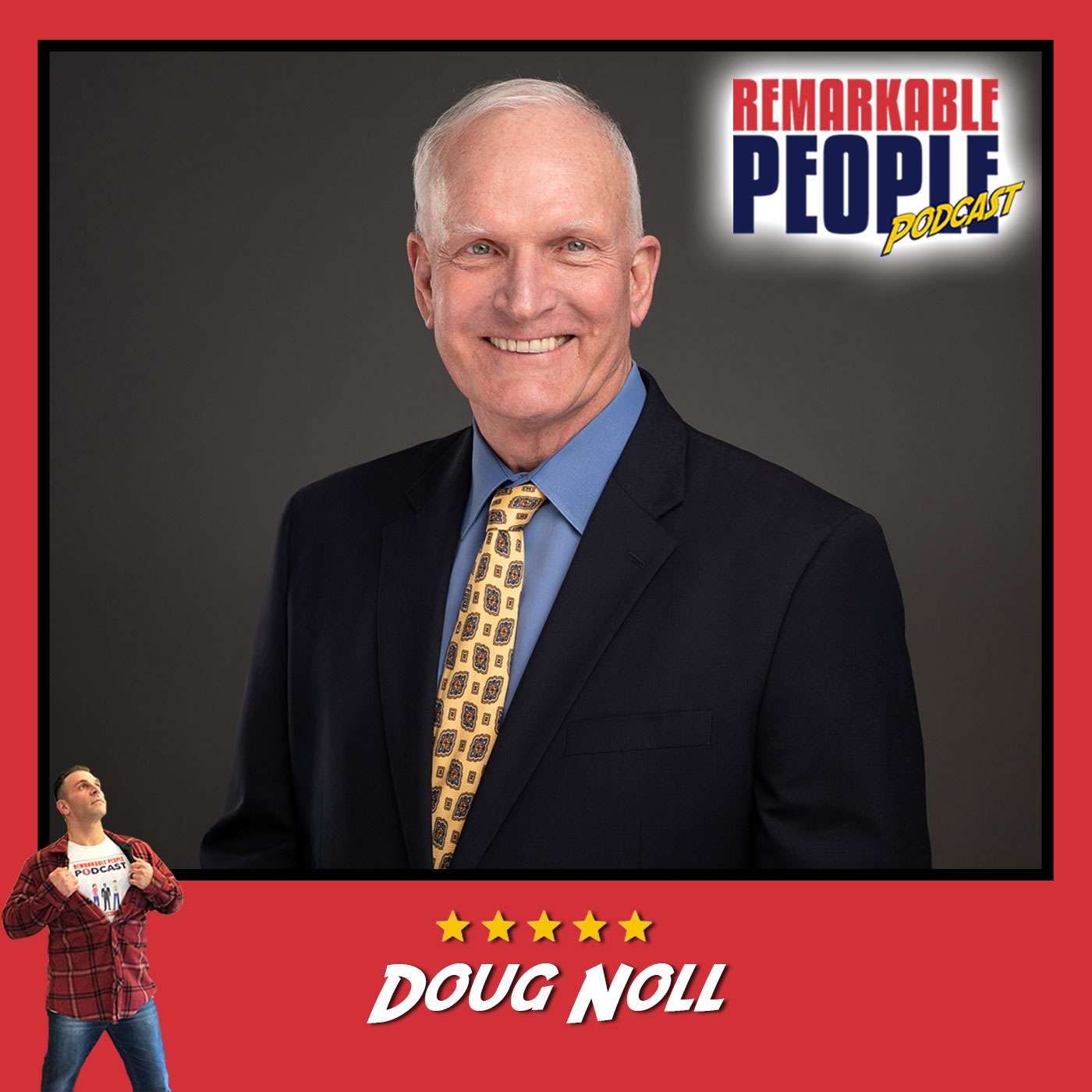
Meet Our Guest:
Guest Contact Info:
- Official Website: https://dougnoll.com
- Email: doug@dougnoll.com
- LinkedIn: linkedin.com/in/dougnoll
- Facebook: facebook.com/doug.noll.52, facebook.com/DouglasNoll
- YouTube: Digital De-Escalation
- Instagram: instagram.com/douglasenoll
Guest Bio:
Doug Noll, J.D., M.A., is a visionary peacemaker, mediator, and expert in emotional de-escalation. After a 22-year career as a ferocious civil trial lawyer, Doug left law practice in 2000 to focus on resolving human conflict at its core. He has since dedicated his life to teaching others how to calm strong emotions and stop arguments in seconds through groundbreaking emotional listening techniques.
Doug’s work has reached thousands—from maximum-security prisons, where he co-founded the Prison of Peace Project, to the U.S. Congressional Budget Office, where he trained staff and analysts. He is the author of De-Escalate: How to Calm an Angry Person in 90 Seconds or Less and Elusive Peace. Recognized as California Attorney of the Year and awarded the Purpose Prize by Encore.org, Doug is also a faculty member at Pepperdine Law’s Straus Institute and chairman of the board at San Joaquin College of Law. He’s been featured on CBS Radio, iTunes, SiriusXM, and iHeartRadio.